
Outify
What is Outify?
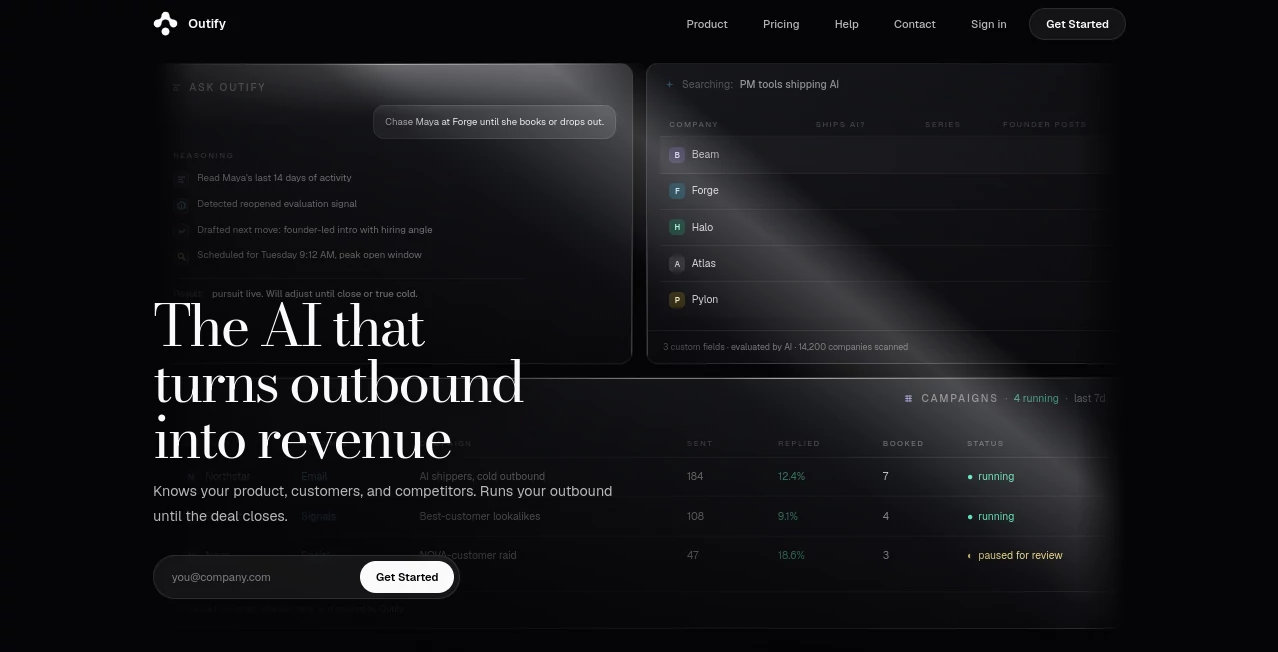
Sales teams have spent years stitching together spreadsheets, scraping tools, and cold email platforms just to keep a pipeline moving. The problem was never a lack of tools — it was that none of them actually understood the business behind the outreach. This platform was built to close that gap. Instead of treating outbound as a list of names and a template, it learns a company's product, its best customers, and its competitors, then uses that context to find leads, write outreach, and follow up until a deal actually closes or genuinely goes cold.
What stands out almost immediately is the shift from "send more emails" to "chase the right deal at the right moment." That distinction sounds small on paper, but anyone who has run outbound knows it's the difference between a full calendar and an inbox full of ignored sequences.
Key Features
User Interface
The dashboard is built around a single command bar where a rep can simply ask for what they need — find accounts that resemble closed-won deals, pull up a contact's recent activity, or launch a campaign — and get back a plan along with the supporting data. Alongside that sits a live signal feed, a lead directory, and an inbox that pulls every email, social reply, and campaign conversation into one thread per prospect. Nothing about it feels like a traditional CRM bolted onto an AI feature; the layout is built around the question "what should I do next," not around static records.
Accuracy & Performance
The system builds what it calls a company brain: a living map of product features, pricing rationale, customer win patterns, and competitor positioning. Every draft, lead score, or signal alert is pulled from that context rather than generic templates, which noticeably reduces the generic, copy-paste feel that plagues a lot of automated outreach. In testing scenarios shown on the platform, fit scores and matched triggers (like a company hiring three product managers in 30 days) are surfaced with the specific evidence behind them, so a rep isn't just trusting a black-box score.
Capabilities
- Maps a company's product, customer history, and competitive landscape into a reusable context graph
- Surfaces real-time buying signals — funding rounds, executive hires, hiring intent, feature launches, ad spend spikes — across thousands of companies
- Builds lookalike lists from a company's actual closed-won accounts
- Drafts and sends personalized campaigns across email and social channels
- Runs an autonomous deal-pursuit engine that decides whether to wait, change the angle, push harder, or mark a prospect as truly cold
- Centralizes every reply — email, social, campaign — into one inbox with suggested next actions
Security & Privacy
Account and team management sit behind a standard sign-in flow, and the platform publishes clear privacy and terms documentation for teams that need to review data handling before rollout. As with any tool that connects to a CRM and outbound channels, it's worth having a quick look at those policies and confirming integration permissions match internal compliance requirements before connecting production data.
Use Cases
- A founder running outbound solo who needs the research, drafting, and follow-up handled without hiring a full SDR team
- An early sales hire trying to prioritize which accounts actually show buying intent instead of working a cold list top to bottom
- A growth team that wants to build lookalike audiences from their best existing customers rather than guessing at an ideal customer profile
- A revenue team monitoring competitor movement and reacting to pricing page visits, hiring signals, or funding news in near real time
- Teams that lose deals to "going quiet" and need something tracking each prospect's pursuit timeline instead of letting leads fall out of a sequence
Pros and Cons
Pros:
- Context-aware outreach that references real product details and customer proof instead of generic copy
- Live signal tracking across hiring, funding, and product launches without manual research
- An actual pursuit system that keeps working a deal instead of stopping after one sequence
- One inbox for email, social, and campaign replies, which cuts down on tab-switching
- Tiered pricing that scales from a solo founder up to a full revenue team
Cons:
- Credit-based usage means high-volume teams will want to watch consumption closely
- The most advanced pursuit and team features are reserved for higher pricing tiers
- Teams without a CRM or clean customer history may need to do some setup work before the lookalike modeling shows its full value
Pricing Plans
Pricing is structured in five tiers, each scaling team size, number of active deal-pursuit prospects, and monthly credits:
- Ignite – $59/month: 1 team member, 1 active pursuit agent, up to 10 active prospects, 20,000 credits — built for founders running outbound themselves
- Accelerate – $99/month: 5 team members, up to 5 pursuit agents, up to 50 active prospects, 50,000 credits — aimed at founder-led teams making their first sales hires
- Scale – $199/month: 10 team members, up to 10 pursuit agents, up to 200 active prospects, 100,000 credits — the most commonly chosen plan, for teams running outbound daily
- Expand – $499/month: unlimited team members and pursuit agents, 500,000 credits — for larger teams covering multiple segments
- Dominate – $999/month: unlimited everything, 1,000,000 credits — for revenue teams operating across several markets at once
Every plan includes the company brain, the ask-anything assistant, campaign tools, AI-driven lead personalization, deal pursuit, integrations, and social activity tracking — the difference is scale, not feature access.
How to Use Outify
- Sign up and enter your company website so the system can learn your product, pricing, and positioning
- Let it map your closed-won customer history to build your ideal customer profile and lookalike targets
- Review the competitor map it builds, including pricing gaps and recent product moves
- Use the assistant to ask for specific account lists, such as companies matching a certain hiring or funding pattern
- Launch a campaign, letting the system draft personalized messages based on each prospect's context
- Hand qualified replies to the pursuit engine, which keeps adjusting timing and messaging until the deal closes or goes cold
- Check the unified inbox daily for suggested next actions across email, social, and campaigns
Comparison with Similar Tools
Most cold email and sales engagement platforms focus on one slice of the funnel: either finding leads, sending sequences, or tracking replies. What separates this platform from typical outbound tools is that it ties all three stages together around a single, continuously updated understanding of the business — and then adds an autonomous layer that keeps pursuing a deal after the first email, rather than stopping once a sequence ends. Traditional sequencers require a human to decide when to follow up or pivot the message; here, that decision-making is built into the product itself, which makes it feel closer to having an AI-powered SDR than a scheduling tool for emails.
Conclusion
For founders and sales teams tired of outbound that feels like a numbers game, this platform offers something genuinely different: outreach grounded in real product and customer context, paired with a system that doesn't give up on a deal after one unanswered email. It won't replace the judgment of an experienced rep, but it removes a huge amount of the manual research and follow-up grind that usually eats up a sales day. Teams looking to scale outbound without scaling headcount at the same rate will find a lot to like here.
Frequently Asked Questions (FAQ)
Does it work for early-stage startups with limited customer history?
Yes, though the lookalike modeling and win-pattern detection become more accurate as more closed-won data is available to learn from.
Can it run outreach across both email and social channels?
Yes, campaigns can be launched across email and social, with replies routed into a single shared inbox.
What happens when a deal goes cold?
The pursuit engine continues monitoring signals and timing, and will mark a prospect as truly cold rather than leaving it in limbo indefinitely.
Is there a free trial?
The platform offers an instant demo built around your own website, so you can see how it maps your product and market before committing to a paid plan.
Which plan is best for a solo founder?
The entry-level Ignite plan is designed specifically for founders running outbound on their own, with one pursuit agent and up to 10 active prospects.
AI Lead Generation , AI Sales Assistant , AI Email Marketing , AI CRM Assistant .
These classifications represent its core capabilities and areas of application. For related tools, explore the linked categories above.

Outify Alternatives Product

Toflow AI

TokTools

Free Email V…

AILeadz.io

Sourcetable

PineBill

TranAI
Apify

Reloq