














Free Email Verifier by Craften
What is Free Email Verifier by Craften?
Let's be real for a second. We've all been there. You spend hours crafting the perfect email, hit send, and… bounce. That little "delivery failed" notification is annoying, sure. But it’s also a quiet killer for your domain’s reputation.
I remember cleaning my own list last year. Thought it was spotless. Turned out, nearly 8% of those addresses were dead weight. That’s wasted time, money, and a whole lot of frustration.
That’s exactly why having a reliable way to check emails before you hit send is non-negotiable. And not one of those clunky tools that asks for your credit card upfront. Something quick, honest, and straight to the point.
This is where a proper email validation tool shines. You paste an address. It does its thing – checks the format, pokes the domain, looks for live mail servers. And in just a few seconds, you know if that email is worth your time. No signup walls. No "start your trial" nonsense. Just a clean, honest result.
Key Features
User Interface
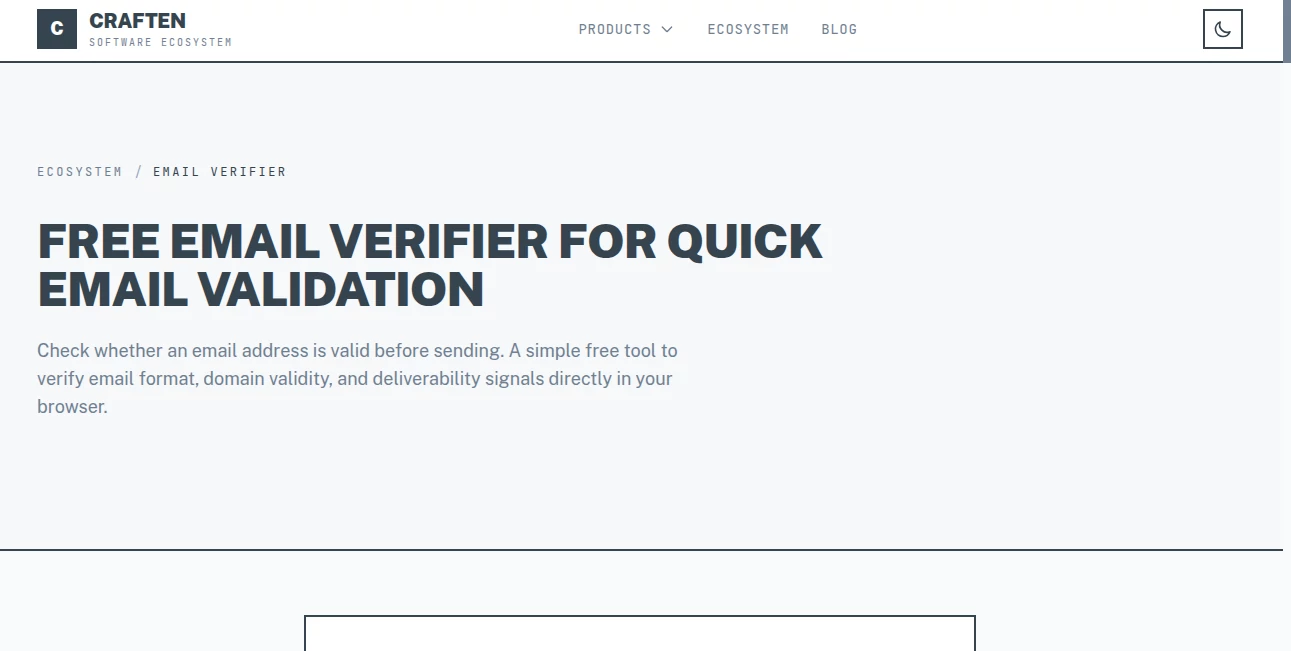
You open the page, and there it is. One single box asking for an email address. No clutter. No flashing ads pretending to be buttons. Type or paste the address, click validate, and you’re done. The whole thing feels like a calculator – simple, predictable, and fast. Even my less tech-savvy friends have used it without asking me for help once.
Accuracy & Performance
Speed is great, but lies are expensive. This tool claims a 99.6% accuracy rate, and from what I’ve seen, it backs it up. It checks syntax, reaches out to the domain’s mail servers (without sending a single email, mind you), and even flags risky stuff like disposable or role-based addresses. Results appear in milliseconds. The difference between this and a basic format check is like night and day.
Capabilities
It doesn’t just say "looks fine" and call it a day. The tool runs through several layers: valid structure (RFC standards), domain existence, MX record presence, and deliverability signals. It’ll catch those sneaky temporary emails that people use for a one-time download. Also spots spam traps if the signals are clear enough. For a free, browser-based tool, that’s surprisingly deep.
Security & Privacy
Here’s a fear we all share: "Is this tool going to store or sell the emails I check?" The short answer is no. The verification happens live, and nothing gets saved. No logs, no sharing with third parties, no "we own your data" fine print. You can verify a client’s email or your own personal address without that creepy feeling in your stomach.
Use Cases
Think you don’t need an email verifier? Let me paint a few quick pictures.
- The small business owner who just collected 50 business cards at a local fair. Half of those might have typos. One quick check saves you from looking unprofessional.
- The marketer with a 10,000-contact list. High bounce rates get you blacklisted by providers like Gmail or Outlook. Verifying first keeps your sender score healthy.
- The developer building a signup form. Temporary email addresses wreck your user metrics and fill your DB with junk. A quick check at entry saves you months of cleanup.
- The sales rep who found a lead on LinkedIn. One wrong keystroke in the email address means your pitch lands in the void. Validate it, then reach out with confidence.
Pros and Cons
Pros:
✓ Completely free. No credit card, no subscription trap.
✓ Instant results – we’re talking milliseconds.
✓ No account or installation needed. Works in any browser.
✓ Detects disposable, role-based, and risky addresses.
✓ Privacy-first – nothing is stored or shared.
Cons:
✗ Designed for single email checks (not bulk lists).
✗ Requires manual entry for each address.
✗ Advanced users might want more detailed SMTP logs.
Pricing Plans
This one is refreshingly simple. The email verifier is free. No hidden tiers, no "pro" version that actually does the real work. You get the full accuracy, domain checks, and deliverability signals without paying a cent. There’s a tiny "buy me a coffee" option for those who want to support the project – but it’s entirely optional. If you need bulk verification or API access, you’d need to reach out separately. But for day-to-day single checks? Zero cost.
How to Use Email Verifier
Step 1 – Open the tool page in your browser.
Step 2 – Type or paste the email address you want to check.
Step 3 – Click the validate button (or let it auto-check).
Step 4 – Read the result. It’ll tell you if the email is safe to send, risky, or invalid.
Step 5 – Act on that info. Send your message, clean your list, or ask for a different address.
That’s it. No learning curve. No tutorial needed.
Comparison with Similar Tools
Most free email verifiers out there are either too shallow (only checking the @ and the dot) or too greedy (asking for an account after two tries). Paid services like NeverBounce or ZeroBounce are fantastic for bulk lists, but they’re overkill – and overpriced – when you just need to check one address.
What sets this tool apart is the combination of depth and simplicity. You get syntax, domain, MX, and deliverability checks in a free package. Others might give you two of those three. Some will even store your data. Here, you lose nothing but a few seconds, and you gain real peace of mind. For a single verification or a quick sanity check before a critical email, this beats the heavy-hitting paid tools hands down.
Conclusion
Look, email bounces are more than just annoying. They hurt your reputation, your deliverability, and your bottom line. A simple habit – verifying an address before you use it – can save you from all that. This tool makes that habit effortless. It’s free, it’s fast, and it respects your privacy.
Next time you get a new contact, or before you blast that newsletter to a "clean" list, take ten seconds. Run the check. See what comes back. You might be surprised how many bad addresses you catch. And your future self, with a healthy sender score and an inbox full of replies, will thank you.
Frequently Asked Questions (FAQ)
Does this tool ever send an actual email to the address I’m checking?
No. It uses technical checks – syntax, DNS, MX records, and SMTP handshakes. No email is ever sent. Your inbox stays quiet.
Can I verify an entire list at once?
This specific page is designed for single email checks. For bulk needs, you’d need to look into API access or a dedicated batch tool.
What does “safe to send” really mean?
It means the address passed all tests: valid format, an existing domain, active mail servers, and no clear red flags like being disposable or a known spam trap. It’s as safe as a check can get without actually sending a message.
Is there any limit on how many emails I can verify?
There’s no published hard limit for reasonable use. But since it’s free and for single checks, verifying hundreds manually would become tedious anyway. For normal day-to-day use, you should be fine.
Does it work with international or custom domains?
Yes. It works with Gmail, Yahoo, Outlook, and any custom domain with proper MX records. Country-specific domains (.de, .jp, .br, etc.) are supported as long as DNS resolution works.
My result said “risky.” What does that mean?
“Risky” usually means the address passed basic checks but has warning flags. It could be a role-based address (info@, support@), a disposable provider, or a catch-all domain where verification is uncertain. Proceed with caution.