
Parsestream
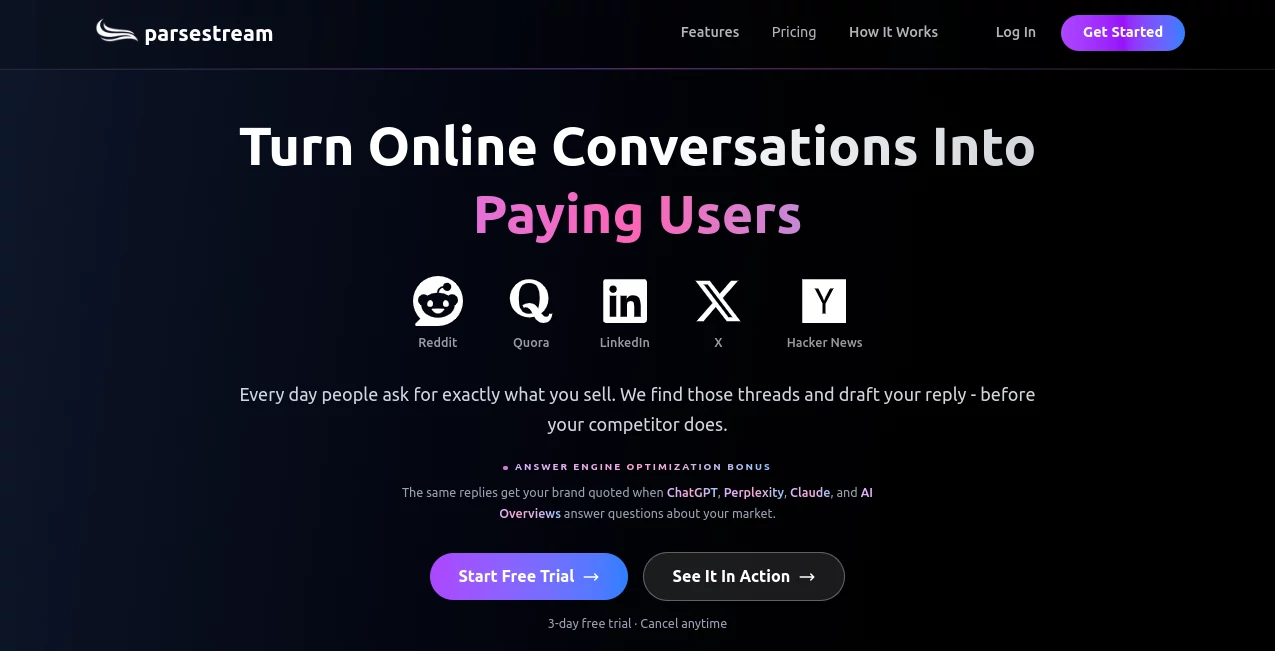
What is Parsestream?
Finding potential customers in online conversations can be surprisingly difficult. People ask questions, compare products, complain about existing solutions, and request recommendations every day, but most businesses only see a small fraction of those conversations. This platform takes a more proactive approach by monitoring conversations across Reddit, Quora, LinkedIn, X, and Hacker News and identifying discussions that may matter to a brand.
Instead of relying entirely on paid advertising or waiting for prospects to discover a company through search, marketers can use conversation-based opportunities to reach people when they are already discussing a problem or looking for a solution. The platform combines keyword monitoring, lead detection, intent analysis, notifications, and AI-generated reply suggestions in one workflow.
It is particularly useful for startups, SaaS companies, agencies, and marketing teams that want to discover high-intent discussions without manually checking several communities throughout the day. A marketer can define relevant keywords, choose the platforms to monitor, and receive notifications when useful conversations appear.
Key Features
- 24/7 monitoring across Reddit, Quora, LinkedIn, X, and Hacker News
- Real-time email and Slack notifications
- Keyword and phrase tracking
- AI-powered filtering for relevant mentions
- Lead detection and intent detection
- Brand relevance filtering
- Subreddit filtering for more focused Reddit monitoring
- AI-generated suggested replies
- Multiple reply approaches and custom brand instructions
- Competitor mention monitoring
- Market and customer feedback discovery
- Read-only Mentions API for external workflows and dashboards
User Interface
The workflow is designed around a central dashboard where monitored conversations can be reviewed without jumping between multiple social networks and communities. Mentions are surfaced with relevant context, while filtering tools help reduce the amount of noise that marketers normally encounter with broad social listening.
The setup process is also straightforward. After creating an account, users can add their brand information, define keywords, and select the platforms they want to monitor. According to the documentation, new mentions can begin appearing in the dashboard within roughly 5 to 15 minutes after setup.
For a small marketing team, this approach can be particularly convenient. Instead of assigning someone to repeatedly search Reddit or LinkedIn for phrases such as “best CRM for startups,” the monitoring system can continuously look for those conversations in the background.
Accuracy & Performance
Keyword monitoring alone can produce a large number of irrelevant results. The platform addresses this with AI filters, brand relevance filtering, lead detection, and intent detection. Mentions can be classified according to signals such as buying intent, pain points, or complaints about competitors, helping teams concentrate on conversations with a stronger commercial connection.
The platform also supports subreddit filtering, which is useful when a brand operates in a specialized community and wants to avoid unrelated Reddit discussions. Users can configure their tracked keywords and refine or remove them as their monitoring strategy develops.
Performance also depends on the keywords, filters, platforms, and audience being monitored. A carefully selected keyword set is likely to produce much more useful results than simply tracking a broad industry term.
Capabilities
The core strength of the platform is turning online conversations into actionable marketing opportunities. A company can monitor its own brand, competitors, product categories, customer problems, and buying-related questions.
Suggested replies add another useful layer. When a relevant conversation is detected, the system can generate a contextual response based on the mention, brand information, and configured instructions. This gives marketers a starting point rather than forcing them to write every response from scratch.
There is also a Mentions API for teams that want to connect collected mentions to tools such as Zapier, internal dashboards, data warehouses, or custom applications. The documented API is read-only, uses bearer authentication, supports filtering and pagination, and provides a rolling 30-day history.
Security & Privacy
The service provides a dedicated privacy policy describing the information it collects and how that information is handled. This includes account information, such as information permitted through Google sign-in, as well as usage and log data such as IP address, browser information, access times, and pages viewed.
Businesses should review the privacy policy and terms before using the service for sensitive workflows or customer-related information. The platform's API is brand-scoped and authenticated with an API key, while the documented Mentions API is read-only.
Use Cases
Lead Generation: Sales and marketing teams can monitor questions where people are actively searching for a product or service. Conversations such as requests for software recommendations can reveal prospects much earlier in the buying process.
Competitor Monitoring: Companies can track competitor mentions and observe what customers praise, criticize, or ask for. These conversations can reveal gaps that are difficult to identify through traditional market research.
Brand Reputation: Monitoring brand-related keywords makes it easier to discover positive feedback, complaints, and questions. Quick responses can help businesses address issues before they become larger reputation problems.
Customer Research: Online communities often contain direct comments about customer frustrations and unmet needs. Collecting these discussions can provide useful input for product development, positioning, and content strategy.
Product Launches: A new product can be introduced in conversations where people are already discussing the problem it solves. This is often more targeted than publishing a generic promotional message and hoping the right audience finds it.
AI Search Visibility: The service positions helpful participation in online discussions as an additional way for brands to become visible in AI-powered search and answer engines. Since AI systems may use public discussions as sources, useful contributions can potentially increase a brand's presence in those environments.
Customer Support: Some customers discuss problems publicly instead of contacting a company's support team. Monitoring relevant conversations can help businesses discover these situations and respond more quickly.
Pros and Cons
Pros
- Monitors several important discussion platforms from one place
- Combines monitoring with lead and intent detection
- Provides real-time notifications
- Offers AI-assisted reply generation
- Useful for both lead generation and market research
- Supports multiple brands and team members on higher plans
- Includes Slack notifications and an API
- Offers a three-day free trial on the paid plans
Cons
- The entry-level plan has limited platform coverage
- Higher platform and keyword limits require more expensive plans
- Results depend heavily on the quality of selected keywords and filters
- The service is more focused on conversation monitoring than traditional all-in-one marketing automation
- Businesses with very large monitoring requirements may need the custom Enterprise plan
Pricing Plans
The pricing structure is based on monthly credits, tracked keywords, domains, team seats, and available platforms. The Lite plan starts with 15,000 credits and supports 20 Reddit keywords and 20 Hacker News keywords for one domain and one team seat. It is priced at $29 per month after a three-day free trial.
The Pro plan provides 50,000 credits, 60 Reddit keywords, 60 Hacker News keywords, and 10 keywords each for Quora, LinkedIn, and X. It supports three domains and three team seats and costs $79 per month after the trial period.
The Growth plan increases the allowance to 140,000 credits, 150 Reddit keywords, 150 Hacker News keywords, and 25 keywords each for Quora, LinkedIn, and X. It supports five domains and eight team seats at $199 per month after the three-day trial.
For larger organizations, the Enterprise plan provides custom credits, custom tracked keywords, unlimited domains, unlimited team seats, priority support, and custom integrations. Pricing is available through the provider.
How to Use It
Start by creating an account and adding your brand information, including your website and a description of what your company offers. This information helps the system understand which conversations are relevant to the business.
Next, add keywords and phrases related to your products, customers, competitors, and industry. You can choose the platforms you want to monitor, including Reddit, Quora, LinkedIn, X, and Hacker News.
Once monitoring is active, relevant mentions appear in the dashboard. Use AI filters, brand relevance settings, intent detection, and platform-specific filters to narrow the results.
When a useful opportunity appears, review the conversation and generate a suggested reply. The response can be adjusted using brand-specific context and custom instructions before it is posted manually to the relevant community.
A practical strategy is to begin with a small group of high-intent keywords rather than tracking everything at once. For example, a SaaS company could monitor phrases involving product recommendations, alternatives, pricing questions, and common customer problems. After seeing the results, additional keywords can be added based on real conversations.
Comparison with Similar Tools
Traditional social listening platforms are often designed primarily around brand mentions, sentiment, analytics, or reputation monitoring. This solution takes a more action-oriented approach by connecting monitoring with lead detection, intent signals, and suggested responses.
It also differs from ordinary keyword alert services because the workflow is built around discovering commercially relevant conversations rather than simply reporting that a keyword appeared somewhere online. The ability to monitor multiple communities and then move directly toward a suggested response makes it particularly interesting for teams using conversational marketing as part of their acquisition strategy.
For organizations that mainly need historical social analytics or broad enterprise listening, a larger traditional social listening platform may offer a wider analytics suite. For teams primarily interested in finding people who are actively discussing problems, products, and purchasing decisions, the more focused workflow can be a strong fit.
Conclusion
Online communities are filled with conversations that can be valuable to businesses, but finding the right ones manually takes time. This platform makes that process more systematic by continuously monitoring major discussion networks, filtering mentions, identifying potential leads, and preparing context-aware responses.
Its strongest use case is not simply knowing when a keyword is mentioned. The real value comes from connecting that discovery to an actionable opportunity. A startup looking for its next customers, an agency researching prospects, or a SaaS company tracking competitor conversations can all use the workflow to spend less time searching and more time engaging.
The combination of monitoring, intent detection, AI filtering, notifications, and suggested replies gives conversation-based marketing a practical structure. For businesses that already see value in Reddit, LinkedIn, X, Quora, or Hacker News discussions, it can become a useful part of their daily lead-generation and market-research routine.
Frequently Asked Questions (FAQ)
Which platforms can be monitored?
The service currently monitors Reddit, Quora, LinkedIn, X, and Hacker News. Users can select the platforms they want to track for their keywords.
Can I track specific keywords?
Yes. Users can add keywords and phrases from the dashboard, and the system can also suggest related terms to expand monitoring coverage.
Does it generate replies?
Yes. Relevant mentions can receive AI-generated suggested replies based on the conversation, brand context, and custom instructions.
Can I receive notifications?
Yes. Email and Slack notifications are available, allowing teams to react to relevant conversations without constantly checking the dashboard.
Is there an API?
Yes. A read-only Mentions API is available for connecting mention data with external workflows, data warehouses, internal dashboards, and custom applications.
Is there a free trial?
Yes. The paid plans currently include a three-day free trial before billing begins.
Can it help with AI search visibility?
It is designed to help brands participate in conversations that may later be discovered or referenced by AI answer engines. However, appearing in a particular AI-generated answer cannot be guaranteed.
Is it suitable for small teams?
Yes. The entry-level plan supports one domain and one team seat, while larger plans increase the number of domains, keywords, credits, and team members.
AI Lead Generation , AI Marketing Plan Generator , AI Social Media Assistant , AI Response Generator .
These classifications represent its core capabilities and areas of application. For related tools, explore the linked categories above.

Parsestream Alternatives Product

BlogBuster

Analyse

softshill

LeadAny

Medialyst

Jasper

ReviewRespon…

Maestra

CheckAEO