


















PitchMonster
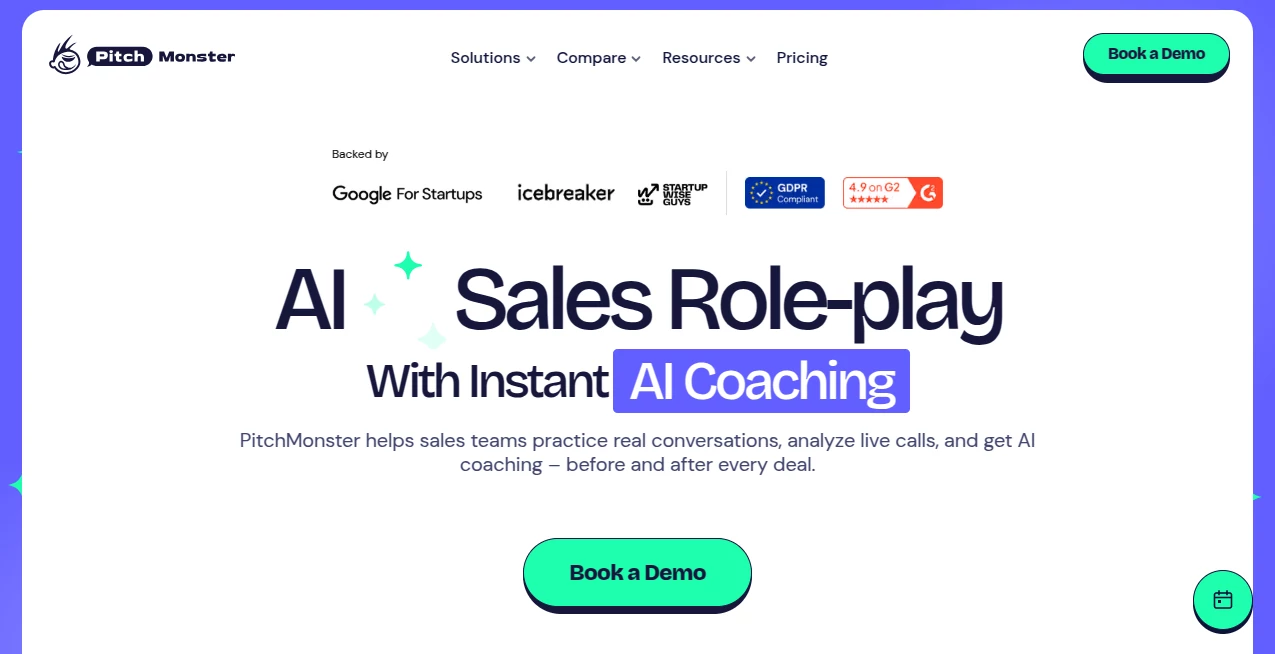
What is PitchMonster?
PitchMonster is an AI-powered sales training platform built to help sales teams practice realistic conversations before they happen with real customers. Instead of relying entirely on manager-led role-play sessions, sales representatives can rehearse calls with AI buyers that respond to objections, challenge weak answers, and adapt to the situation.
The platform brings together three connected parts of the sales training process: AI role-play, call analysis, and AI coaching. This creates a practical feedback loop where reps can practice, review their performance, understand their weak points, and try again. It is particularly useful for sales enablement teams that need to train many representatives without asking managers to personally review every practice session.
Another useful detail is the platform's support for 29 languages, making it suitable for organizations with distributed sales teams and international markets. The role-play experience can also be adapted around a company's actual sales process, including its ideal customer profile, objections, methodologies, and existing sales material.
Key Features
- AI Sales Role-play: Representatives can practice conversations with simulated buyers that respond to objections and behave according to defined customer profiles.
- Realistic Buyer Scenarios: Role-plays can be created from sales recordings, CRM notes, lost-deal reasons, objection libraries, product documentation, transcripts, and website content.
- Multiple Practice Modes: Teams can simulate face-to-face conversations, phone calls, screen-sharing sessions, pitches, discovery calls, and demos.
- AI Call Analysis: Practice conversations can be evaluated against defined sales standards and scorecards.
- Personalized AI Coaching: The coaching experience uses the completed session to help representatives understand what happened and where they can improve.
- Custom Scorecards: Teams can create scoring criteria around their own sales process or use templates based on established methodologies.
- Difficulty Controls: Managers can adjust scenarios from beginner practice sessions to more demanding simulations for experienced representatives.
- Analytics and Reporting: Sales leaders can monitor performance, identify recurring weaknesses, and track improvement over time.
- Sales Integrations: Salesforce and Gong can be connected to help create scenarios from live deal information.
- Multilingual Training: The platform supports training and analysis across 29 languages and teams in more than 40 countries.
User Interface
The interface is designed around the practical workflow of building and completing sales scenarios. Managers can create role-plays, define goals and scoring criteria, adjust difficulty, and use existing sales material as the foundation for training.
For representatives, the experience is intentionally closer to a conversation than a traditional online course. A rep can enter a scenario, interact with an AI buyer, handle objections, and then review the results. This makes the platform particularly appealing for people who learn better by doing rather than simply watching training videos.
Accuracy & Performance
The strength of the platform comes from grounding simulations in the company's actual sales environment. Instead of forcing every team to practice the same generic conversation, scenarios can be based on real buyers, objections, call recordings, transcripts, CRM information, and sales documentation.
Its scorecards can also be aligned with a team's specific methodology. That means performance can be measured against the behaviors the organization actually expects rather than a generic definition of a good sales call.
The company reports measurable results from customer deployments, including faster ramp times, improved onboarding, better call quality, and higher conversion rates. Customer examples published on the site include a reported 53% faster onboarding result and an 8.3% increase in conversion rate.
Capabilities
The platform covers several stages of the sales lifecycle. New representatives can use it for onboarding and ramp-up, while experienced sellers can use targeted role-plays to improve particular skills. Sales teams can rehearse discovery calls, product pitches, demonstrations, objection handling, renewals, upsells, and difficult customer conversations.
It can also be used beyond conventional sales training. The platform supports candidate screening through simulated sales conversations, channel and reseller training, post-training certification, and upskilling for lower-performing representatives.
One especially useful capability is the ability to build scenarios from company content. A team can turn product documentation, real conversations, transcripts, and website information into practice material, giving representatives a much closer approximation of the conversations they are likely to face.
Security & Privacy
Security is an important part of the platform's enterprise positioning. The company states that it provides encryption for data at rest and in transit, enterprise single sign-on, and European data residency. GDPR compliance is also highlighted, with data processing agreements available for organizations that require additional documentation.
For larger companies handling sensitive sales information, these features can make the platform easier to evaluate as part of an enterprise sales enablement stack. Organizations should still review the current security documentation and data-processing terms directly with the provider before deploying sensitive customer or internal information.
Use Cases
- Sales onboarding: New representatives can practice common conversations before speaking with real prospects.
- Objection handling: Teams can repeatedly practice difficult objections without risking a real sales opportunity.
- Sales certification: Managers can evaluate whether representatives can consistently follow the required sales process.
- Call preparation: Reps can rehearse upcoming conversations and prepare for likely objections.
- Low-performer development: Managers can identify specific skill gaps and provide targeted practice.
- Channel training: Companies can standardize sales messaging across resellers and external partners.
- Recruitment: Sales candidates can be evaluated through simulated customer conversations before hiring decisions are made.
- Customer success: Teams can practice renewals, upsells, and challenging customer conversations.
- International sales: Global teams can practice with AI buyers in multiple supported languages.
Pros and Cons
- Pros: Realistic AI buyer simulations, customizable scenarios, multiple practice modes, detailed scoring, AI coaching, analytics, multilingual support, enterprise security features, and integrations with major sales systems.
- Pros: Training can be built around real company content rather than generic sales examples.
- Pros: Representatives can practice repeatedly without requiring a manager to participate in every session.
- Cons: The platform is primarily designed for sales organizations, so individual users looking for a general-purpose AI assistant may find it unnecessarily specialized.
- Cons: Enterprise-oriented functionality may be more than a very small sales team needs.
- Cons: Pricing is not presented as a simple public self-service plan, so organizations may need to speak with the provider to understand the commercial options.
Pricing Plans
Pricing is handled through a sales-led model rather than a clearly displayed public pricing table. Visitors are directed toward booking a product demonstration, where the platform can be presented around their sales team's specific requirements.
This approach makes sense for larger organizations that may require custom scenarios, integrations, security reviews, data requirements, and different levels of deployment. However, smaller teams that prefer transparent monthly pricing may want to confirm the expected cost and minimum commitment before investing time in an evaluation.
How to Use It
Start by defining the sales situation you want representatives to practice. This might be a discovery call, product demonstration, objection-handling conversation, renewal, or another stage of your sales process.
Next, provide the relevant sales context. Product documentation, transcripts, call recordings, CRM information, objection libraries, and website content can help create scenarios that resemble the organization's real customer conversations.
Set the goal and scoring criteria for the role-play. Teams can create their own scorecards or use established sales methodologies as a foundation. Difficulty can then be adjusted according to the representative's experience.
The representative completes the simulated conversation with the AI buyer. Afterward, call analysis and AI coaching provide feedback on the session. The rep can use that feedback to identify a specific weakness and repeat the exercise until the desired behavior becomes more natural.
Comparison with Similar Tools
Traditional sales training often depends on workshops, classroom exercises, manager-led role-play, and manual call reviews. Those methods can be valuable, but they become difficult to scale when a company has dozens or hundreds of representatives.
General-purpose conversational AI can also be used for basic sales practice, especially when someone simply wants to rehearse a script. The difference here is the focus on structured sales enablement. Custom buyer scenarios, scorecards, sales methodologies, call analysis, coaching, analytics, and integrations are designed specifically around improving sales performance.
For a small team that only needs occasional conversation practice, a simpler solution may be enough. For an organization that wants repeatable sales simulations and measurable training across a large team, a dedicated platform offers a more complete workflow.
Conclusion
For sales organizations, practice quality can have a direct effect on what happens when representatives finally speak to real prospects. The ability to rehearse difficult conversations without putting an actual deal at risk is one of the strongest reasons to consider an AI-based training platform.
What makes this solution particularly interesting is its combination of realistic role-play, performance analysis, and personalized coaching. Teams can build scenarios around their own buyers and sales process instead of relying entirely on generic training material. The addition of multilingual support, enterprise security, analytics, and integrations also makes it suitable for larger organizations.
If your main goal is to help sales representatives become more confident, handle objections more effectively, and reach readiness faster, this is a specialized solution worth evaluating.
Frequently Asked Questions (FAQ)
What is this platform used for?
It is an AI-powered sales training platform used to simulate customer conversations, analyze sales practice sessions, and provide coaching to sales representatives.
Can sales representatives practice with AI buyers?
Yes. Representatives can practice realistic sales conversations with AI buyers that respond to objections and adapt to the context of the scenario.
Can companies create custom sales scenarios?
Yes. Organizations can create scenarios around their ideal customer profiles, objections, sales methodologies, product information, real conversations, transcripts, and other company content.
Does it support different languages?
Yes. The platform supports 29 languages for its AI sales training and analysis capabilities.
Can it analyze sales calls?
Yes. Call analysis is one of the platform's core capabilities and can be combined with customized scorecards and sales standards.
Can it be used for sales candidate screening?
Yes. Companies can use simulated sales conversations to evaluate candidates before making a hiring decision.
Does it integrate with CRM and sales platforms?
Yes. Salesforce and Gong integrations are available for creating role-plays and using live deal information as part of sales preparation.
Is pricing publicly available?
The website currently uses a demo-based sales process rather than displaying a standard public pricing table. Companies can contact the provider to discuss their requirements and pricing.
Is it suitable for enterprise teams?
Yes. Enterprise-oriented features include SSO, encryption, European data residency, GDPR compliance, analytics, integrations, and support for large international teams.
AI Sales Assistant , AI Recruiting , AI Customer Service Assistant .
These classifications represent its core capabilities and areas of application. For related tools, explore the linked categories above.
PitchMonster details
Website unavailable — View Alternatives
Pricing
- Freemium
Apps
- Web App
Categories

PitchMonster Alternatives Product

FINIITE AI

LSGRO

Sourcetable

HeyZinc

AIOutreach

ZynfoAI

AILeadz.io

FeatureShark

JobbTwine
