















JobbTwine
Verified Blue CheckMark
Verified Blue CheckMark products are featured above free or unverified listings.
This badge indicates authenticity and builds trust, giving your product higher visibility across the platform.
Upgrade to get verified
Verified Blue CheckMark products are featured above free or unverified listings. This badge indicates authenticity and builds trust, giving your product higher visibility across the platform.
Upgrade to get verified
What is JobbTwine?
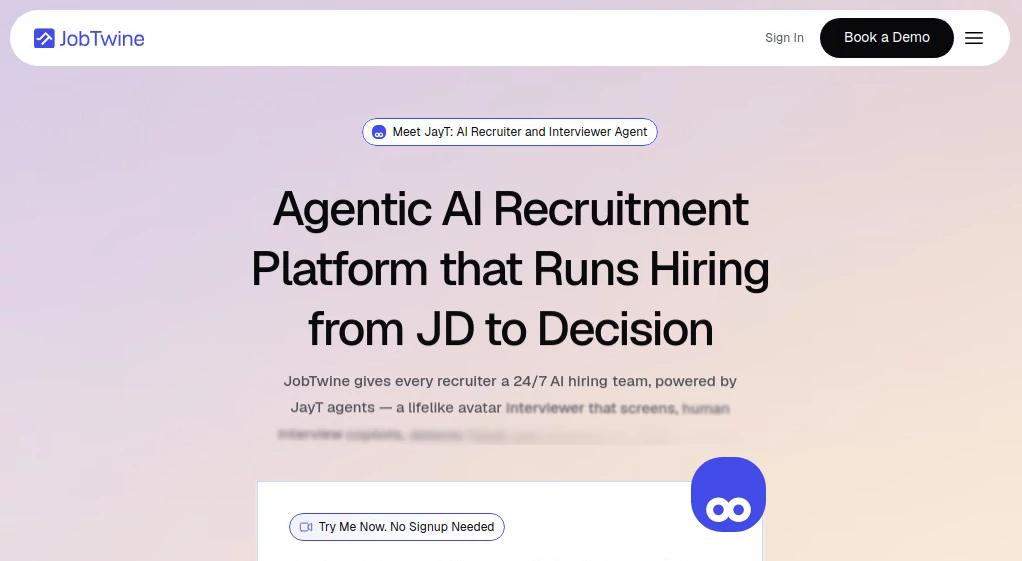
Hiring gets difficult when a company has more qualified applicants than its recruiting team has time to properly review. Resume screening, interview scheduling, note-taking, candidate evaluation, and feedback collection can quickly turn into a long chain of repetitive work. JobTwine approaches this problem by bringing AI into multiple stages of the recruitment process, from the initial job description to interview feedback and hiring decisions.
The platform is designed for teams that need to evaluate candidates at scale without making the hiring process feel completely automated or impersonal. Its AI avatar can conduct first-round interviews independently, while an AI interviewer copilot supports human interviewers during live conversations. There is also a fraud detection layer designed to identify suspicious behavior and possible AI-assisted cheating during interviews.
One particularly useful aspect is the connection between these stages. A job description can be turned into a structured interview playbook, applicants can be ranked, first-round interviews can be conducted automatically, and the resulting information can move into later interview stages. This gives recruiting teams a more connected view of each candidate instead of relying on scattered notes and separate tools.
Key Features
- AI-powered resume shortlisting and candidate ranking
- Autonomous first-round AI avatar interviews
- Human interviewer copilot with real-time guidance
- Smart playbook creation from job descriptions
- Structured competency-based interview questions
- Automated candidate scoring and interview summaries
- Real-time fraud and cheating detection
- LLM usage detection during interviews
- Real-time gaze and attention monitoring
- Interview transcription and timestamped insights
- Automated feedback and scorecard generation
- Integration with major ATS and video meeting platforms
User Interface
The interface is built around the recruitment workflow rather than forcing recruiters to manage a collection of disconnected AI features. A hiring team can start with a job description, create an interview structure, review shortlisted candidates, and then follow the interview results through the same process.
For live interviews, the copilot works with familiar video environments including Google Meet, Microsoft Teams, and Zoom. This is a practical choice because interviewers do not have to abandon the tools they already use simply to receive AI assistance. Real-time prompts, interview guidance, notes, and feedback are designed to stay close to the conversation.
The candidate-facing experience also has an interesting angle. The AI avatar can be configured as a human-like recruiter avatar, while a voice-only mode is available for high-volume screening. This gives organizations a choice between a more branded interview experience and a faster, lower-friction approach.
Accuracy & Performance
Performance is one of the strongest parts of the platform's proposition. The AI avatar is designed to conduct interviews continuously, allowing organizations to handle large candidate pools without depending entirely on recruiter availability or calendar slots.
According to the product's published figures, the system can support large numbers of concurrent interview sessions, reports a 94% interview completion rate, and claims 99% interview consistency. The company also reports an average interview length of roughly 6 to 24 minutes depending on role complexity.
The scoring process is built around the requirements of the position rather than simply matching keywords in a resume. The system can generate role-specific competencies and questions from a job description, then evaluate candidate responses against those criteria. Human review remains important, but much of the repetitive preparation and first-pass analysis can happen before a recruiter starts making final decisions.
Capabilities
The platform covers several stages of modern recruitment. Its smart playbook builder turns a job description into structured interview criteria and question sets. The shortlisting system can process large applicant pools and rank candidates based on relevant skills and requirements.
The AI avatar then handles first-round screening. Rather than simply reading a fixed list of questions, it can use intelligent probing, acknowledgement handling, turn detection, silence detection, and early-exit logic to make the conversation more responsive. It can also generate a candidate summary and scorecard after the session.
Human-led interviews are supported through a separate copilot. Interviewers receive contextual prompts and can spend more attention on the candidate instead of constantly writing notes or remembering the next question. Afterward, the system can organize transcripts, highlights, feedback, and candidate insights.
Fraud detection adds another layer for organizations concerned about AI-assisted interviews. The system is designed to flag possible LLM usage, identity-related issues, off-screen assistance, unusual behavior, and attention signals such as eye movement. Flags can include timestamps and supporting evidence, making them easier for recruiting teams to review.
Security & Privacy
Recruitment platforms handle sensitive information, so data protection is an important consideration. The service states that interview information is encrypted and securely stored and that its technology follows GDPR requirements.
The company also states that its platform has ISO 27001 and SOC 2 certifications. These credentials are particularly relevant for organizations that need formal security controls when introducing AI into hiring workflows.
Because recruitment decisions can have a significant impact on candidates, organizations should still establish their own policies for human review, data retention, candidate consent, and responsible use of automated assessments. AI-generated scores can support a hiring team, but they should not replace appropriate human judgment.
Use Cases
High-volume recruitment is a natural fit. A company receiving hundreds of applications for the same role can use automated shortlisting and first-round interviews to reduce the amount of repetitive work handled manually by recruiters.
Growing technology companies can also benefit when engineers and hiring managers are spending too much time interviewing instead of working on core projects. Automating early screening and assisting interviewers during later rounds can return valuable hours to the team.
Remote and international hiring is another useful scenario. The AI avatar can conduct interviews around the clock, which means candidates do not necessarily have to wait for a recruiter in another time zone to become available.
Organizations hiring for technical, sales, marketing, operations, leadership, and other professional roles can build role-specific interview frameworks instead of using the same generic questionnaire for every position.
Finally, companies that are increasingly concerned about AI-assisted cheating can use the fraud detection capabilities to add another verification layer to their interview process.
Pros and Cons
- Pros: Automates first-round screening and candidate ranking.
- Pros: Provides real-time assistance during human interviews.
- Pros: Supports structured and competency-based interviews.
- Pros: Includes AI-assisted fraud and cheating detection.
- Pros: Connects with major ATS and video meeting platforms.
- Pros: Designed to support high-volume recruitment.
- Cons: Public pricing information is not clearly displayed.
- Cons: Organizations still need human oversight for important hiring decisions.
- Cons: Candidates or companies that strongly prefer fully human interviews may need time to adapt to an AI-first screening process.
Pricing Plans
Public pricing for the main AI recruitment platform is not clearly listed as fixed monthly plans. Instead, organizations are encouraged to contact the sales team for a tailored solution. This approach makes sense for larger hiring teams because interview volume, integrations, workflows, and required services can vary significantly between companies.
The provider also offers Interview-as-a-Service with flexible pricing models that can include per-interview, subscription-based, or volume-based arrangements. For companies evaluating the platform, requesting a quote based on expected hiring volume is the best way to understand the actual cost.
How to Use the Platform
Start by providing the job description for the position you are hiring for. The system can use the role requirements to create a structured playbook containing competencies, interview questions, and evaluation criteria.
Next, review the applicant pool and allow the AI shortlisting process to identify candidates who best match the requirements. The strongest candidates can then move into the first-round screening stage.
For automated screening, candidates can complete an AI avatar or voice-based interview. The system asks role-specific questions, responds to candidate answers, probes when additional information is useful, and evaluates the conversation against the defined criteria.
When a candidate reaches a human interview, the interviewer can use the copilot for live guidance, contextual prompts, note capture, and structured evaluation. After the interview, the collected information can be transformed into feedback and scorecards.
Finally, hiring teams can review the complete candidate picture and move relevant information into their ATS. This creates a continuous workflow instead of forcing recruiters to manually transfer information between different stages.
Comparison with Similar Tools
Many AI recruiting products concentrate on one part of the hiring funnel, such as asynchronous screening or interview transcription. This platform takes a broader approach by connecting candidate shortlisting, automated interviews, human interviewer assistance, feedback, fraud detection, and ATS workflows.
That difference becomes particularly noticeable after the initial screening stage. An automated screening product may produce a report and leave the recruiter to start the next interview from scratch. Here, information gathered during earlier stages can continue into human interviews through the copilot, giving interviewers more context before they begin speaking with a candidate.
The platform also places more emphasis on interview integrity than a basic screening tool. Real-time signals related to possible AI assistance, eye movement, identity issues, and other suspicious behavior can be surfaced for human review.
For a small company hiring only a handful of people each year, such a broad recruitment system may be more than necessary. For organizations handling hundreds or thousands of candidates, however, having screening, interviewing, evaluation, and workflow automation connected in one system can make a substantial difference.
Conclusion
Modern recruiting teams are under pressure to move faster without sacrificing the quality of their decisions. That is difficult when every additional applicant creates more resumes to review, interviews to schedule, notes to write, and feedback to consolidate.
This platform offers a convincing answer to that problem by combining automated screening with human-centered interview assistance. The AI avatar handles repetitive first-round conversations, the copilot helps interviewers stay focused during live sessions, and structured scoring makes candidate comparisons easier to manage.
Its fraud detection capabilities are another useful addition in a hiring environment where candidates can increasingly use generative AI during assessments. Combined with ATS integrations, structured playbooks, and automated feedback, the result is a recruitment workflow designed for organizations that need to hire at scale.
It is not a replacement for thoughtful hiring managers, and it should not be treated as one. Its real value is in taking care of the repetitive work while giving human decision-makers better information to work with.
Frequently Asked Questions (FAQ)
What does the platform do?
It is an AI recruitment platform that helps organizations automate candidate shortlisting, first-round interviews, interview assistance, scoring, feedback, and parts of the hiring workflow.
Can AI conduct the first-round interview?
Yes. The AI avatar can conduct first-round interviews autonomously using role-specific questions and structured evaluation criteria. It can also probe further when a candidate's answer requires clarification.
Can it assist human interviewers?
Yes. The interviewer copilot provides real-time guidance, contextual prompts, note capture, and post-interview insights while the human interviewer remains responsible for the conversation and final evaluation.
Does it detect AI cheating during interviews?
Yes. Its fraud detection system is designed to identify signals associated with LLM usage, AI-assisted responses, identity fraud, off-screen assistance, unusual behavior, and attention-related signals.
Does it integrate with ATS platforms?
Yes. The platform supports integrations with major applicant tracking systems, allowing candidate information, scores, notes, and interview data to move through the existing recruitment workflow with less manual entry.
Is the platform suitable for high-volume hiring?
Yes. The system is specifically designed for large applicant pools and can run multiple interview sessions concurrently, making it particularly useful for organizations with frequent or high-volume recruitment needs.
Is pricing publicly available?
Fixed public pricing is not clearly displayed for the main platform. Organizations can contact the provider for pricing tailored to their hiring volume and requirements.