
Promer
What is Promer?
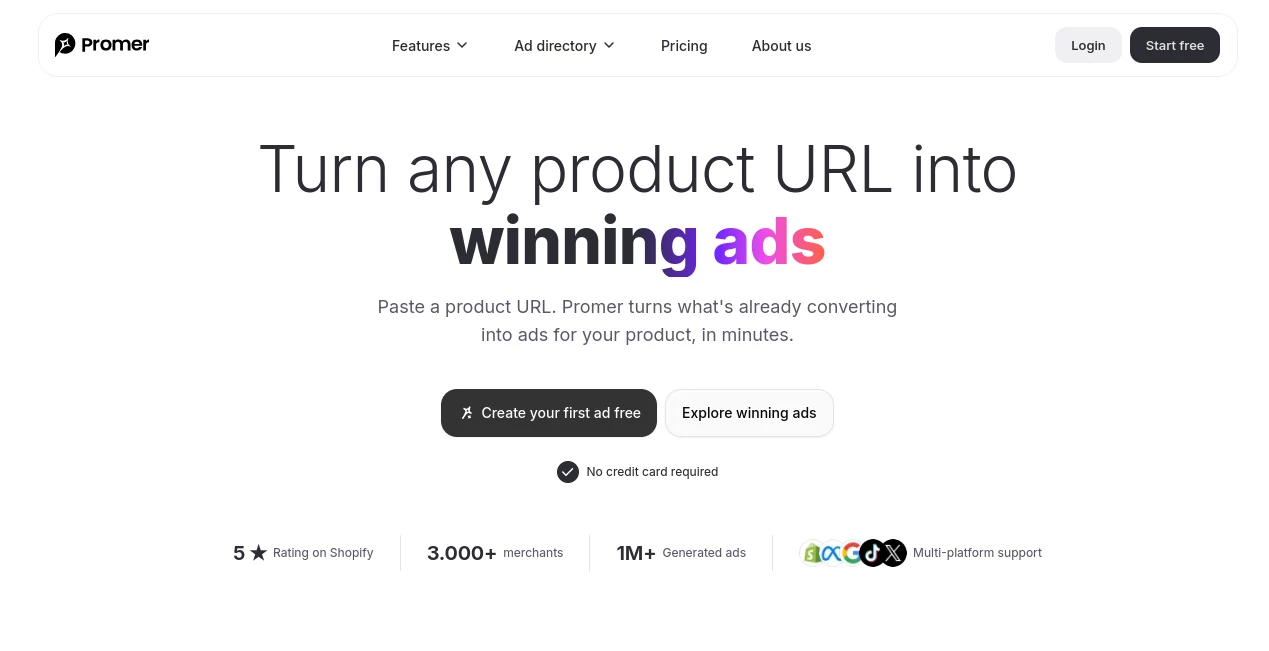
Creating advertising creatives for an online store can quickly become a time-consuming job. Finding a good angle, studying competitors, writing the copy, preparing product visuals, and then producing several versions for different platforms often means moving between several tools. Promer takes a more connected approach by combining market research, competitive ad intelligence, and AI-powered creative generation in one workflow.
The process starts with something simple: a product URL. From there, the platform can analyze the product and help identify creative directions based on real advertising activity. Instead of beginning with a completely blank canvas, merchants can look at active ads, winning templates, and existing creative patterns before producing their own variations.
This makes the platform particularly interesting for e-commerce merchants, dropshippers, DTC brands, media buyers, and small marketing teams that need fresh advertising material regularly. The website reports more than 3,000 merchants using the service and more than 1 million ads generated, with a 5.0 rating shown on its Shopify listing. These figures give the product a useful track record among online sellers.
Key Features
- AI-powered ad creative generation based on product information.
- Ad Clone for creating variations inspired by existing winning creatives.
- Ad Concept for developing new hooks, angles, headlines, and visual directions.
- Ad Prompt for generating images from a specific creative brief.
- Ad Animation for turning static creatives into short video advertisements.
- Product photoshoot capabilities for creating advertising-ready product imagery.
- Ad Spy for researching active advertisements from brands and competitors.
- A searchable Ad Library containing advertising examples and creative references.
- Support for static and video advertising formats.
- Multiple aspect ratios for different advertising placements.
- Access to market information and winning creative patterns.
- Creative generation designed around e-commerce products and paid advertising.
User Interface
The workflow is designed around the way an online merchant actually works. Rather than requiring users to understand complicated image-generation prompts from the beginning, the platform guides them through product research, creative discovery, and generation. A merchant can start with a product URL, review possible advertising directions, choose an approach, and then create variations.
The research side is especially useful because the interface brings competitor advertising information into the same general workflow. Users can search active Meta advertisements by brand, keyword, category, format, and longevity, making it easier to understand what is currently being advertised in a particular market.
For someone running a small store without an in-house designer, this streamlined process can remove several repetitive steps from the advertising workflow.
Accuracy & Performance
One of the more interesting aspects of the platform is its focus on real advertising data rather than relying entirely on generic templates. The website states that its system learns from real ads, top stores, and winning templates. Its advertising research database is presented as containing more than 200,000 live ads, 150,000 winning templates, and over 60,000 top stores, with the data updated daily.
This approach does not guarantee that every generated advertisement will perform well. Advertising results still depend on the product, audience, offer, landing page, budget, and campaign strategy. What it can do is give merchants a more informed starting point and make it considerably easier to produce and test multiple creative directions.
Capabilities
The creative workflow covers several stages of ad production. Ad Concept can generate multiple directions around a product, including headlines, hooks, visual ideas, and copy angles. Users can begin with five concepts in a session and expand the selection to as many as fifteen.
Ad Clone takes another route by allowing users to work from an existing creative and develop new variations. This can be useful when a particular format or advertising structure has already caught the merchant's attention.
For users who want more direct control, Ad Prompt allows a detailed brief to guide image generation. Static advertisements can also be animated into short video creatives, with options for video-only output or AI-generated voiceover.
Security & Privacy
The public-facing product information focuses primarily on advertising research, creative generation, and e-commerce workflows rather than providing extensive technical details about its security architecture. Businesses considering the platform should review its current privacy policy and terms before uploading sensitive commercial information or proprietary assets.
For normal advertising work, users should still follow good data-handling practices and avoid providing confidential customer information or other material that is not necessary for generating an advertisement.
Use Cases
- E-commerce stores: Create product advertisements without relying on a separate design workflow for every campaign.
- Dropshipping businesses: Quickly test different creative angles around products and offers.
- DTC brands: Produce a steady supply of fresh creatives for paid campaigns.
- Media buyers: Research competitor advertisements and generate multiple creative directions for testing.
- Small marketing teams: Reduce the amount of manual work involved in preparing advertising assets.
- Shopify merchants: Create promotional banners and advertising creatives around products in an e-commerce workflow.
- Creative testing: Develop alternative hooks, visuals, formats, and concepts to reduce creative fatigue.
- Social advertising: Prepare static and video creatives suitable for channels such as Meta and TikTok.
Pros and Cons
Pros:
- Combines ad research and creative generation in one workflow.
- Useful for e-commerce-focused advertising.
- Can work from a product URL rather than requiring a long creative brief.
- Provides competitor and market advertising research.
- Supports both static and video creative production.
- Ad Clone makes it easier to explore variations of existing ideas.
- Offers a free plan without requiring a credit card.
- Can be useful for merchants without a dedicated creative team.
Cons:
- Generation is credit-based, so heavy users may need a higher subscription or additional credits.
- The free plan has limited generation capacity and download restrictions.
- The platform is primarily focused on e-commerce advertising rather than general-purpose graphic design.
- AI-generated creatives still require human review before being used in live campaigns.
- Businesses looking for highly specialized brand design may still need traditional design software.
Pricing Plans
A free plan is available with no credit card required. It provides 40 credits per month and allows users to generate up to 8 ad creatives while exploring the core AI features. Paid plans increase the available credits and unlock broader creative capabilities.
- Free: $0 forever, 40 credits per month, up to 8 ad creatives, creative downloads after upgrading, and limited access to AI features.
- Starter: $14 per month when billed monthly, or $11.20 per month with yearly billing. It includes 300 credits per month, up to 300 ad creatives, unlimited downloads, and access to static ads, video ads, and the editor.
- Pro: $29 per month when billed monthly, or $23.20 per month with yearly billing. It includes 800 credits per month and is positioned for stores running advertising campaigns regularly.
- Unlimited: $59 per month when billed monthly, or $47.20 per month with yearly billing. It provides 1,800 credits per month and includes human-assisted creative support.
Yearly billing is advertised with a 20% saving. Additional credits can also be purchased separately, and purchased top-up credits do not expire. Plan credits, however, are tied to the billing cycle.
How to Use It
- Start by creating an account and opening the advertising workspace.
- Add the URL of the product you want to advertise.
- Let the platform analyze the product and provide market context.
- Explore competitor advertisements and proven creative directions through the research tools.
- Choose whether you want to clone an existing creative direction, develop new concepts, or work from a detailed prompt.
- Generate several variations and review the results.
- Use the editor or available creative tools to refine the assets when necessary.
- For video campaigns, turn suitable static creatives into animated advertisements.
- Download the finished creatives and test them in your advertising campaigns.
Comparison with Similar Tools
Many AI advertising products concentrate primarily on generating an image from a prompt. This platform takes a somewhat different route by placing competitive research before creative production. That distinction can be valuable for merchants who do not simply want attractive graphics but want to understand what other brands are currently testing.
Traditional design applications offer much deeper manual control, but they can require considerably more time and design experience. General AI image generators may provide more creative freedom, while dedicated e-commerce advertising software can offer a more focused workflow for product campaigns.
The strongest reason to consider this platform is therefore not simply that it can generate an advertisement. It is the connection between researching the market, finding useful creative patterns, developing new concepts, and producing variations. For a store that needs to test advertising ideas frequently, keeping these steps together can make the process much more practical.
Conclusion
For e-commerce businesses, the difficult part of advertising is often not creating one attractive image. The real challenge is continuously finding new ideas, understanding what competitors are doing, and producing enough variations to test. This platform addresses that problem by connecting market research with AI-assisted creative production.
The product URL workflow is particularly convenient for store owners who want to move from a product page to advertising concepts without spending hours preparing a creative brief. Features such as Ad Spy, Ad Library, Ad Clone, Ad Concept, and Ad Animation make the platform more than a basic image generator.
It is not a replacement for good advertising strategy, audience research, or campaign optimization. However, for merchants and marketing teams that need fresh product creatives on a regular basis, it offers a practical way to shorten the distance between an idea and a testable advertisement.
Frequently Asked Questions (FAQ)
What type of businesses can benefit from this platform?
It is primarily designed for e-commerce merchants, dropshippers, DTC brands, media buyers, marketing agencies, and small teams that regularly create paid advertising creatives.
Can I create advertisements from a product URL?
Yes. The workflow is built around starting with a product URL, after which the platform can use product and market information to help develop advertising concepts and creatives.
Can it create video advertisements?
Yes. Static advertising creatives can be converted into short animated video advertisements. An AI-generated voiceover can also be added for supported video generation workflows.
Does it offer competitor ad research?
Yes. The Ad Spy and Ad Library features allow users to research active and historical advertisements and explore creative activity across different brands, categories, formats, and platforms.
Is there a free plan?
Yes. The Free plan provides 40 credits per month and allows users to generate up to 8 ad creatives while exploring the platform. A credit card is not required to start.
Do unused purchased credits expire?
No. Additional credits purchased separately do not expire. Subscription credits follow the rules of the applicable billing cycle.
Is this a replacement for a professional designer?
It can reduce the amount of routine creative work required for many e-commerce campaigns, but businesses with complex branding or highly specialized creative requirements may still benefit from working with a professional designer.
AI Ad Creative Assistant , AI Ad Generator , AI E-commerce Assistant , AI Advertising Assistant .
These classifications represent its core capabilities and areas of application. For related tools, explore the linked categories above.

Promer Alternatives Product

RankingRider

Ad Suite AI

Orchestra

Vmake AI

Surgeflow

wigoo

LyricStudio

LazyLister

Leonardo.ai