
Razorpay Agent Studio
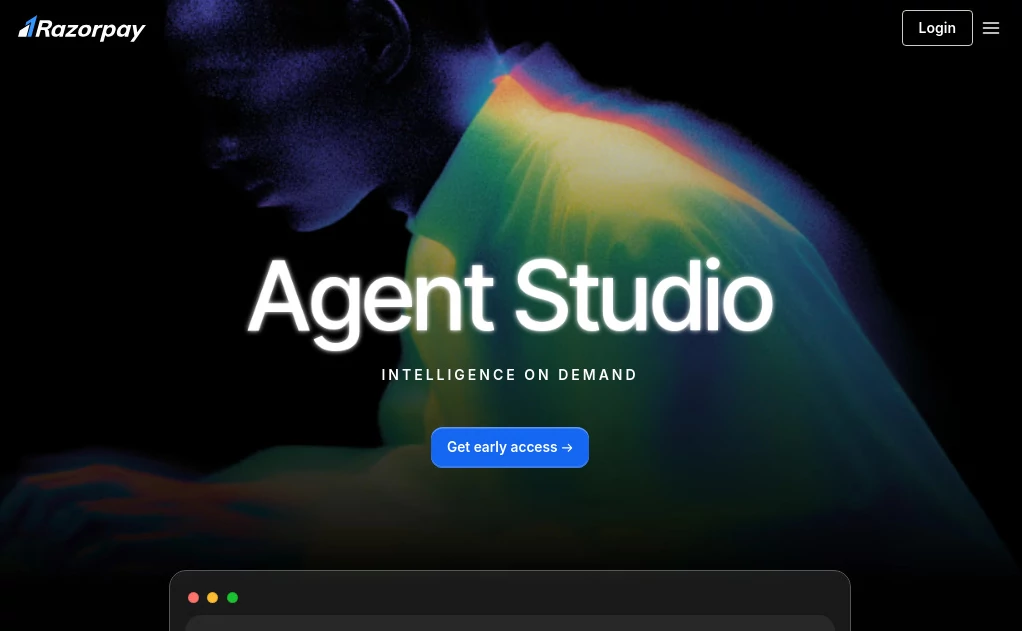
What is Razorpay Agent Studio?
Razorpay Agent Studio is an AI-powered agent platform designed to help businesses automate payment operations, recover lost revenue, and handle repetitive financial workflows. Instead of asking teams to constantly monitor failed payments, disputes, abandoned checkouts, settlements, and cash flow, it puts specialized AI agents to work on these tasks.
The idea is refreshingly practical. A business can start with a prebuilt agent, connect it to its existing workflows and business logic, or create a custom agent from scratch. The platform is built around real commerce problems rather than generic chatbot conversations, making it particularly interesting for merchants and teams that already depend on digital payments.
For example, a company dealing with recurring payment failures could use an agent to analyze failed subscriptions, apply smarter retry strategies, and trigger targeted customer follow-ups. Another business might use an agent to respond to chargebacks or identify abandoned carts that are worth recovering.
Key Features
- Prebuilt AI agents for payment and revenue operations
- Customizable agents that can work with business workflows, tools, and logic
- Ability to build custom agents from scratch, currently offered in beta
- Automated dispute and chargeback responses
- Subscription payment recovery workflows
- Abandoned-cart recovery through personalized customer outreach
- RTO risk detection and insights
- Settlement summaries and payment monitoring
- Cash-flow forecasting with alerts
- Integration with business payment workflows and first-party data
- Powered by Anthropic's Claude Agent SDK
User Interface
The interface is designed around the concept of choosing or creating an agent rather than configuring a maze of traditional automation rules. Businesses can begin with a prebuilt agent and adapt it to their own workflows, tools, and business requirements.
For teams that want something more specific, the platform also introduces a build-your-own-agent experience. The process is intended to work with natural-language instructions, allowing a business to describe the task it wants automated and define the systems and rules the agent should use.
This approach can be particularly useful for non-technical business teams. Instead of explaining a complex automation sequence to a developer, a finance or operations manager can start by describing the outcome they need and then refine the agent around their existing processes.
Accuracy & Performance
Performance here is less about producing a clever paragraph and more about making the right operational decision. The agents are designed to work with data from connected business systems, giving them access to first-party information rather than relying on scraped or unverified web data.
The platform also includes merchant-defined controls. For example, when an agent handles cart recovery, it can personalize the communication while staying within offers and discount limits already approved by the business. This creates an important distinction between autonomous execution and unrestricted decision-making.
Its collection of specialized agents also makes the system easier to evaluate. A business can measure whether failed subscriptions are being recovered, disputes are being handled effectively, abandoned carts are converting, or settlement information is reaching the right people without manual dashboard checks.
Capabilities
The range of available agents covers several common payment and commerce problems. The Dispute Responder can automatically respond to chargebacks with relevant evidence. Subscription Recovery focuses on failed recurring payments and customer nudges, while Abandoned Cart Conversion can re-engage shoppers through channels such as WhatsApp or email.
Other capabilities include RTO Shield for identifying potentially risky cash-on-delivery orders, RTO Insights for analyzing return patterns, Settlement Insights for sending daily settlement information, and Cashflow Forecaster for looking ahead at expected cash positions and potential financial risks.
The platform is also designed to grow beyond its initial collection of agents. Businesses can customize existing agents or create their own, opening the door to workflows that are specific to a particular company rather than forcing every organization into the same automation template.
Security & Privacy
Security is especially important when AI agents can take actions involving payments and business operations. The platform emphasizes merchant control and guardrails around agent behavior. Agents work with verified first-party data from connected systems, while important business rules remain under the merchant's control.
One useful example is discount management. An agent can personalize an offer for a customer, but it does not independently invent a new discount or exceed the limits configured by the merchant. This type of boundary helps keep automation aligned with existing commercial policies.
The platform also states that pricing for individual agents is displayed before installation, with additional communication costs shown when an agent uses services such as voice calls, SMS, or email. Businesses therefore have clearer visibility into the operational and commercial implications before activating an agent.
Use Cases
One of the strongest applications is recovering revenue that would otherwise disappear quietly. A subscription business, for instance, may have hundreds of failed recurring transactions every month. An automated recovery agent can analyze those failures, apply appropriate retry logic, and follow up with customers without requiring a member of the finance team to check every account.
E-commerce businesses can use abandoned-cart automation to identify shoppers who left before completing checkout and send personalized follow-ups. This can be especially valuable when the company already has approved offers and customer communication channels in place.
Finance and operations teams can also benefit from settlement monitoring and cash-flow forecasting. Instead of repeatedly checking dashboards, they can receive summaries and alerts that highlight important changes, upcoming shortfalls, or potential payroll and payout risks.
For businesses handling payment disputes, automated evidence gathering and response preparation can reduce repetitive manual work. The same principle applies to RTO monitoring, where identifying suspicious or high-risk orders before dispatch can potentially prevent avoidable losses.
Pros and Cons
Pros
- Focused on practical business and payment operations
- Offers specialized agents instead of one generic assistant
- Supports customization of prebuilt agents
- Allows custom agent creation in beta
- Works with first-party business data
- Includes merchant-defined controls and operational guardrails
- Useful for revenue recovery, disputes, subscriptions, and settlements
- Built on Anthropic's Claude Agent SDK
Cons
- The platform is primarily relevant to businesses with payment and commerce workflows
- Some custom-agent functionality is still in beta
- Availability and commercial terms may vary depending on the agent and rollout stage
- Businesses outside the payments ecosystem may find a general-purpose automation platform more suitable
Pricing Plans
Pricing depends on the individual agent and its commercial configuration. The platform states that the pricing of each agent is displayed before installation, with no hidden fees or surprise charges. For early partners, a free 30-day trial with a defined credit limit has been offered to allow businesses to test agents on real transactions before committing to paid usage.
Some agents can also generate additional communication costs when they use outbound channels such as voice, SMS, or email. These costs are shown before activation and cover the underlying communication services. Because the commercial model can evolve as the platform expands, businesses should check the current terms for the specific agent they want to deploy.
How to Use It
Start by identifying a repetitive payment or revenue operation that consumes time for your team. This might be failed subscription recovery, abandoned-cart follow-up, dispute management, settlement monitoring, or another workflow.
Next, select a suitable prebuilt agent and review what it can access and automate. Customize its workflow, connected tools, and business logic where supported. Make sure its actions fit your existing commercial policies and operational rules.
If none of the available agents matches your requirements, the platform also provides a custom agent-building option in beta. Describe the task you want automated, define the systems and rules the agent should work with, and configure the workflow around your business requirements.
Before putting an agent into a critical workflow, start with a measurable use case. Track metrics such as recovered payments, dispute outcomes, conversion rates, prevented losses, or time saved. This makes it much easier to decide whether the automation is delivering meaningful business value.
Comparison with Similar Tools
Traditional workflow automation platforms are generally built around predefined triggers, conditions, and actions. They can be excellent for predictable processes, but payment operations often require more context. A failed transaction may need to be interpreted alongside customer history, payment behavior, subscription status, or other business information.
Generic AI assistants take a different approach. They are good at understanding questions and generating responses, but they are not necessarily designed to monitor payment workflows and take controlled operational actions.
This platform sits closer to the middle: it combines agentic AI with specialized payment and commerce workflows. The strongest advantage is therefore not simply that it uses AI, but that its agents are designed around specific business outcomes such as recovering revenue, handling disputes, monitoring settlements, and forecasting cash flow.
Conclusion
For businesses that process significant volumes of digital payments, the work that happens after a transaction can be just as important as the transaction itself. Failed payments, disputes, abandoned carts, returns, settlements, and cash-flow questions all create operational overhead, and small inefficiencies can become expensive at scale.
This platform takes a focused approach to that problem by giving businesses specialized AI agents that can monitor data, reason about operational situations, and perform defined actions within merchant-controlled boundaries. The combination of prebuilt agents, customization, first-party data, and a path toward custom agent creation makes it a compelling option for payment-heavy businesses looking to reduce manual work.
It is not intended to replace every automation or AI platform. Its real strength is narrower and more useful: putting autonomous agents directly into the workflows where payments, revenue, and financial operations meet.
Frequently Asked Questions (FAQ)
What is this platform designed for?
It is designed for businesses that want to use AI agents to automate payment operations, revenue recovery, dispute management, settlement monitoring, subscription recovery, and related financial workflows.
Can businesses create their own AI agents?
Yes. Businesses can customize prebuilt agents, while custom agent creation from scratch is available in beta. Custom agents can be tailored around specific payment workflows and business logic.
Does it work with real business data?
Yes. The platform is designed to use verified first-party data from connected business systems rather than relying on web scraping or unverified external sources.
Can an agent create its own discounts?
No. Merchant-defined discount and coupon rules remain in control. An agent can personalize how an approved offer is presented, but it cannot independently create a new discount or exceed the configured limits.
What types of agents are available?
Examples include agents for dispute response, subscription recovery, abandoned-cart conversion, RTO risk detection, RTO analysis, settlement insights, and cash-flow forecasting.
Is there a free trial?
Early partners have been offered a 30-day free trial with a defined credit limit. Availability and terms can vary, so businesses should review the current offer for the specific agent they plan to use.
Who is it best suited for?
It is particularly well suited to e-commerce companies, subscription businesses, online merchants, and teams with significant payment, revenue, finance, or post-payment operational workloads.
Does it require coding?
Prebuilt agents can be customized around workflows and business logic, while the custom agent experience is designed around describing the desired behavior and connecting the appropriate systems and rules. The exact technical requirements depend on the workflow being created.
AI Workflow Management , AI Sales Assistant , AI Analytics Assistant , AI E-commerce Assistant .
These classifications represent its core capabilities and areas of application. For related tools, explore the linked categories above.
Razorpay Agent Studio details
Website unavailable — View Alternatives
Pricing
- Freemium
Apps
- Web App
Categories

Razorpay Agent Studio Alternatives Product

UseWok

Lebesgue: AI…

Zamicus

AI Wire

SellerPic

Youfiliate

GEO Checker

AlpacaBag

HISAB 360