
ReadyToTalk
What is ReadyToTalk?
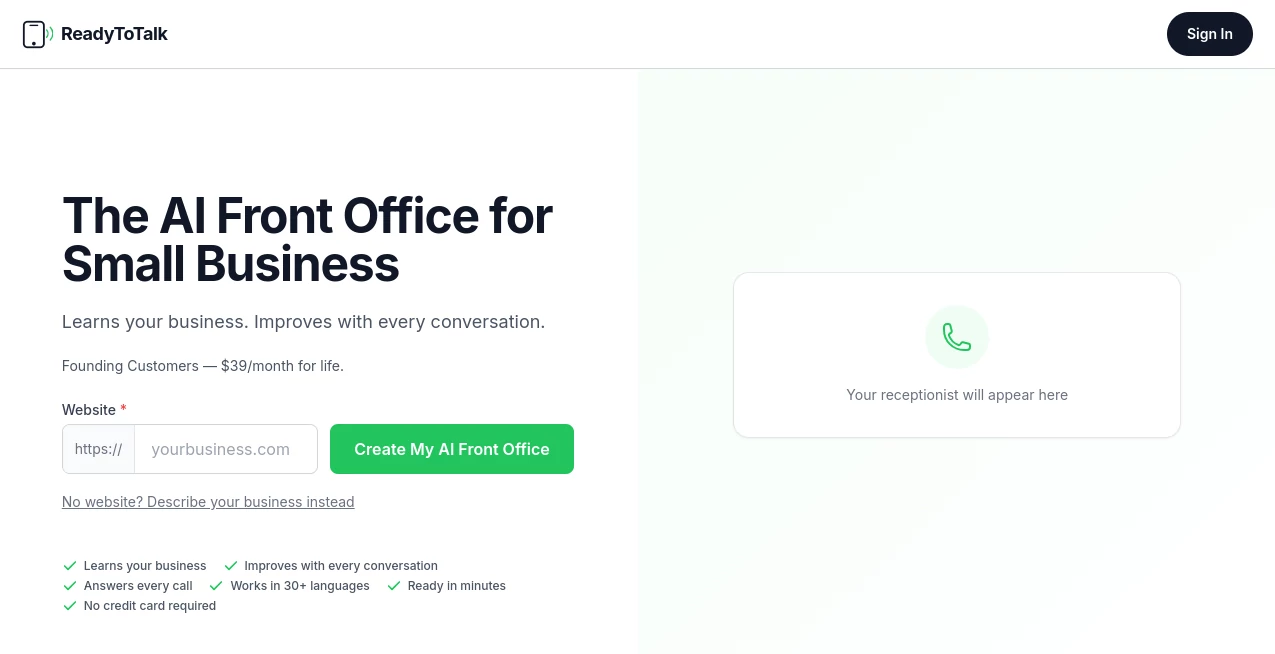
ReadyToTalk is an AI-powered front office built for small businesses that cannot afford to miss important phone calls. It works as an always-on AI receptionist that answers incoming calls, understands what customers need, captures their details, and sends a clear summary after the conversation.
The idea is refreshingly simple: instead of asking a busy business owner to stop working every time the phone rings, the AI handles the first conversation. It can answer questions, take messages, collect callback information, and identify appointment requests while the business owner stays focused on the work in front of them.
Getting started is also unusually straightforward. A business owner can provide their website, and the system learns about services, business hours, FAQs, and other useful information without requiring lengthy scripts, coding, or a separate training process. For a plumber, law firm, salon, contractor, restaurant, or another phone-based business, that can make a meaningful difference during busy hours.
Key Features
- 24/7 AI Receptionist: Answers business calls around the clock, including nights, weekends, and other times when staff may not be available.
- Automatic Business Knowledge: Learns from a company's website, including services, opening hours, and frequently asked questions.
- Fast Call Answering: The service is designed to answer calls in under two seconds, helping reduce the chance that callers hang up before reaching someone.
- 30+ Languages: Supports conversations with customers in more than 30 languages.
- Call Summaries: Sends information about the caller, reason for calling, and callback number after a conversation.
- Lead Capture: Collects useful caller details instead of simply sending unanswered calls to voicemail.
- Appointment Request Detection: Identifies callers who are trying to schedule an appointment or request a service.
- Existing Number Support: Businesses can keep their current phone number and use call forwarding when they cannot answer.
- No-Code Setup: The initial setup does not require programming, complicated scripts, or a technical team.
- Continuous Learning: The AI is designed to improve its understanding of the business through real conversations.
User Interface
The setup experience is focused on simplicity rather than a long configuration process. Instead of building complicated call flows from scratch, businesses can start by providing their website. The system uses that information as a foundation for understanding what the company does and how it should respond to callers.
The experience is particularly appealing to owners who are not interested in learning another complicated business platform. The core promise is straightforward: provide the business information, get the phone setup ready, and let the AI handle incoming conversations.
Accuracy & Performance
Speed matters when a potential customer is already on the phone. The service states that calls can be answered in under two seconds, reducing the frustrating experience of repeated ringing or voicemail.
Performance is not only about response time, though. The system also focuses on understanding the business behind the phone number. It reads website information before the first call and continues learning from real conversations, giving it an opportunity to become more familiar with the questions customers actually ask.
For example, imagine a homeowner calling a plumbing company because a kitchen sink is badly blocked. Instead of reaching voicemail while the plumber is working, the AI can answer, understand the reason for the call, collect the customer's details, and send a concise summary to the business owner.
Capabilities
The platform is designed around practical phone-based business operations. It can answer common questions, take messages, capture caller information, and help businesses keep track of requests that need a human response.
It is also suitable for businesses serving customers in different languages. With support for more than 30 languages, the AI can make phone communication more accessible for companies that receive calls from a multilingual customer base.
Another useful capability is call forwarding. A business does not necessarily need to replace its existing phone number. Calls can be forwarded to the AI receptionist when the business cannot answer, allowing owners to maintain their familiar number while adding an automated layer of coverage.
Security & Privacy
Businesses should review the provider's privacy policy and security documentation before using any AI phone service for sensitive customer conversations. This is especially important for industries such as legal services, healthcare, finance, and other businesses that may handle confidential information.
The service is designed around business calls and customer information, including names, reasons for calling, and callback numbers. Companies should therefore make sure their own call-handling practices and customer disclosures are appropriate for their industry and location.
Use Cases
- Home Services: Plumbers, electricians, HVAC companies, contractors, and repair businesses can capture calls while technicians are working.
- Law Firms: Firms can have an automated first point of contact available when staff are busy or outside normal office hours.
- Real Estate: Agents can capture inquiries and caller information without having to personally answer every incoming call.
- Salons: Customer questions and appointment requests can be handled even when employees are serving clients.
- Restaurants: Businesses can provide basic information and capture important customer requests during busy periods.
- Small Clinics: The system can act as an initial phone receptionist, although businesses should carefully evaluate privacy and regulatory requirements before using it for sensitive information.
- After-Hours Coverage: Businesses that receive calls outside their normal working schedule can maintain a consistent first response.
- Lead Capture: Companies can collect caller details rather than relying entirely on voicemail.
Pros and Cons
Pros
- Available 24/7 for incoming calls.
- Fast call answering designed to respond in under two seconds.
- Supports more than 30 languages.
- Can learn business information directly from a website.
- Captures caller details and provides call summaries.
- Can identify appointment requests.
- No coding or lengthy manual scripting is required for initial setup.
- Businesses can keep their existing phone number through call forwarding.
- Designed specifically around the needs of small businesses.
Cons
- Call usage is billed separately, so total costs depend on the number of connected minutes.
- Businesses with highly specialized workflows may still need human involvement for complex requests.
- Companies handling sensitive customer information should carefully review privacy and compliance requirements.
- The quality of responses depends partly on how accurately the business information is understood and represented.
Pricing Plans
The pricing structure is designed to be accessible to small businesses. The standard pricing shown on the website is $39 per month plus $0.20 per minute on connected calls, with prepaid credits. There are no setup fees or long-term contracts.
The website also promotes a founding-customer offer of $39 per month for life. This can make the service particularly interesting for early adopters who want predictable monthly pricing while adding automated phone coverage to their business.
A free starting option is also promoted without requiring a credit card, allowing businesses to explore the setup before committing to paid usage.
How to Use It
- Step 1: Start by providing your business website.
- Step 2: Let the system learn your services, business hours, FAQs, and other relevant information.
- Step 3: Set up the provided business phone number or configure call forwarding from your existing number.
- Step 4: Test the receptionist with realistic customer questions and scenarios.
- Step 5: Start receiving calls and allow the AI to capture messages, caller details, and appointment requests.
- Step 6: Review the call summaries so you know who contacted the business and why.
Comparison with Similar Tools
Traditional answering services depend on human receptionists and often operate during specific hours. They can provide a personal experience, but their costs may become significant as a business grows or requires coverage outside normal working hours.
Basic voicemail systems sit at the opposite end of the spectrum. They are inexpensive and simple, but they put the responsibility back on the customer to leave a message and wait for a response. For businesses where every missed call could represent a new customer, that gap can be costly.
This solution takes a different approach by combining automated phone answering, business-specific knowledge, multilingual support, caller information capture, and post-call summaries. At $39 per month plus usage, it is positioned as a lower-cost alternative to traditional human answering services while offering more interaction than standard voicemail.
Conclusion
For a small business, a ringing phone is not always convenient. A plumber may be under a sink, a salon employee may be with a customer, and a lawyer may already be in a meeting. The problem is that the caller does not necessarily know any of that. If nobody answers, they may simply try another business.
This AI receptionist offers a practical way to close that gap. It can answer calls around the clock, learn the business from its website, communicate in more than 30 languages, capture important caller information, and send useful summaries after conversations.
The strongest part of the concept is its simplicity. There is no need to build an elaborate phone tree or spend hours writing scripts before getting started. For small businesses looking for a way to stay reachable without hiring another full-time receptionist, it is a compelling option worth testing.
Frequently Asked Questions (FAQ)
What is an AI receptionist?
An AI receptionist is an automated phone agent that answers business calls, understands what callers need, answers common questions, takes messages, captures information, and can help route requests.
How does the AI learn about my business?
You provide your business website, and the system reads information such as services, business hours, and FAQs. It is also designed to improve its understanding through real customer conversations.
Can I keep my existing business phone number?
Yes. Businesses can keep their existing number and configure call forwarding so calls can be sent to the AI receptionist when they are unable to answer.
How much does it cost?
The listed pricing is $39 per month plus $0.20 per connected minute, using prepaid credits. The service states that there are no setup fees or long-term contracts.
Does it support multiple languages?
Yes. The service supports more than 30 languages, making it suitable for businesses that communicate with customers from different linguistic backgrounds.
What information is included in a call summary?
Call summaries can include the caller's name, reason for calling, and callback number. Appointment requests can also be flagged so the business knows which calls may require prompt attention.
What types of businesses can use an AI receptionist?
It is designed for many small businesses that receive phone calls, including law firms, salons, real estate businesses, plumbers, contractors, clinics, restaurants, and other service-based companies.
Does it require coding or technical knowledge?
No. The setup is designed to work without coding, manual scripts, or a dedicated technical team. Providing the business website is the main starting point.
AI Sales Assistant , Business , AI Customer Service Assistant , AI Voice Assistants .
These classifications represent its core capabilities and areas of application. For related tools, explore the linked categories above.

ReadyToTalk Alternatives Product

Beat API
AILeadz.io

VoiceMOAT

AIOutreach

Krisp

BetterAntisp…

Oasis

FINIITE AI

Gpt Realtime…