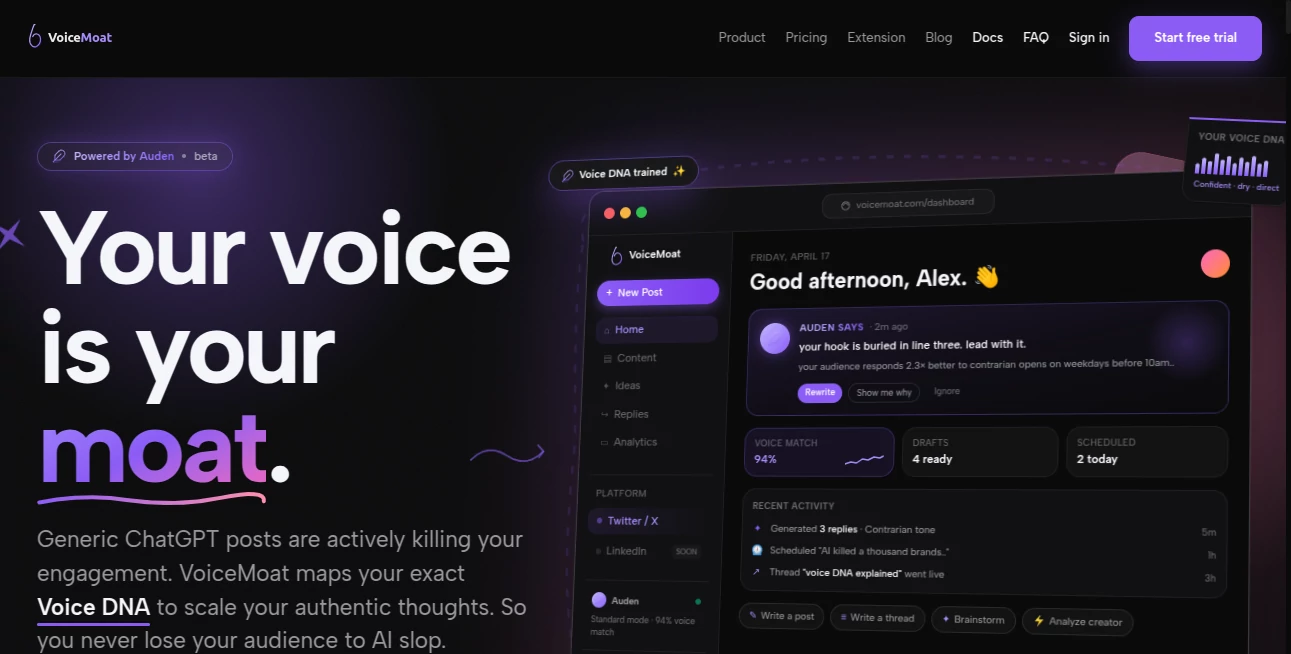
The personal brand operating system for Twitter and LinkedIn.
Create, schedule, engage, analyze, and grow, all in a voice that still sounds like you.
AI made content easier to produce. It also made it easier for everyone to sound the same.
The same hooks.
The same phrasing.
The same cadence.
The same polished, generic AI voice.
VoiceMoat is built on the opposite idea:
You are your brand. Your voice is what makes it recognizable.
So instead of replacing your voice with AI, VoiceMoat learns it, works within it, and helps you scale it.
Your voice is your moat.
The Problem
AI solved the blank page.
It didn't solve sameness.
Everyone can create more content than ever.
Everyone has access to the same AI models.
Everyone is being fed the same content patterns, hooks, and formulas.
As a result, more content feels interchangeable.
The harder problem now isn't producing content. It's producing content that feels unmistakably yours.
The scarce asset online isn't content anymore.
It's a voice people recognize, remember, and trust.
The VoiceMoat Belief
We believe your personal brand starts with something AI shouldn't erase:
your voice.
You're your own brand, so you shouldn't sound like everyone else.
Your writing style is built from years of experience, opinions, habits, and personality.
Generic AI can generate content. It doesn't automatically know what makes your writing yours.
The goal isn't simply to publish more.
The goal is to publish more without losing the identity behind the content.
Voice is not a setting. It's an asset.
Your voice is your moat.
Meet audenAI
The intelligence behind VoiceMoat
audenAI is the writing and growth intelligence at the center of VoiceMoat.
It doesn't start with a blank prompt and a generic model.
It starts with you.
VoiceMoat builds a Voice DNA from your existing writing and analyzes the patterns that make your communication distinct, including:
Hooks
Tone
Cadence
Rhythm
Vocabulary
Structure
Sentence length
Openers
References
Sign-offs
audenAI then uses that Voice DNA whenever it helps you create, engage, or improve content.
The result is AI that works from your writing patterns, not a generic house style.
Create in Your Voice
From blank page to publish-ready draft
Start with an idea, thought, topic, or rough draft.
Let audenAI do the heavy lifting.
Draft single posts, threads, and replies.
Turn rough ideas into structured content.
Improve hooks, tighten writing, shorten drafts, or reshape an idea.
Generate a strong first draft without starting from zero.
See a voice-match score for every draft.
Review, edit, and approve before anything goes live.
You get the speed of AI without handing over the part that makes your content yours.
AI handles the first draft. You keep the final say.
One Voice Across Every Post
Your audience shouldn't meet a different version of you every time you publish.
VoiceMoat helps you maintain a consistent writing identity across Twitter and LinkedIn.
Create for both platforms from the same core idea.
Adapt the format to each platform without losing your voice.
Keep your writing recognizable even as your output increases.
Build consistency without turning every post into a manual production task.
One identity. Two platforms. No tone whiplash.
Schedule and Publish
Turn consistency into a system
Great content does little if you publish only when you remember to.
VoiceMoat gives you the infrastructure to stay consistent.
Plan content ahead of time.
Build and manage a publishing calendar.
Schedule your posts in advance.
Publish natively to Twitter and LinkedIn.
Maintain a sustainable posting rhythm.
Keep your content pipeline moving without living inside a scheduler.
Because consistency compounds.
VoiceMoat is built to make consistency easier to maintain.
Engage Where the Conversations Happen
Don't just publish. Participate.
Building a personal brand isn't only about what you post.
It's also about who you interact with.
With VoiceMoat, you can discover relevant conversations and draft replies in your own writing style.
On Twitter, the Chrome extension brings audenAI directly into your feed.
Find conversations worth joining.
Draft replies in your voice.
See how closely a reply matches your writing style.
Edit and approve before posting.
Turn passive scrolling into meaningful participation.
You don't need to spend all day replying to everything.
Show up where the right conversations are happening.
Ideas When You Need Them
Never stare at “What should I post?”
When inspiration runs dry, VoiceMoat helps you find the next idea.
Brainstorm content ideas.
Explore what is resonating in your niche.
Save interesting posts for later.
Remix ideas through your own perspective.
Turn inspiration into content that fits your voice.
Instead of endlessly asking what to post, you can spend more time deciding what is worth saying.
Know What Is Working
Your content should teach you what to create next.
VoiceMoat brings your publishing and performance into the same system.
Track the signals behind your content:
Impressions
Engagement
Follower growth
Hooks
Formats
Topics
Best-performing posts
Best-performing times
Then use audenAI to understand the patterns.
What worked?
Why did it work?
What should you try next?
Create from your voice. Learn from your data. Improve over time.
Twitter + LinkedIn
Two platforms. One recognizable you.
VoiceMoat is built for the two platforms where personal brands increasingly live.
Twitter
Create posts and threads.
Schedule and publish.
Discover conversations.
Draft replies through the Chrome extension.
Track performance and audience growth.
LinkedIn
Create platform-native posts.
Schedule and publish.
Maintain the same underlying Voice DNA.
Analyze performance and identify what resonates.
The platform changes.
Your voice doesn't have to.
Who VoiceMoat Is For
Creators
Build an audience without turning your content into AI-generated wallpaper.
Founders
Build in public, develop authority, and shape how people perceive you and your company.
Ghostwriters
Manage multiple clients while keeping every voice distinct.
Coaches, consultants, and experts
Turn expertise into consistent content without sounding like a template.
Solo operators and indie hackers
Run your personal brand without adding another full-time job to your workload.
Sales and B2B professionals
Build trust and visibility on LinkedIn through consistent, recognizable content.
Teams and agencies
Manage multiple people and brands while keeping every Voice DNA separate.
Why VoiceMoat Is Different
Most AI writing tools optimize for one thing:
How fast can we generate more content?
VoiceMoat starts somewhere else:
How can we help you create more without losing what makes your content yours?
That difference shows up throughout the product.
Voice-first
Your writing patterns become the foundation for AI-assisted creation.
Measurable
Every draft can be evaluated with a voice-match score instead of asking you to blindly trust the output.
Context-aware
audenAI can work with your content, history, analytics, creators, drafts, and publishing workflow instead of treating every request like a brand-new conversation.
End-to-end
Create, engage, schedule, publish, analyze, and improve in one system.
Human-controlled
AI can accelerate the work, but you decide what actually gets published.
**VoiceMoat isn't trying to replace your personal brand.
It's trying to help you scale it.**
Plans That Scale With You
Start free and experience the system before committing.
As your needs grow, so does VoiceMoat.
More daily credits for higher publishing volume.
More Voice DNA profiles for multiple brands or clients.
More advanced audenAI capabilities.
Team functionality for agencies and larger operations.
Higher limits for demanding content workflows.
For agencies and ghostwriters, separate voice profiles mean every client can maintain their own distinct identity.
Your clients don't need to sound like you. They need to sound like themselves.
How People Use VoiceMoat
Build a personal brand from zero on Twitter and LinkedIn.
Maintain a daily or near-daily publishing habit.
Turn one idea into platform-native content for both networks.
Draft thoughtful replies without writing every response from scratch.
Turn long-form thinking into posts and threads.
Discover what is working in your niche and build from it.
Use analytics to refine future content.
Manage multiple distinct voices from one workspace.
Replace a scattered collection of generic AI tools with one voice-first workflow.
The Bigger Picture
Content has become abundant.
AI made that inevitable.
You can generate another post in seconds.
You can generate a hundred.
That isn't the hard part anymore.
The harder problem is creating content that still feels like it came from a real person.
Someone with opinions.
Experience.
Taste.
Humor.
Context.
A point of view.
That's what a personal brand is built on.
VoiceMoat exists to help you keep that human signal while removing the parts of content creation that slow you down.
You bring the ideas, experience, taste, and judgment.
audenAI helps with the blank page, the workflow, and the scale.
You stay in control of what represents you.
The Future of Personal Brand Building
The next generation of personal brands won't be built by people who simply publish more AI content.
They'll be built by people who use AI without becoming indistinguishable from everyone else using it.
VoiceMoat is built for that.
Create in your voice.
Engage in your voice.
Grow in your voice.
Every day.
VoiceMoat
Your personal brand.
Your voice.
Your moat.