


















Research Master
What is Research Master?
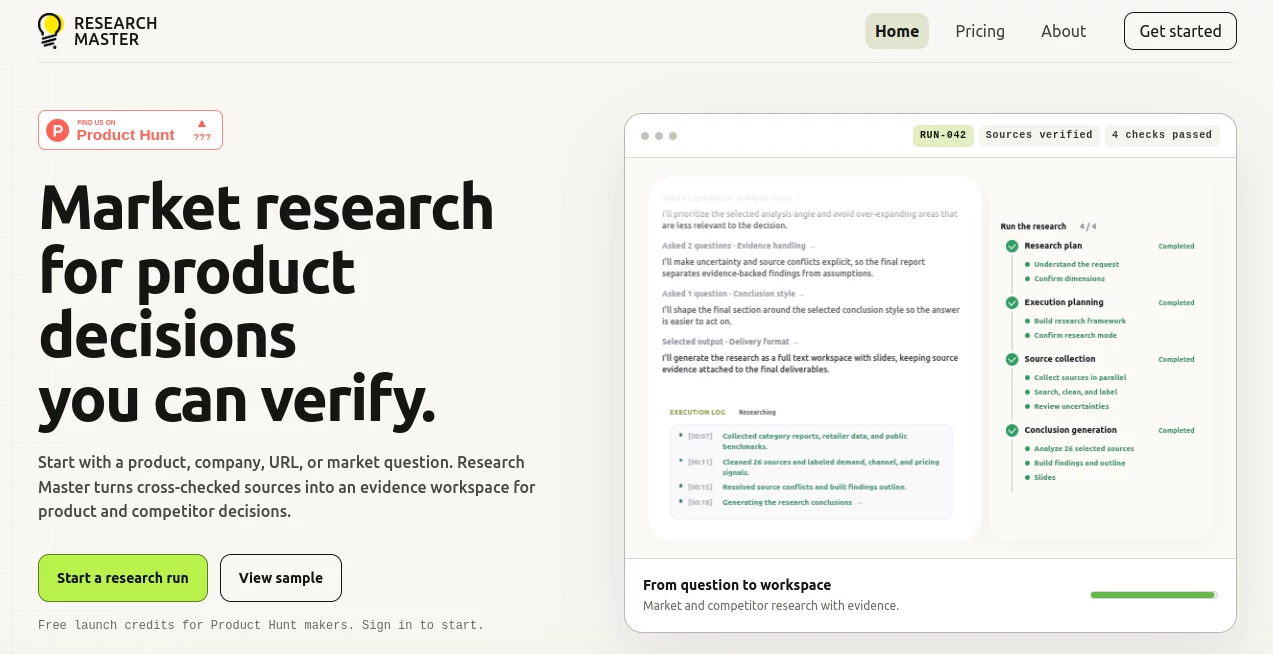
ResearchMaster is built for people who need more than a quick AI-generated answer. It turns a research question, company name, product, URL, article, or document into a structured research deliverable by combining automated information gathering, multi-source verification, analysis, and report generation.
The platform is particularly useful for market researchers, investors, strategy teams, product managers, entrepreneurs, and researchers who regularly spend hours collecting information before they can even begin analyzing it. Instead of jumping between search results, documents, and notes, users can start with a research topic and let the system organize much of the process automatically.
One of its most appealing aspects is the focus on traceability. The platform says its conclusions are cross-checked against more than 300 professional data sources, while its reports can reach a structured length of more than 10,000 words. That makes it a compelling option when a short chatbot response simply is not enough.
Key Features
- Multi-source research using more than 300 professional information sources.
- Seven dedicated AI agents working in parallel during the research process.
- Automatic analysis across more than 20 research dimensions.
- Research for companies, products, industries, markets, competitors, and feasibility questions.
- Support for company names, product names, URLs, articles, PDFs, and other uploaded content.
- Source references designed to make important findings easier to verify.
- Long-form structured research reports suitable for professional use.
- Export options including PDF, PPTX, and Markdown.
- Multilingual source processing for international and cross-border research.
User Interface
The interface keeps the starting point refreshingly simple. Users can enter a research topic and provide supporting material when necessary, including PDF, Word, Excel, Markdown, TXT, PNG, JPG, and JPEG files. There is no need to build a complicated research workflow before getting started.
This simplicity is especially useful for users who know what they want to investigate but do not want to spend time configuring research agents, source lists, or analysis templates. The system is designed to recognize the type of research required and determine how the investigation should be structured.
Accuracy & Performance
Research quality is one of the strongest selling points. The platform states that its research process uses more than 300 professional sources and seven specialized agents to collect and cross-check information. Instead of relying on a single response, the system is designed to gather evidence from multiple places before building the final report.
Standard research tasks are advertised as taking around 30 minutes, which is a significant improvement over a traditional manual workflow that can take days or weeks. Of course, complicated subjects and topics with limited public information can still require additional review.
The source-traceability approach is also important. AI-generated research should never be treated as automatically correct, particularly when it involves investment decisions, financial information, regulation, or other high-stakes subjects. The platform itself recommends reviewing sources and applying human judgment before making important decisions.
Capabilities
The platform covers three broad research scenarios: product and company research, industry and market research, and solution or feasibility research. This gives it a wider practical range than a tool designed solely for academic literature searches.
For company research, users can investigate areas such as company background, funding, product positioning, competitors, teams, and operating information. For market research, the workflow can examine market size, major players, trends, regulations, and business models. Feasibility research can focus on recommendations, execution conditions, risks, and practical next steps.
The multi-format delivery system is another useful feature. A single research project can result in a detailed report and presentation-ready materials, with exports available in PDF, PPTX, and Markdown. For someone preparing an internal strategy meeting, investor discussion, or market presentation, that can save considerable editing time.
Security & Privacy
Research workflows can involve sensitive business information, so users should always review the platform's privacy policy and terms before uploading confidential material. The service supports document uploads and processes information supplied by the user as part of its research workflow, making it sensible to avoid submitting highly sensitive data unless the applicable privacy and security terms meet your requirements.
For ordinary market research, competitor research, public-company investigation, and publicly available information, the workflow is particularly well suited. For confidential corporate documents or regulated information, organizations should perform their own security review first.
Use Cases
- Market Research: Investigate market size, trends, competitors, regulations, business models, and industry developments.
- Competitive Analysis: Compare companies and products while organizing findings into a structured report.
- Investment Research: Support early-stage due diligence and industry investigation with traceable research.
- Product Management: Explore competitors, positioning, market opportunities, and product-related trends.
- Startup Research: Investigate markets, competitors, financing activity, and business opportunities before making strategic decisions.
- Strategy Planning: Gather information for market-entry assessments and strategic decision-making.
- Feasibility Studies: Examine execution requirements, risks, recommendations, and practical next steps.
- Academic and Professional Research: Organize large amounts of information into a more readable and structured research document.
Pros and Cons
Pros
- Designed specifically for deep research rather than casual chatbot conversations.
- Uses multiple sources and parallel research agents.
- Strong emphasis on source traceability.
- Covers company, product, industry, market, and feasibility research.
- Can produce long-form reports instead of short summaries.
- Supports PDF, PPTX, and Markdown exports.
- Simple starting workflow with no specialized research experience required.
- Useful for international and cross-border research scenarios.
Cons
- AI-generated findings still need human verification before important decisions.
- Research quality can depend on the amount and reliability of publicly available information.
- Complex investigations may take longer than the advertised standard research time.
- Users working with highly confidential documents should review the privacy and security terms carefully before uploading them.
Pricing Plans
The service offers a free version for users who want to try the core research workflow. The official website currently advertises paid access starting at ¥49 per month, with an annual-plan discount available.
Pricing and usage limits can change over time, so users who need a larger research volume should check the current pricing information before subscribing. The free option makes it easier to test the quality of the research workflow before committing to a paid plan.
How to Use the Tool
- Start with a clear research question, company name, product name, industry, or URL.
- Add supporting material when useful, such as an article, PDF, spreadsheet, or other accepted file.
- Let the system identify the appropriate research scenario and organize the investigation.
- The research agents collect information from multiple professional sources and cross-check relevant findings.
- The system analyzes the information across multiple dimensions and builds a structured report.
- Review the findings and source references, especially when the research will influence an important business or financial decision.
- Export the finished research as PDF, PPTX, or Markdown depending on how you plan to use it.
Comparison with Similar Tools
Traditional AI chat assistants are excellent for quick questions, brainstorming, rewriting, and short summaries, but they are not always designed around a complete research workflow. A user who needs a serious market report may still have to search for sources, compare information, organize notes, and format the final document manually.
This platform takes a more research-oriented approach. Its workflow is centered around source collection, cross-verification, multi-dimensional analysis, and structured deliverables. The stated use of more than 300 professional sources, seven parallel agents, and 20-plus research dimensions gives it a more specialized purpose than a general-purpose chatbot.
It is therefore best viewed not simply as another AI writing assistant, but as a research workflow designed to reduce the repetitive work between the initial question and a professional research deliverable.
Conclusion
For anyone who regularly researches companies, markets, competitors, industries, or business opportunities, this platform offers a practical way to compress a traditionally time-consuming process into a much shorter workflow. Its strongest qualities are the depth of its research structure, multi-source approach, traceability, and ability to turn one research task into several usable formats.
The biggest advantage is not simply generating more text. It is bringing information collection, verification, analysis, and presentation into one place. That makes it particularly attractive to strategy professionals, investors, product teams, entrepreneurs, and researchers who need useful information quickly but still want the ability to inspect where important conclusions came from.
As with any AI research system, the best results come when automated findings are treated as a strong starting point rather than an unquestionable final authority. With that approach, it can become a valuable part of a modern research workflow.
Frequently Asked Questions (FAQ)
What type of research can it perform?
It is designed for product and company research, industry and market research, and solution or feasibility research. Examples include competitor analysis, market investigation, company research, industry trends, and business feasibility questions.
How long does a typical research report take?
The platform states that most standard research tasks can be completed in about 30 minutes. More complicated subjects or investigations involving larger source sets may require additional time.
Does it provide sources for its findings?
Yes. Source traceability is a central part of the workflow, and important conclusions are designed to include references so users can review the underlying information.
Can I upload documents?
Yes. The platform supports several file types, including PDF, Word, Excel, Markdown, TXT, PNG, JPG, and JPEG. Users can provide documents as supporting material for their research.
Can it research companies using only a URL?
Yes. A company or product URL can be used as an input. The system can then identify the research type and build the investigation around the available information.
Does it support multilingual research?
Yes. The platform supports multilingual source processing, making it useful for international markets and cross-border research projects.
Can research reports be exported?
Yes. Completed research can be delivered in Markdown, PDF, and PPTX formats, which makes it easier to edit, share, or use in presentations.
Is there a free version?
Yes. A free version is available for trying the basic functionality. Paid access is available for users who need higher usage limits.
Should AI-generated research be trusted without checking it?
No. Even with multi-source verification, AI-generated research can contain outdated information, gaps, or interpretation errors. Important findings should always be checked against the cited sources and evaluated using human judgment.
Who can benefit most from this tool?
Strategy leaders, investors, analysts, product managers, entrepreneurs, and researchers are among the users who can benefit most from its structured research workflow.
AI Report Writing , AI Research Tool , AI Presentation Generator .
These classifications represent its core capabilities and areas of application. For related tools, explore the linked categories above.
Research Master details
Website unavailable — View Alternatives
Pricing
- Free
Apps
- Web App
Categories

Research Master Alternatives Product

SalaryHow
CoolVerdict

SciSpace

DidYouSEO

Treeova

Lessie AI

PurityRadar

TopPDF

Prelight
