















PurityRadar
What is PurityRadar?
PurityRadar is a water-quality intelligence platform designed to make public water data easier to understand. Instead of asking homeowners to dig through technical reports, regulatory records, and contaminant tables, it brings important information together in a straightforward safety report for a specific location.
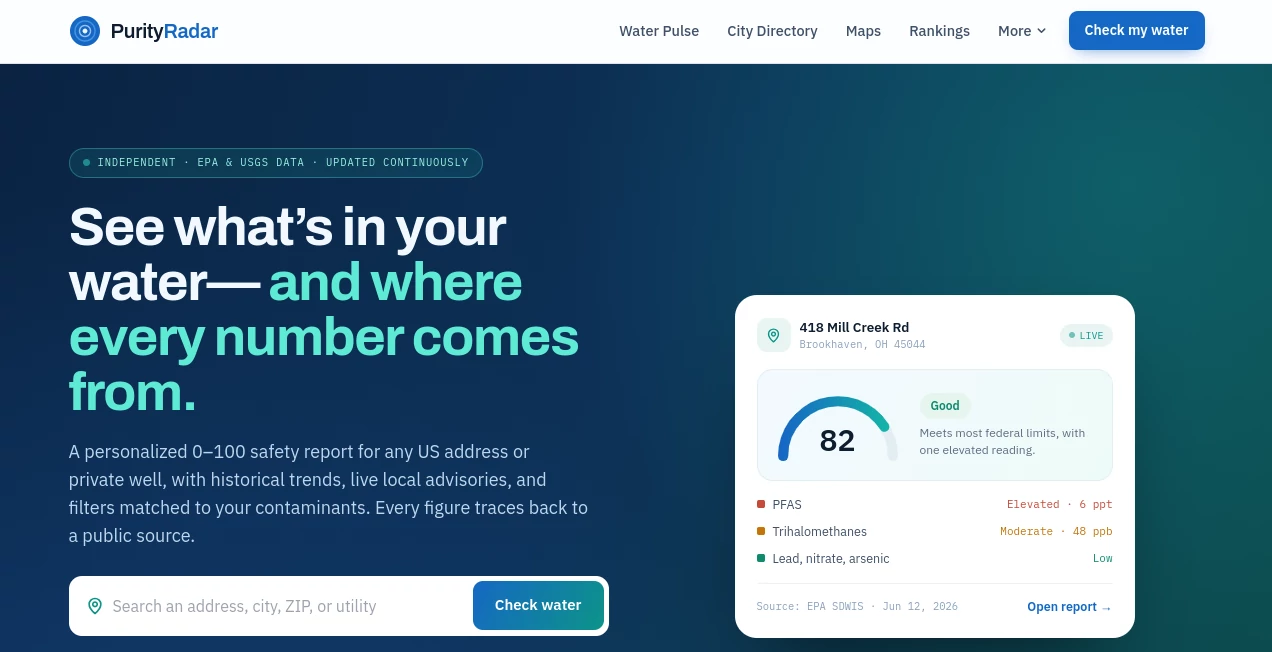
Users can search an address, city, ZIP code, or water utility and receive a personalized 0–100 water safety score. The platform combines public records from sources such as the EPA and USGS, while also showing historical trends, local advisories, contaminant readings, and information that can help users understand what may be affecting their water.
One of the strongest aspects of the service is transparency. Rather than presenting a score without context, it connects individual figures to their underlying public sources. That makes it particularly useful for homeowners, renters, researchers, and anyone who wants to take a closer look at local water quality.
Key Features
- Personalized 0–100 water safety reports
- Address, city, ZIP code, and utility searches
- Water-quality information based on EPA and USGS public records
- Historical water-quality trends
- Private well risk information
- Local and live water advisories
- Contaminant tracking and reporting
- Source links for individual data points
- City-by-city water-quality comparisons
- Filter recommendations matched to contaminants
- Water-quality rankings for major US cities
- Educational guides about testing and interpreting water reports
User Interface
The interface is built around a simple idea: enter a location and get useful information without having to understand environmental databases first. The main search makes it possible to check an address, city, ZIP code, or utility directly from the homepage.
Results are organized around an overall safety score, contaminant information, trends, and relevant alerts. The presentation feels more like a consumer report than a complicated scientific dashboard, which is a major advantage for people who simply want to understand their local water.
The city directory and rankings add another useful layer. Someone researching a new location can compare water-quality scores across major US cities instead of looking at one area in isolation.
Accuracy & Performance
The platform's data-driven approach is one of its most appealing qualities. Information is assembled from public EPA, USGS, and utility records, and individual figures can be traced back to their underlying source. The site also displays publication or update dates, helping users understand how current a particular measurement is.
Another useful feature is historical context. A single contaminant reading can be misleading without knowing what happened before it. Looking at trends over time gives users a better way to understand whether water conditions have remained stable or changed.
For private wells, the platform takes a different approach by using USGS data to model area-level risk. This is important because private wells do not always have the same centralized monitoring information available for public water systems.
Capabilities
The platform goes beyond simply displaying contaminant numbers. It combines water-system information, environmental monitoring, violations, enforcement records, historical data, and local advisories into a more understandable picture.
For example, a report can highlight contaminants such as PFAS, lead, arsenic, nitrate, or other substances and place their readings alongside relevant limits or available context. Users can also investigate water systems, explore city rankings, and learn how different types of water testing work.
The filter guide is another practical addition. Rather than suggesting that every household needs the same type of filtration, the service is designed to connect filter choices with the contaminants identified in an area. That makes the information more actionable for homeowners who are considering a filtration system.
Security & Privacy
Privacy is especially important when a service asks users to search an address. The platform states that it does not sell data submitted through its guide signup and provides dedicated privacy and terms pages.
Users should still remember that the reports are based on public environmental records and are intended as general information. The service itself recommends confirming important decisions with the local water provider and official Consumer Confidence Reports, and it does not position its reports as a replacement for testing water directly.
Use Cases
Homeowners can use the service to get a clearer picture of the water supplied to their property and identify contaminants that may deserve closer attention. This can be especially useful when considering whether additional water testing or filtration is worthwhile.
People buying or renting a home can also use the location-based reports as part of their research. Checking the local water system before moving can reveal information that may not be obvious from a property listing.
Private well owners have another practical use case. Since well water can vary considerably by location, area-level environmental information can provide useful background before deciding whether further testing is necessary.
Researchers, journalists, and students can benefit from the site's collection of public records and city-level comparisons. Instead of starting with raw government datasets, they can use the reports to understand the broader picture and then follow the provided sources for deeper research.
There is also value for anyone trying to understand a local water advisory. Having alerts, contaminant information, and source information in one place can make it easier to determine what is happening in a particular area.
Pros and Cons
Pros
- Easy-to-understand water safety scoring
- Uses public EPA and USGS information
- Individual data points can be traced to sources
- Includes historical trends rather than isolated readings
- Supports private-well research
- Provides local water advisories
- Offers practical filter-related information
- Useful city directory and ranking features
- Free access to the core water-quality information
Cons
- Coverage is focused on the United States
- A location-based score cannot account for every home's internal plumbing
- Public-record information may not reflect the exact quality of water coming from an individual household tap
- Users making important health-related decisions may still need professional or laboratory testing
Pricing Plans
The core water-quality checking experience is available for free. Users can search locations and explore water-quality information without needing to purchase a subscription.
For people who want to investigate their local water, this makes the service particularly accessible. The value comes from bringing together public environmental records and presenting them in a format that is considerably easier to interpret than raw government datasets.
How to Use PurityRadar
Start by entering an address, city, ZIP code, or water utility into the search field. Select the relevant location to open its water-quality report.
The report provides an overall safety score along with information about detected contaminants, relevant water-system records, and other available data. Pay attention to the dates attached to individual measurements so you can distinguish recent information from older records.
Next, review the contaminant section and look at the historical information when available. If a particular contaminant stands out, use the linked source information to understand where the figure came from.
If you are considering a filtration system, the filter guide can help connect your concerns with the types of filtration designed for specific contaminants. For important decisions, compare the findings with your utility's official report or consider certified laboratory testing.
Comparison with Similar Tools
Many water-quality resources focus on individual reports, contaminant databases, or general educational information. This platform takes a broader approach by combining location-based scoring, historical trends, environmental records, advisories, and source attribution in one experience.
That combination makes it particularly useful for people who want an initial overview rather than raw datasets alone. Someone researching a city can explore rankings and water systems, while a homeowner can narrow the search down to a specific location and then investigate the underlying information.
It is worth remembering that no online database can perfectly describe the water coming from every individual household tap. Plumbing age, service lines, private infrastructure, and other local factors can influence actual tap-water quality. For that reason, this service works best as a research and decision-support resource alongside official utility information and, when necessary, direct water testing.
Conclusion
Understanding water quality should not require a background in environmental science. This platform does a good job of turning complicated public records into information that ordinary homeowners and researchers can actually use.
The combination of location-based safety scores, historical trends, contaminant data, local advisories, private-well information, and source transparency gives users more context than a simple pass-or-fail water checker. The ability to follow individual figures back to public records is particularly valuable for anyone who wants to verify what they are seeing.
It is not a replacement for laboratory testing or official guidance, but it can be an excellent starting point for learning what is known about water quality in a particular US location. For homeowners, renters, researchers, and environmentally conscious consumers, it offers a practical way to turn scattered public data into a much clearer picture.
Frequently Asked Questions (FAQ)
What does the water safety score mean?
The platform provides a 0–100 safety score intended to summarize available water-quality information for a location. The score should be considered a research aid rather than a substitute for professional water testing.
Where does the water-quality data come from?
The service uses public information from sources including the EPA, USGS, and water utilities. Individual figures can be traced back to their underlying public records when source information is available.
Can I check water from a private well?
Yes. The service includes private-well research and uses USGS information to model area-level risk. Because a model cannot measure the water inside an individual well, direct testing remains important for homeowners who rely on private wells.
Does the service recommend water filters?
Yes. Its filter guide is designed to help users match filtration options with contaminants found in their area, making it easier to research which type of filter may be relevant.
Is the water information a replacement for laboratory testing?
No. The reports are based on public records and provide general information about water quality. When an important health or household decision depends on the actual quality of tap or well water, users should consider certified testing and consult their water provider.
Is the service free?
Yes. The core location-based water-quality information is available without a paid subscription.