Residencias Médicas
What is Residencias Médicas?
Preparing for a medical residency exam is not simply a matter of reading more books. The real challenge is learning how to recognize recurring topics, make decisions under time pressure, understand mistakes, and keep practicing consistently. This platform is built around that idea, giving medical students and graduates a practical environment for preparing for residency exams in Argentina.
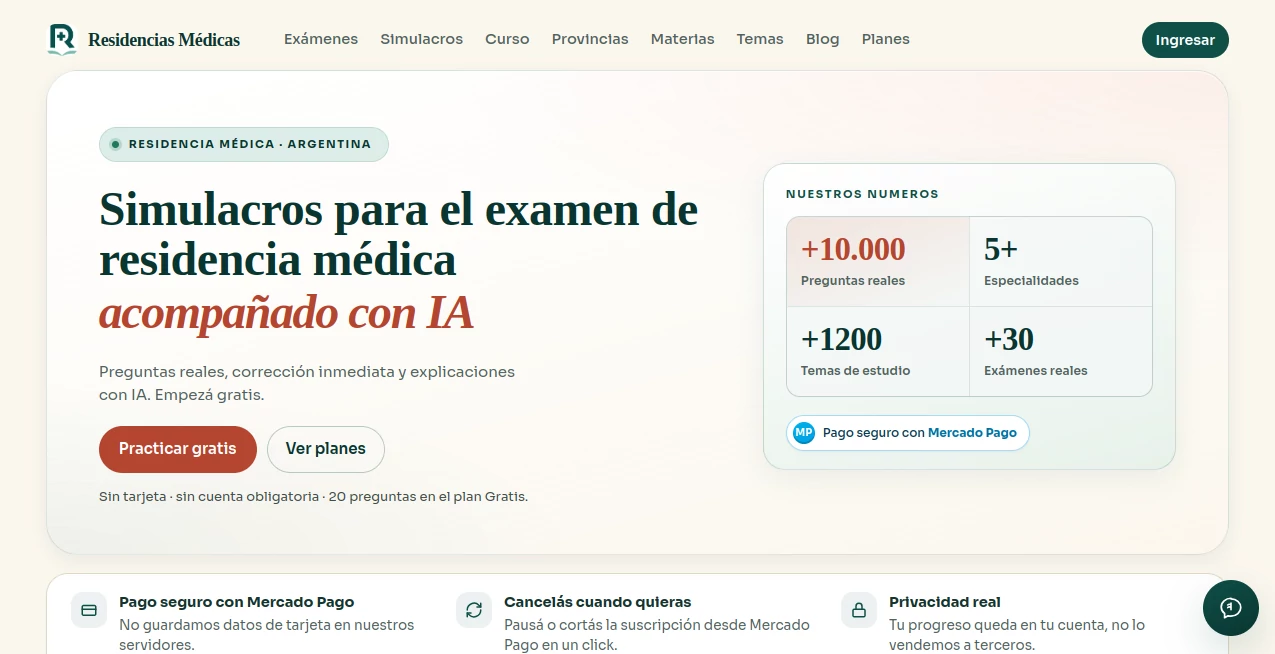
Instead of relying only on passive study, users can work through real multiple-choice questions from previous residency examinations, receive immediate corrections, review their mistakes, and use artificial intelligence when a question needs further explanation. The platform currently brings together more than 10,000 real questions, over 30 exams, more than 1,200 study topics, and content covering five or more specialties.
The approach feels particularly useful for students who have already spent hours studying theory but want to know whether they can actually apply what they know in an exam situation. A short daily practice session can turn weak areas into something measurable and easier to review.
Key Features
- More than 10,000 real questions for residency exam practice.
- Questions organized by subject, year, province, and examination.
- Immediate correction after selecting an answer.
- AI-powered explanations for difficult questions.
- An AI study assistant that can answer questions and provide contextual guidance.
- Speed, survival, challenge, and error-review practice modes.
- Performance tracking with accumulated accuracy, daily streaks, and subject-level error patterns.
- Access to historical examinations dating back to 2016.
- Additional practice using real MIR questions from Spain.
- A free plan that allows users to try the platform before subscribing.
User Interface
The interface is designed around the activity that matters most during exam preparation: answering questions. Rather than forcing students through a complicated sequence of menus, the platform lets them select a subject, year, or examination and begin practicing.
The organization by province, subject, and year makes it easier to create a study routine that matches the student's situation. Someone preparing for a specific provincial examination can concentrate on relevant material, while another student can work through complete historical examinations to reproduce a more realistic testing experience.
The practice modes also add variety. Speed mode introduces a 30-second limit per question, while Survival mode gives the learner three lives. Challenge mode mixes subjects so that the next question cannot be predicted, which makes the experience closer to the mental pressure of an actual examination.
Accuracy & Performance
Performance tracking is one of the more practical parts of the experience. After completing a block, users can see accumulated accuracy, daily practice streaks, and the distribution of mistakes by subject. This changes preparation from a vague feeling of “I need to study more” into something more concrete.
Immediate correction is equally important. Instead of completing an entire test and waiting until the end to discover mistakes, the platform shows the result as soon as an answer is selected. When a wrong answer is confusing, the AI explanation can provide additional reasoning and help distinguish between similar options.
The platform is not presented as a replacement for medical textbooks or formal courses. Its strength is repetition and exam-oriented practice, making it a useful companion for students who want to test how well their theoretical knowledge holds up under real question formats.
Capabilities
The platform supports several ways of practicing. Students can work by medical subject, complete examinations from particular years, or focus on provincial examinations. The available material includes areas such as clinical medicine, surgery, pediatrics, gynecology, and obstetrics.
There is also a dedicated error-review mode that brings previously missed questions back into the study cycle. This is particularly valuable because mistakes are often more useful than questions answered correctly: they reveal exactly where another round of study is needed.
Another distinctive capability is the integrated AI assistant. Students can ask about a medical topic, request clarification about a question, or explore subjects available within the platform. For example, a learner who is unsure why one clinical option is preferable to another can ask for an explanation instead of leaving the question unresolved.
Security & Privacy
The platform states that payment processing is handled securely through Mercado Pago and that card information is not stored on its own servers. It also states that user progress is not sold to third parties.
For students using the service regularly, this is reassuring because their study history, accuracy data, and progress are part of a personal preparation process. As with any online educational service, users should still review the current privacy information and terms before creating an account or subscribing.
Use Cases
This platform is particularly suited to medical students, recent graduates, and professionals preparing for residency examinations in Argentina.
- Daily exam preparation: Complete a manageable number of questions every day instead of postponing practice until the final weeks.
- Provincial exam preparation: Focus on examinations and questions associated with specific jurisdictions such as Córdoba, CABA, or Buenos Aires.
- Weak-area revision: Use performance information and error review to identify subjects that require additional attention.
- Timed practice: Use the speed mode to practice making decisions within a strict time limit.
- Full exam simulation: Work through historical examinations to become familiar with the rhythm and structure of the real experience.
- Last-minute review: Revisit previously incorrect questions rather than spending valuable time reviewing material that is already well understood.
- AI-assisted learning: Ask the integrated assistant for explanations when a question or medical concept remains unclear.
Pros and Cons
Pros
- Large collection of real residency examination questions.
- Immediate feedback makes mistakes easier to learn from.
- Multiple practice modes help reproduce exam pressure.
- Questions can be organized by subject, year, and jurisdiction.
- AI explanations add another layer of support during practice.
- A free option allows users to test the experience before paying.
- Progress and error patterns help make study sessions more targeted.
Cons
- The complete examination catalog requires a Premium subscription.
- AI explanations are more fully available on the Premium plan.
- The platform is primarily focused on residency examination preparation rather than general medical education.
- Students looking for comprehensive textbook-style learning will still need additional medical references.
Pricing Plans
The service offers a free option as well as several Premium plans. The Free plan allows users to try a sample examination with up to 20 questions and experience the immediate correction system.
The Premium options are structured for different preparation periods. The monthly plan is listed at $24,000 per month and renews automatically. The three-month plan is $63,000 paid in advance, while the six-month plan is $108,000 paid in advance. The annual plan costs $180,000 in total, equivalent to $15,000 per month, and is presented as the lowest monthly price.
Premium access includes the complete examination catalog, expanded AI explanations, the AI study assistant, error review, and additional training modes. There are also institutional plans for courses, universities, and study groups that require a customized arrangement.
How to Use Residencias Médicas
Getting started is straightforward. Begin by selecting a practice block based on the subject, examination year, province, or another available category. Each block contains multiple-choice questions based on real examination material.
Answer each question and review the correction immediately. If the reasoning behind an answer is unclear, use the AI explanation when available to explore why the correct option works and why the alternatives do not.
After completing a session, review your performance. Pay attention to recurring errors rather than only looking at your overall score. Returning to missed questions through the review mode can gradually turn weak areas into stronger ones.
For a more demanding session, switch to Speed, Survival, or Challenge mode. A student preparing for the actual exam could, for example, spend weekdays working on individual subjects and reserve one session each week for a timed or mixed-subject simulation.
Comparison with Similar Tools
Many medical education platforms focus heavily on lectures, flashcards, or large collections of theoretical material. This platform takes a different route by putting actual examination questions at the center of the learning experience.
That distinction matters for residency preparation. Reading a chapter can improve knowledge, but answering a question forces the student to retrieve that knowledge, interpret a clinical situation, compare alternatives, and make a decision. The immediate correction and error-review features then shorten the distance between making a mistake and learning from it.
The integrated AI component adds another advantage over a conventional question bank. Instead of simply marking an answer as correct or incorrect, learners can request additional explanations when they need help understanding the reasoning behind a question.
For someone who already has a primary medical course or bibliography, this makes the platform especially interesting as a dedicated practice layer rather than a replacement for existing study resources.
Conclusion
Residency exam preparation becomes much more manageable when practice is consistent, measurable, and closely connected to the format of the real examination. This platform does a good job of keeping that principle at the center of the experience.
The combination of real historical questions, immediate correction, performance tracking, specialized practice modes, and AI-assisted explanations gives medical students a practical way to turn study time into repeated exam practice. The large question library is particularly useful for learners who have reached the point where they need more than another round of passive reading.
It is not designed to replace medical textbooks, university courses, or professional guidance. Instead, it works best as a focused training environment where students can practice, make mistakes, understand them, and return to the topics that need attention. For anyone preparing for medical residency examinations in Argentina, that can make the final stages of preparation considerably more structured.
Frequently Asked Questions (FAQ)
What type of questions are available?
The platform provides real multiple-choice questions from previous residency examinations, organized by subject, year, province, and examination. Its catalog includes examinations dating back to 2016.
Can I use the platform for free?
Yes. The Free plan allows users to try a sample examination with up to 20 questions. Full access to the catalog and additional Premium features requires a subscription.
Does the platform provide AI explanations?
Yes. Premium users can request AI-powered explanations when an answer needs further clarification. The AI assistant can also help explain medical topics, questions, and concepts within the platform.
Can I practice under time pressure?
Yes. Speed mode gives 30 seconds per question, while Survival mode introduces a three-life system. Challenge mode presents mixed questions without revealing what subject will appear next.
Can I review questions I answered incorrectly?
Yes. The review mode focuses on previous mistakes, allowing users to revisit questions they answered incorrectly and use them as targeted study material.
Is this a replacement for medical textbooks or courses?
No. The platform is intended as a practice and preparation tool. It works particularly well alongside established medical references, courses, and other study resources.
Does it include provincial residency examinations?
Yes. The catalog includes provincial examination material, including content for jurisdictions such as Córdoba, CABA, and Buenos Aires, alongside other available examination collections.
AI Quizzes , AI Education Assistant , AI Coaching .
These classifications represent its core capabilities and areas of application. For related tools, explore the linked categories above.
Residencias Médicas details
Website unavailable — View Alternatives
Pricing
- Freemium
Apps
- Web App
Categories

Residencias Médicas Alternatives Product

AI page tran…

SuperAI

Parking Prac…

SlideStorm AI

Gochu

ekstrakt

Twee

GetFIT App

AHelp