
Sayora
What is Sayora?
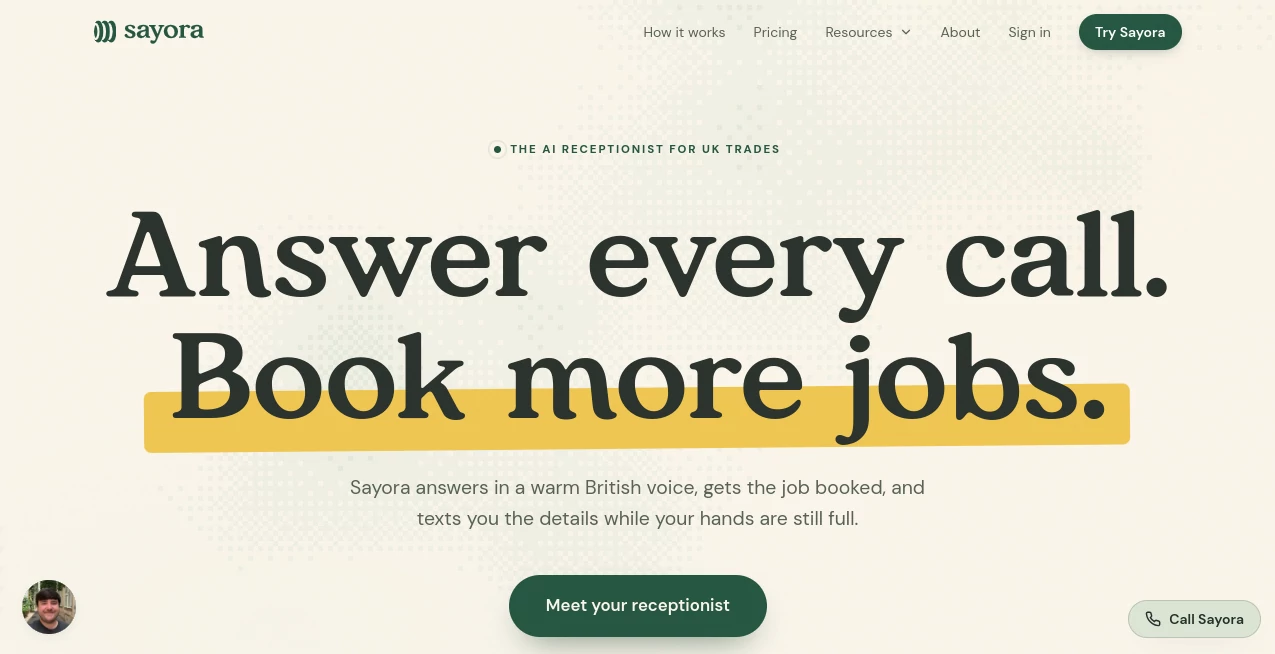
Missing a phone call can mean missing a customer, especially when you're working on a job and simply cannot reach your phone. Sayora is built around a straightforward idea: give UK small businesses a reliable AI receptionist that can answer calls when the owner is busy, capture useful information, and help turn enquiries into booked work.
Designed specifically with UK businesses in mind, the service uses a warm British voice and can be trained using information from a company's website. Instead of sending callers to voicemail, it can handle common questions, identify urgent enquiries, screen unwanted sales calls, and pass important details back to the business by text.
The approach feels particularly practical for tradespeople. A plumber working under a sink, an electrician on-site, or a roofer working at height may not be able to answer every call. Having an assistant available around the clock gives those businesses a better chance of responding to genuine enquiries without interrupting the work already in progress.
Key Features
- 24/7 AI phone answering for UK small businesses.
- A dedicated UK landline with a local area code.
- Training based on the business website, services, pricing, and knowledge base.
- Lead summaries sent instantly by SMS after calls.
- Appointment booking using real calendar availability.
- Customer confirmation texts sent in the business's name.
- Screening for unwanted cold sales calls.
- Returning-caller recognition and memory.
- Call recordings and transcripts available through the app.
- Urgent calls can be highlighted so important enquiries are easier to spot.
User Interface
The companion inbox is designed around the information a busy business owner actually needs. Calls can be reviewed with their summaries, recordings, and transcripts, while leads can be prioritised according to their importance. A business owner can quickly see who called, what they wanted, and whether a follow-up is required.
The interface is particularly useful for people who spend most of their day away from a desk. Instead of listening to a collection of voicemail messages later in the evening, they can check organised call information from one place and call customers back when convenient.
Accuracy & Performance
Performance is one of the most important considerations for any automated phone receptionist. The service is designed to work from information supplied by the business rather than simply guessing what a company offers. Its training process uses the business website and knowledge provided by the owner, helping conversations stay relevant to actual services and customer questions.
Another useful safeguard is its approach to uncertainty. When it does not know the answer to a question, it is designed to say so, collect the caller's contact details, and notify the business rather than inventing an answer. That is a sensible approach for customer-facing phone conversations where an incorrect promise can create more problems than a simple callback.
Capabilities
The system goes beyond simply answering and recording telephone messages. It can collect lead information, identify urgent enquiries, answer frequently asked questions, schedule appointments, and send SMS summaries after conversations.
Calendar integration also makes it possible to discuss genuine availability during a call and place an appointment into the connected calendar. Google Calendar and Cal.com are currently supported, with additional calendar options planned.
For businesses that receive a mixture of customer enquiries and unsolicited sales calls, call screening can be another useful time saver. The receptionist can politely decline unwanted sales conversations while keeping genuine customer enquiries moving.
Security & Privacy
Privacy is an important consideration when an AI system handles customer conversations. The service states that caller information is handled under UK GDPR and that personal data is not sold. Call audio is deleted within 90 days according to the published information.
For calendar integration, the service also states that Google calendar data is not transferred to AI or machine-learning models for training the underlying model. Calendar access can be disconnected through the account settings, and the company provides information about how connected data is handled.
Use Cases
The service is especially well suited to UK trades and other small businesses where phone calls often arrive while the owner is busy.
- Plumbers: Capture emergency plumbing enquiries, boiler problems, and repair requests while the plumber is working.
- Electricians: Handle enquiries about electrical work, inspections, repairs, and charger installations without interrupting an active job.
- Roofers: Take calls about storm damage, leaks, repairs, and quotation requests while work continues on-site.
- Heating engineers: Capture breakdowns, service requests, and appointment enquiries throughout the day.
- Landscapers: Handle enquiries about garden projects, patios, decking, and schedule changes.
- Builders: Collect information about extensions, renovations, quotations, and current projects.
- Small service businesses: Provide an always-available first point of contact without hiring a full-time receptionist.
Pros and Cons
- Pros: 24/7 availability, UK-focused phone experience, British voice options, unlimited minutes on the current plan, appointment booking, SMS lead summaries, call transcripts, recordings, spam screening, and business-specific training.
- Pros: Existing business numbers can remain in place through call forwarding, so customers do not necessarily need to learn a new number.
- Pros: The system openly identifies itself as AI at the beginning of calls rather than attempting to disguise its identity.
- Cons: The current service is primarily designed for UK businesses and UK phone lines, so companies operating elsewhere may not find it as suitable.
- Cons: Some callers may prefer speaking with a human receptionist, particularly for complicated or sensitive enquiries.
- Cons: Calendar integrations are still developing, so businesses using less common calendar platforms may need to wait for additional support.
Pricing Plans
The current early-access offer uses a single plan priced at £49 per month. It includes unlimited minutes, a dedicated UK number, 24/7 call answering, business-specific training, SMS lead summaries, appointment booking, call recordings and transcripts, returning-caller recognition, and sales-call screening.
There is no setup fee and no long-term contract. A seven-day trial begins when the receptionist is claimed, while the initial build and test experience can be started without a card. The subscription can be cancelled at any time.
How to Use It
Start by providing the business name and website so the receptionist can be created around the company's information. You can then test the experience by making a real call and seeing how it handles typical customer questions.
Once the receptionist is ready, the business can choose when incoming calls should be forwarded to it. The existing business number can remain with the current carrier, while calls are redirected when the owner cannot answer.
After activation, calls are handled automatically. Lead information, summaries, transcripts, and recordings can then be reviewed through the inbox, while supported calendar connections can be used to schedule appointments during conversations.
Comparison with Similar Tools
Traditional voicemail is inexpensive, but it leaves the responsibility of following up entirely with the business owner. That can be a problem when a caller is looking for a quick response and simply moves on to another company.
A human answering service provides a more traditional experience, but costs can increase considerably depending on call volume and the service package. It may also be less flexible for a small business that needs coverage outside normal working hours.
An AI receptionist sits between these approaches. It can remain available day and night, handle repetitive questions, collect structured information, and perform certain actions such as appointment booking without charging per minute under the current plan. For a small UK business where missed calls translate directly into lost enquiries, that combination can be particularly appealing.
Conclusion
For a small business, the phone is often one of the most valuable channels for winning new work. The problem is that the person doing the work is frequently the same person expected to answer it. This service addresses that gap with a practical receptionist built around phone conversations, lead capture, scheduling, and follow-up.
The strongest part of the offering is its focus. Rather than trying to become a general-purpose business platform, it concentrates on a common problem faced by tradespeople and other UK small businesses: what happens when an important customer calls at exactly the wrong moment.
With 24/7 answering, business-specific training, calendar booking, SMS summaries, call records, and a simple flat-rate early-access price, it is an appealing option for businesses that want fewer missed opportunities without committing to a traditional full-time receptionist.
Frequently Asked Questions (FAQ)
Can it answer calls 24/7?
Yes. The service is designed to answer incoming calls day and night, including calls that arrive outside normal business hours.
Can I keep my existing business number?
Yes. Businesses can keep their existing number with their current carrier and use call forwarding when they want calls handled by the AI receptionist.
Can it book appointments?
Yes. When a supported calendar is connected, it can check real availability during a call and book an available appointment. Google Calendar and Cal.com are currently supported.
Does it tell callers that they are speaking with AI?
Yes. The receptionist identifies itself as AI at the beginning of every call. This provides transparency rather than attempting to make the caller believe they are speaking with a human.
What happens if it does not know the answer?
It is designed to avoid making up information. Instead, it can acknowledge that it cannot answer the question, collect the caller's details, and notify the business so someone can follow up.
Is there a free trial?
Yes. The current offer provides a seven-day trial after the receptionist is claimed. The service can initially be built and tested without entering card details.
How much does it cost?
The current early-access price is £49 per month, with unlimited minutes and the available features included in one plan. There is no setup fee or long-term contract.
Is it suitable for businesses outside the UK?
The service is specifically built around UK small businesses, UK phone lines, local UK numbers, UK pricing, and UK regulatory requirements. Businesses outside the UK should check whether the current setup matches their needs.
Business , AI Scheduling , AI Customer Service Assistant , AI Voice Assistants .
These classifications represent its core capabilities and areas of application. For related tools, explore the linked categories above.

Sayora Alternatives Product

MeetAssist

Supawazap

Read

Free Voice C…

Krisp

SocialRails

Rierino

Zinng

Peanut AI