


















ScrapeOps
What is ScrapeOps?
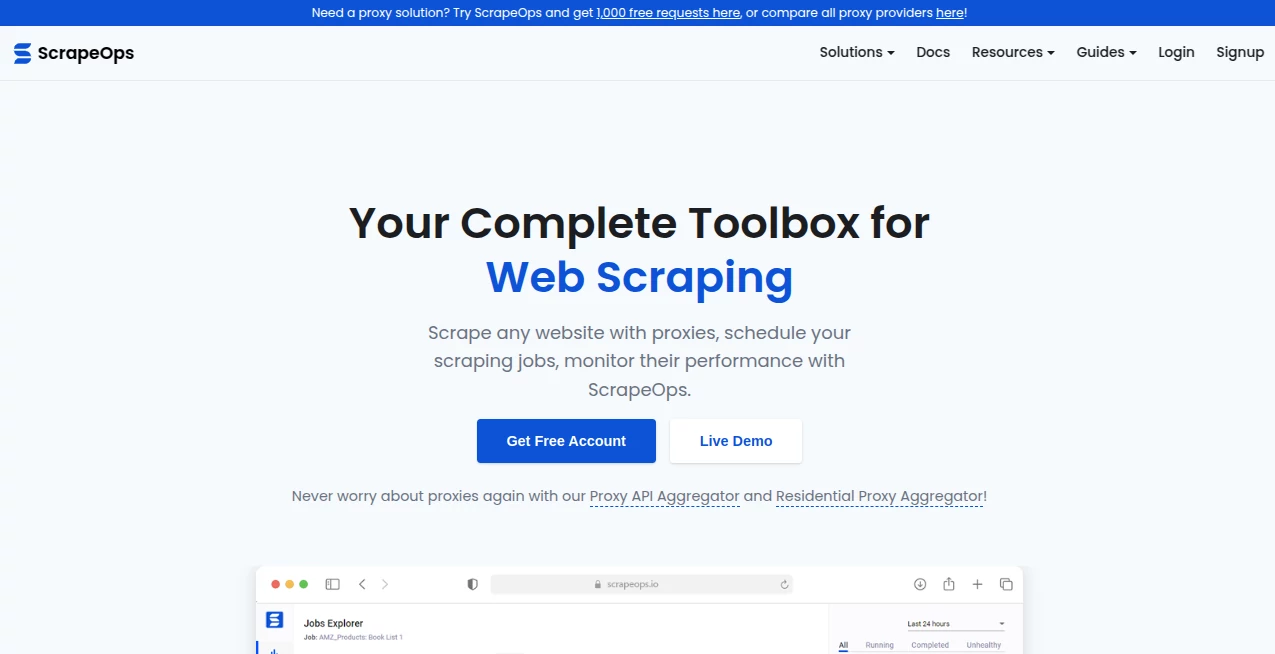
Building and maintaining a stable web scraping system is often far more complex than it appears at first glance. Websites change, proxies fail, requests get blocked, and suddenly a simple data pipeline turns into a constant maintenance challenge. This platform was designed to remove that friction by offering a clean, developer-friendly infrastructure layer that makes scraping more stable, scalable, and production-ready.
Instead of spending time fixing broken scrapers or managing unreliable proxy setups, developers can focus on what actually matters: collecting and using data. The system acts like a backbone for scraping operations, ensuring requests are handled efficiently and with minimal interruption.
Key Features
User Interface
The dashboard is minimal and practical. It avoids unnecessary complexity and instead focuses on clarity. Users can quickly monitor requests, track usage, and configure scraping workflows without digging through confusing menus.
Accuracy & Performance
One of the strongest aspects is request reliability. The system is designed to reduce failures caused by blocks, timeouts, or inconsistent responses. It helps ensure that data collection pipelines remain stable even under heavy load or when targeting difficult websites.
Capabilities
- Scalable request handling for large scraping workloads
- Proxy and request optimization for better success rates
- Monitoring tools for tracking scraping performance
- Integration-friendly architecture for developers
- Support for production-level data pipelines
Security & Privacy
Security is treated as a core requirement rather than an afterthought. Requests are handled through structured systems that reduce exposure risks, and sensitive operations are isolated to maintain safe data handling practices. This makes it suitable for both small projects and enterprise-level workflows.
Use Cases
- Market research and competitor analysis
- Price monitoring across e-commerce platforms
- Data aggregation for AI and machine learning models
- Lead generation and business intelligence
- Content and trend tracking from public web sources
Pros and Cons
Pros
- Reduces infrastructure complexity for scraping projects
- Improves request success rates significantly
- Developer-friendly integration
- Suitable for both small and large-scale use
Cons
- Requires technical understanding for best results
- Advanced configurations may take time to master
Pricing Plans
The service typically follows a usage-based or tiered pricing model, allowing users to start small and scale as their scraping needs grow. Entry-level plans are usually sufficient for testing and small projects, while higher tiers are designed for production workloads with higher request volumes and reliability requirements.
How to Use ScrapeOps
Getting started is straightforward. After creating an account, users can configure their scraping environment, connect their existing scripts or tools, and begin routing requests through the system. From there, monitoring dashboards provide visibility into success rates, failures, and overall performance. Adjustments can be made easily to improve efficiency as data needs evolve.
Comparison with Similar Tools
Compared to traditional proxy providers or raw scraping setups, this platform offers a more structured and managed experience. Instead of manually handling retries, blocks, and infrastructure issues, users get a unified layer that simplifies operations. While some alternatives focus only on proxies or scraping APIs, this solution leans toward full operational reliability and observability.
Conclusion
For developers and teams working with web data at scale, having a dependable scraping infrastructure can make a major difference in both speed and stability. This platform removes much of the operational burden and allows users to focus on extracting value from data rather than maintaining fragile systems. It is especially useful for projects that require consistent, large-scale data collection without constant interruptions.
Frequently Asked Questions (FAQ)
Is it suitable for beginners?
It is more developer-oriented, but once basic setup is complete, it becomes easy to manage.
Can it handle large-scale scraping?
Yes, it is designed to support scalable workloads and production-level traffic.
Does it require proxy management?
Proxy handling is abstracted to reduce manual configuration and maintenance.
What kind of projects is it best for?
It works best for data-heavy projects such as market research, AI training datasets, and competitive analysis.
AI Data Mining , AI Developer Tools , AI Web Scraping , Code & IT .
These classifications represent its core capabilities and areas of application. For related tools, explore the linked categories above.

ScrapeOps Alternatives Product

Velokey

AgentOne

AyeWatch AI

Gemini Omni
MyToolster W…

AIQualityHQ

GOLANG COLLE…

Project Mela

UpMocker