

















Velokey
Verified Blue CheckMark
Verified Blue CheckMark products are featured above free or unverified listings.
This badge indicates authenticity and builds trust, giving your product higher visibility across the platform.
Upgrade to get verified
Verified Blue CheckMark products are featured above free or unverified listings. This badge indicates authenticity and builds trust, giving your product higher visibility across the platform.
Upgrade to get verified
What is Velokey?
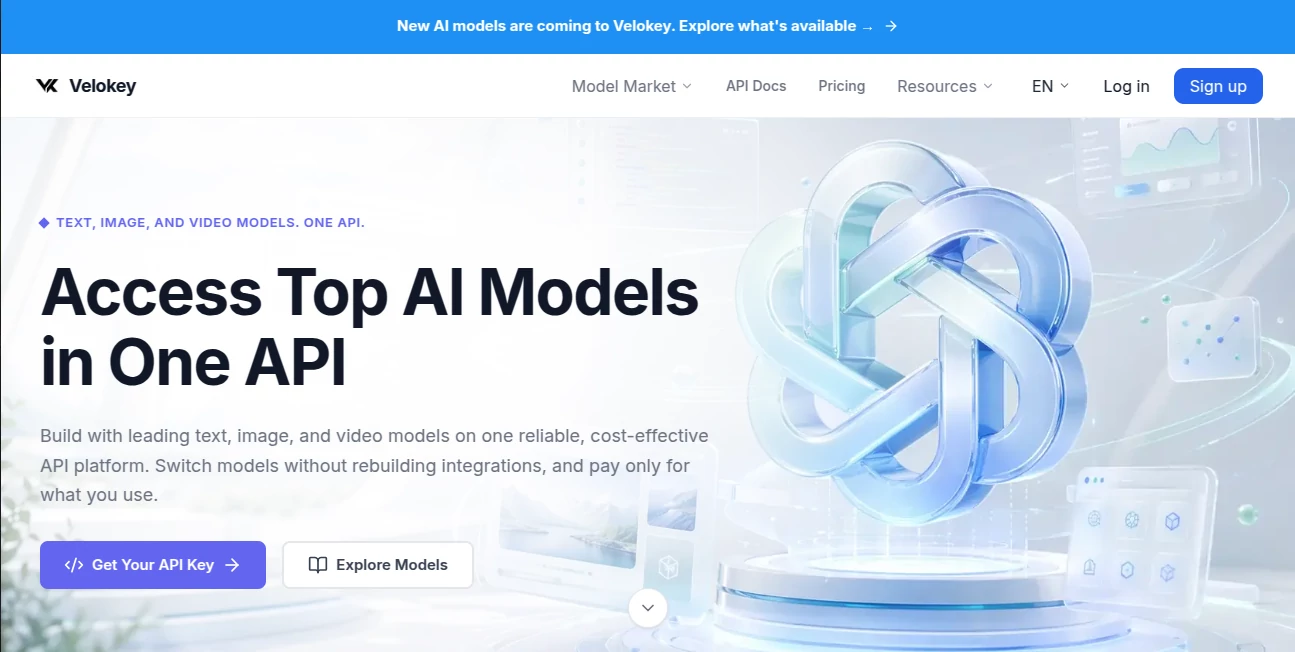
Velokey is a unified AI API platform built for developers and businesses that want to integrate multiple leading artificial intelligence models without maintaining separate providers or rebuilding existing applications. Instead of managing different APIs for language, image, and video generation, the platform offers a single endpoint that simplifies development while giving users the flexibility to choose the most suitable model for every task.
Modern AI development changes rapidly. New models appear almost every month, and switching providers often requires additional engineering work. This platform removes that complexity by supporting an OpenAI-compatible API, allowing existing applications to migrate with minimal changes. Developers can experiment with different models, compare quality and pricing, and deploy production-ready applications from one centralized dashboard.
Whether building AI assistants, content generation tools, coding applications, image creators, or multimedia workflows, users gain access to a large ecosystem of models while maintaining a consistent development experience. This approach helps reduce maintenance costs and allows engineering teams to focus on product innovation instead of infrastructure management.
Key Features
User Interface
The dashboard is clean, developer-friendly, and designed for fast navigation. API keys, model selection, request history, usage statistics, billing information, and performance metrics are available from one place. Developers can monitor requests, identify errors, review latency, and manage projects without switching between multiple services.
Accuracy & Performance
The platform supports intelligent model routing and automatic failover, helping applications remain reliable even when one provider experiences temporary issues. Developers can compare models based on response quality, speed, context size, pricing, and capabilities before deciding which one fits a particular workload. This flexibility improves performance while keeping operational costs under control.
Capabilities
The service supports access to a wide collection of AI technologies, including large language models, image generation models, video generation models, reasoning models, and multimodal AI systems. Existing applications using OpenAI-compatible SDKs can migrate by updating only a few configuration settings instead of rewriting their integrations. Teams can freely test different providers while using a consistent API structure across projects.
Usage analytics, request monitoring, token tracking, spending reports, and centralized billing make it suitable for startups, independent developers, SaaS companies, enterprise software teams, and AI product builders who require scalability without unnecessary complexity.
Security & Privacy
The platform provides centralized API management with secure authentication, organized project controls, and detailed request monitoring. Teams can review usage history, manage API credentials, and monitor spending through one interface. Centralizing multiple AI providers under a single management layer also simplifies operational oversight and improves visibility across AI workloads.
Use Cases
Developers can build conversational AI assistants, document analysis systems, coding assistants, AI-powered customer support, marketing content generators, image creation tools, video generation applications, research platforms, workflow automation software, educational products, and enterprise AI solutions. It is equally valuable for companies comparing model performance before deploying production systems or businesses looking to reduce vendor lock-in.
Pros and Cons
Pros
Single API for multiple AI providers.
Supports text, image, and video generation models.
OpenAI-compatible integration minimizes migration effort.
Smart routing improves reliability.
Automatic failover reduces downtime.
Centralized usage analytics and billing.
Simple developer experience for experimenting with different AI models.
Cons
Advanced capabilities depend on the selected underlying AI model.
Pricing varies according to model usage.
Some premium models may have higher operational costs.
Pricing Plans
The platform follows a pay-as-you-go pricing model, allowing users to pay only for the resources they consume. A free trial is available for new users, making it easy to evaluate different AI models before committing to production workloads.
How to Use Velokey
Create an account and generate an API key from the dashboard.
Update your application to use the provided API endpoint.
Select the desired AI model for your task.
Send requests using an OpenAI-compatible SDK or standard HTTP calls.
Monitor request history, token usage, costs, and performance from the dashboard.
Experiment with different models and optimize applications based on speed, quality, or pricing.
Comparison with Similar Tools
Unlike platforms that provide access to only one AI provider, this solution allows developers to work with multiple leading AI models through a unified API. Compared with building direct integrations for every provider, it significantly reduces engineering effort and makes switching models far easier. The addition of smart routing, centralized monitoring, and usage analytics also gives development teams greater operational flexibility than maintaining separate vendor integrations.
Conclusion
For developers who want flexibility without sacrificing simplicity, this platform delivers an excellent balance between convenience and capability. The unified API, broad model selection, intelligent routing, and centralized management make it an attractive choice for startups, SaaS companies, and enterprise engineering teams. Instead of committing to a single AI ecosystem, organizations can continuously evaluate the latest models while keeping their applications stable, scalable, and easier to maintain.
Frequently Asked Questions (FAQ)
What types of AI models are supported?
The platform provides access to language, image, video, reasoning, and multimodal AI models from multiple providers.
Can existing OpenAI applications migrate easily?
Yes. Applications using OpenAI-compatible SDKs typically require only minimal configuration changes.
Is it suitable for production applications?
Yes. Features such as smart routing, failover, monitoring, and usage analytics are designed for production environments.
Does it include analytics?
Yes. Developers can review request history, token consumption, latency, errors, and spending from a centralized dashboard.
Who should use this platform?
It is ideal for developers, AI startups, SaaS companies, enterprise engineering teams, and businesses building applications powered by multiple AI models.