
Scrivy
What is Scrivy?
Self-published authors hear the same myth over and over: write a great book and readers will find it. In practice, Amazon's algorithm doesn't work that way. It promotes books that already show momentum — the right keywords, the right categories, a listing that converts browsers into buyers. Without those pieces in place, even a genuinely good book can sit invisible on page nine of search results for months. This platform was built specifically for that gap, giving independent authors the same kind of keyword tracking, sales analytics, and listing optimization that traditional publishers have had access to for years, minus the agency fees and guesswork.
Key Features
User Interface
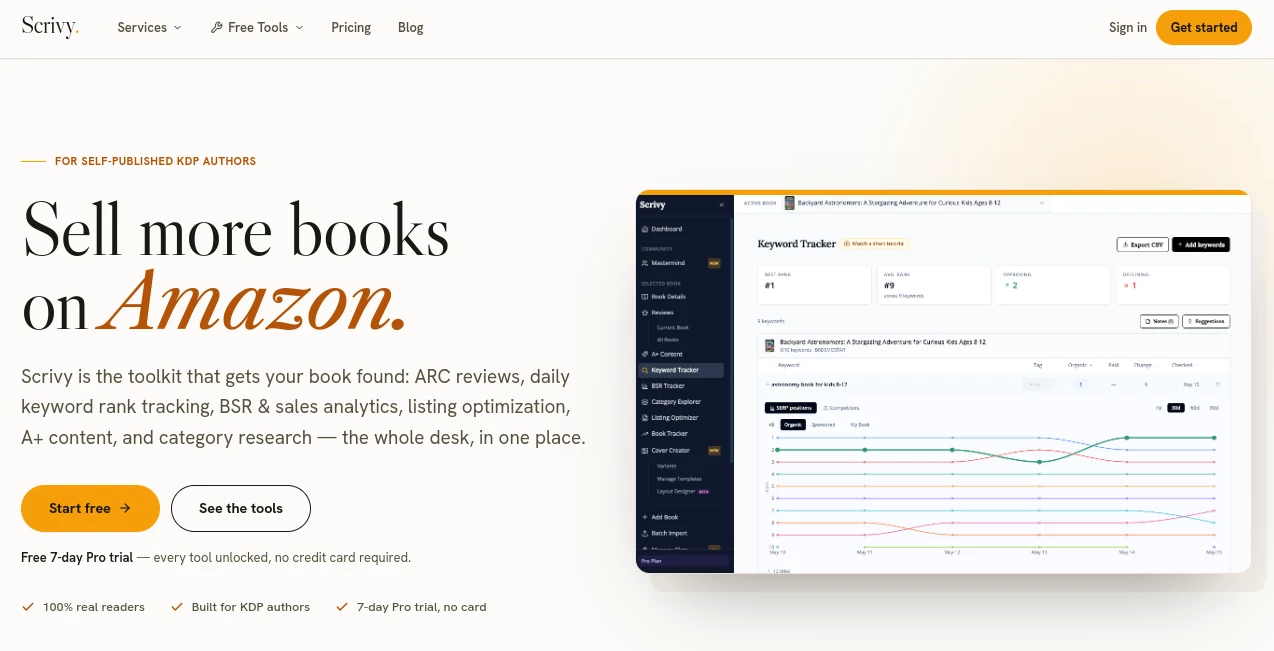
The dashboard is organized the way an author actually thinks about their catalog — book by book, with each title showing its category fit, keyword rankings, and listing health at a glance. Charts track ranking trends over the last 30 days, and a before/after timeline shows the direct impact of changes like a price drop or a new cover. Nothing about it feels like it was designed for marketing agencies; it reads like a tool built by people who've actually published on KDP and gotten frustrated with spreadsheets.
Accuracy & Performance
Keyword rank tracking updates daily, pulling real Amazon search engine results page data so authors can see exactly where they sit against competitors for terms like "historical fiction kids" or "chapter books boys," not just where they hoped to land. The category engine scores a book against more than 5,200 Amazon categories, ranking each by realistic relevance instead of just listing every category that technically applies — since KDP only gives authors 10 slots, and most waste eight of them on categories with too much competition or too little relevance.
Capabilities
Beyond tracking, the listing optimizer compares a book's product description against the top 10 ranking competitors for the same keywords, flags relevancy gaps, and suggests specific rewrites rather than vague advice to "improve your copy." There's also an A+ Content generator that builds the "From the Publisher" section many indie authors skip entirely because it's tedious to design — upload the book, pick a layout, and the tool handles copy and imagery, a feature shown to lift conversion by roughly 8% when present on a listing. A Book Tracker rounds things out by importing KDP sales reports and logging events like cover swaps or keyword changes, so an author can actually measure which tweak moved daily orders and KENP reads instead of guessing after the fact.
Security & Privacy
Books are added either by ASIN import directly from Amazon or entered manually, and KDP sales reports are uploaded by the author rather than pulled through any backdoor access to Amazon accounts. That keeps the data flow straightforward: what goes in is what the author chooses to upload, and nothing more.
Use Cases
- A debut author who published months ago and has no idea why sales never took off
- A romance or mystery writer trying to pick the right 10 KDP categories instead of guessing
- An indie author who wants to know if their book description is actually competitive against top sellers in their niche
- A children's book author tracking keyword rankings across age-targeted search terms
- A multi-title author trying to figure out which cover redesign or price change actually moved the needle on orders
Pros and Cons
Pros:
- Daily keyword rank tracking with real competitor SERP data, not estimates
- Category scoring across 5,200+ Amazon categories tailored to the specific book
- A+ Content generation handles a section most indie authors never get around to building themselves
- Before/after impact tracking makes it possible to measure what a cover change or price drop actually did to sales
- A genuinely free 7-day Pro trial with every tool unlocked and no credit card required
Cons:
- The free Base plan limits authors to one book, which may feel restrictive for anyone with a growing catalog
- Authors with more than 25 titles will outgrow even the top-tier plan
- Like any optimization tool, the insights are only as useful as the action an author takes on them — it surfaces the problem but the rewrite still needs a final human pass
Pricing Plans
Every plan includes a 7-day Pro trial with everything unlocked before any payment is required.
- Base — Free: add one book and use the core optimization tools forever, including the Category Finder, Listing Optimizer, and the free web-based A+ Content Generator.
- Pro — $29/month: the full toolkit for up to 5 books, including daily keyword rank tracking, AI listing suggestions, the A+ Content generator, an AI Cover Creator, discovery across 5,000+ categories, and competitor analysis.
- Ultra — $79/month: everything in Pro, scaled to support up to 25 books, plus priority support for authors managing a larger catalog.
How to Use Scrivy
- Add a book by importing its ASIN from Amazon or entering the details manually
- Run the Category Finder to see which of 5,200+ categories actually fit the book, instead of the ones that just sound right
- Check daily keyword rankings and see where competitors are outranking the listing
- Run the Listing Optimizer to compare the description against top-ranking competitors and apply suggested rewrites
- Build A+ Content with a chosen layout and AI-generated copy and imagery
- Log changes like a price drop or new cover in Book Tracker and watch the before/after impact on orders
Comparison with Similar Tools
Generic keyword research tools built for general Amazon sellers tend to miss the specifics of book publishing entirely — they don't understand KDP's 10-category limit, KENP reads, or how A+ Content interacts with a Kindle listing versus a physical product. A spreadsheet-based DIY approach can technically track the same numbers, but it won't surface competitor SERP data automatically or generate rewrite suggestions on the fly. What sets this apart is that every feature, from category scoring to the A+ generator, is built around the specific mechanics of self-publishing on Amazon rather than retrofitted from a general ecommerce toolkit.
Conclusion
Publishing a book is the visible part of the work; getting it discovered is the part nobody warns authors about. This toolkit doesn't promise to write a bestseller, but it removes the guesswork from the pieces that actually determine whether Amazon's algorithm notices a title at all — categories, keywords, listing copy, and measurable iteration. For an author staring at flat sales numbers wondering what went wrong, this is the kind of diagnostic and optimization layer that turns "I have no idea why this isn't selling" into a concrete list of fixable problems.
Frequently Asked Questions (FAQ)
Is there a free plan?
Yes, the Base plan is free forever and includes one book with access to the Category Finder, Listing Optimizer, and a free A+ Content Generator.
Do I need a credit card to try the paid features?
No. Every plan includes a 7-day Pro trial with all tools unlocked and no card required.
How often are keyword rankings updated?
Keyword rank tracking updates daily and includes competitor SERP data for comparison.
How many books can I manage?
The Base plan supports 1 book, Pro supports up to 5, and Ultra supports up to 25.
What does A+ Content actually do for my listing?
It builds the "From the Publisher" section of an Amazon listing, which has been shown to lift conversion by up to 8% when present.
AI SEO Assistant , AI Content Generator , AI Analytics Assistant , AI E-commerce Assistant .
These classifications represent its core capabilities and areas of application. For related tools, explore the linked categories above.

Scrivy Alternatives Product

StyleBias

InspiroBot

Jasper

Analyse

AyeWatch AI

Sleepless Tr…
GPT Image 2 …

Marketbetter…

ScriptHook