SerpStep
What is SerpStep?
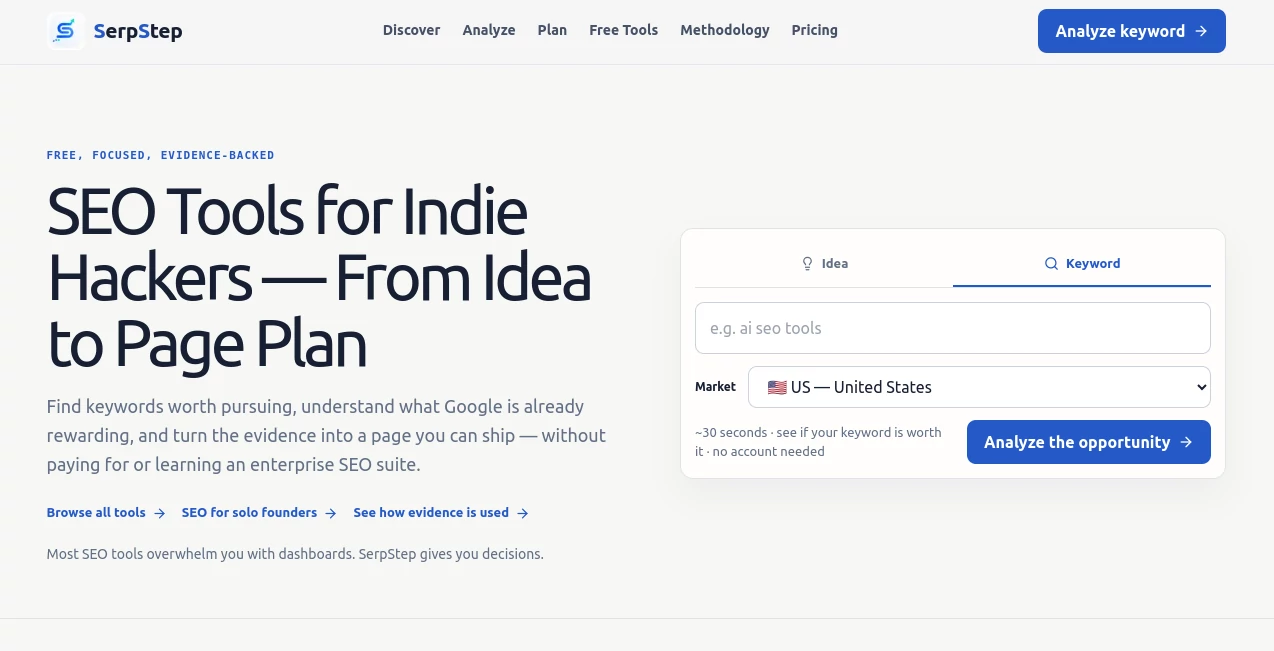
SerpStep is an SEO research platform built with a clear audience in mind: indie hackers, solo founders, and small teams that want to make better search decisions without committing to a heavyweight enterprise SEO suite. Its focus is practical rather than overwhelming, bringing together keyword evaluation, search result analysis, and content planning in one place.
For a founder working on a new product, one of the hardest parts of SEO is often deciding what to target before spending hours creating content. A keyword may look attractive at first glance, yet the search results can tell a very different story. By helping users evaluate keyword difficulty and understand SERP patterns, the platform provides a useful starting point for making those decisions.
The content brief functionality adds another helpful step. Instead of treating keyword research as the final destination, the workflow can move from an initial idea toward a clearer page plan. That makes the service particularly interesting for people who handle their own SEO and content rather than relying on a large marketing department.
Key Features
- Keyword difficulty evaluation for assessing potential search opportunities.
- SERP pattern analysis to understand what currently appears for a search query.
- Content brief generation to turn research into a practical page plan.
- A workflow designed around indie hackers and solo founders.
- Free SEO tools that can be useful for early-stage projects and smaller websites.
- A focused approach that avoids the complexity commonly associated with large enterprise SEO platforms.
User Interface
The product is designed around a straightforward research workflow rather than an enormous collection of dashboards. That distinction matters for independent founders. When you are researching a keyword for a landing page or planning the next article for a small SaaS website, you usually want answers quickly, not another analytics system that takes days to learn.
The overall concept moves naturally from an idea to search research and then toward a page plan. That makes the experience easier to understand, particularly for users who know their product well but are not full-time SEO specialists.
Accuracy & Performance
SEO research is only useful when it helps people make better decisions. Keyword difficulty can provide an initial indication of how challenging a search opportunity may be, while SERP analysis adds valuable context by showing the type of pages competing for attention.
The combination is more useful than looking at a single metric in isolation. A keyword with appealing potential may still be a poor target if the existing results are dominated by highly authoritative pages or a search intent that does not match your website. Reviewing the SERP pattern before creating content can help reduce that kind of wasted effort.
Capabilities
The strongest part of the platform is its progression from research to execution. Keyword analysis helps answer the question of what might be worth targeting. SERP analysis helps explain what Google is rewarding for that query. Content briefs then provide a bridge between research and production.
For an indie founder launching a new feature, for example, the workflow can help turn a vague topic idea into a more considered content opportunity. Instead of immediately asking an AI writer to produce an article, the founder can first investigate the search landscape and establish what the eventual page should accomplish.
This approach also fits small content teams that need a repeatable process. The emphasis is not simply on producing more pages; it is on giving each page a clearer reason to exist.
Security & Privacy
Because SEO research can involve website and keyword information, privacy is naturally worth considering when choosing any online research service. Users should review the platform's current privacy policy and terms before entering confidential business information or sensitive project data.
For routine keyword research and content planning, the most sensible approach is to provide only the information necessary for the task and avoid entering proprietary material that is unrelated to SEO research.
Use Cases
One of the most obvious uses is planning SEO content for a new SaaS product. A founder can start with a product-related topic, investigate the difficulty of relevant keywords, examine the existing search results, and then use the research to shape a content brief.
It can also be useful for independent bloggers who want to stop choosing topics based purely on intuition. Search visibility is competitive, and a little research before writing can make the difference between publishing another generic article and creating a page aimed at a specific opportunity.
Small marketing teams may find the workflow useful as well. When resources are limited, knowing which topics deserve attention becomes especially important. The platform's focus on practical SEO research makes it suitable for this kind of prioritization.
Another interesting use case is launching pages around newly developed features. Rather than waiting until the product is finished and then thinking about search traffic, founders can research relevant search demand while planning the content and positioning.
Pros and Cons
Pros
- Focused specifically on SEO research and content planning.
- Useful for indie hackers and solo founders who do not need an enterprise SEO suite.
- Combines keyword difficulty and SERP research with content briefs.
- Helps connect SEO research with the actual page-creation process.
- Free tools make it approachable for users exploring SEO opportunities.
Cons
- Users looking for a large all-in-one enterprise SEO platform may need additional tools.
- SEO metrics should be treated as decision-support data rather than guarantees of ranking.
- More advanced SEO teams may still require specialized tools for broader technical and competitive analysis.
Pricing Plans
The service presents itself around free SEO tools, making it accessible to people who are still validating an idea, launching a side project, or building an early-stage website. This is particularly appealing for indie hackers because SEO research does not always justify a large monthly software budget during the first stages of a project.
Before committing to any paid functionality, users should check the current pricing and feature availability directly on the service, as plans and limits can change over time.
How to Use SerpStep
Start with a keyword or topic connected to the page you want to create. Rather than immediately producing content, use the available research tools to understand whether the opportunity is realistic.
- Choose a topic or keyword relevant to your product or audience.
- Evaluate the keyword difficulty to get an initial sense of competition.
- Review the SERP patterns and examine the types of pages competing for the query.
- Consider whether the search intent matches the page you want to build.
- Use the content brief workflow to turn the research into a clearer page plan.
- Create and optimize the final page based on the research rather than relying on keyword volume alone.
This workflow is especially useful when you are working with limited resources. A few minutes of research can prevent hours of writing around a topic that was never a strong fit.
Comparison with Similar Tools
Large SEO platforms often cover an enormous range of functions, including backlink databases, rank tracking, site audits, competitor research, keyword research, and reporting. That breadth is valuable for agencies and established SEO departments, but it can also make the experience unnecessarily complicated for a solo founder.
This platform takes a narrower route. Its positioning around keyword difficulty, SERP patterns, and content briefs makes it more appealing to someone who primarily needs help deciding what to build and write next.
In practical terms, the difference is less about replacing every SEO platform and more about choosing a focused research workflow. Someone running a small SaaS project may prefer a compact tool for everyday research, while an agency managing dozens of clients may need the much broader datasets and reporting systems offered by larger platforms.
Conclusion
Good SEO starts before the first paragraph is written. The choice of keyword, the competition in the search results, and the intent behind the query all influence whether a page has a sensible opportunity to attract organic traffic.
This platform takes that early-stage problem and turns it into a focused workflow. Its combination of keyword difficulty research, SERP analysis, and content briefs is particularly well suited to indie hackers and solo founders who want a practical way to move from an idea toward a structured page plan.
It will not eliminate the need for good content, strong websites, or thoughtful SEO strategy. What it can do is make the research stage more deliberate. For a small team where every article and landing page needs to earn its place, that can be a worthwhile advantage.
Frequently Asked Questions (FAQ)
What is this tool designed for?
It is designed for SEO research, particularly keyword difficulty evaluation, SERP analysis, and creating content briefs for indie hackers and solo founders.
Can beginners use it?
Yes. Its focused workflow makes it suitable for people who understand their product or business but may not have extensive experience with professional SEO platforms.
Does it help with keyword research?
Yes. Keyword difficulty evaluation is one of its core functions and can help users assess potential search opportunities before creating a page.
What are SERP patterns?
SERP patterns describe the types and characteristics of pages appearing in search results for a particular query. Studying them can help users understand search intent and the competitive environment.
Can it create content briefs?
Yes. Content briefs are part of the workflow, helping turn SEO research into a more structured plan for a page.
Is it an alternative to large SEO suites?
It can serve as a focused alternative for users who mainly need keyword and SERP research plus content planning. Larger teams may still prefer broader SEO platforms with extensive technical, backlink, rank-tracking, and reporting features.
Is it free?
The platform is positioned around free SEO tools. Users should check the current service for the latest limits, available features, and any paid plans.
AI SEO Assistant , AI Marketing Plan Generator .
These classifications represent its core capabilities and areas of application. For related tools, explore the linked categories above.

SerpStep Alternatives Product

Nodu AI

Orchestra

LeadAny

SEOBlogger AI

Cataseo AI

RankPeak

Grow Creator

Roipad

Prelight