Snoopreport
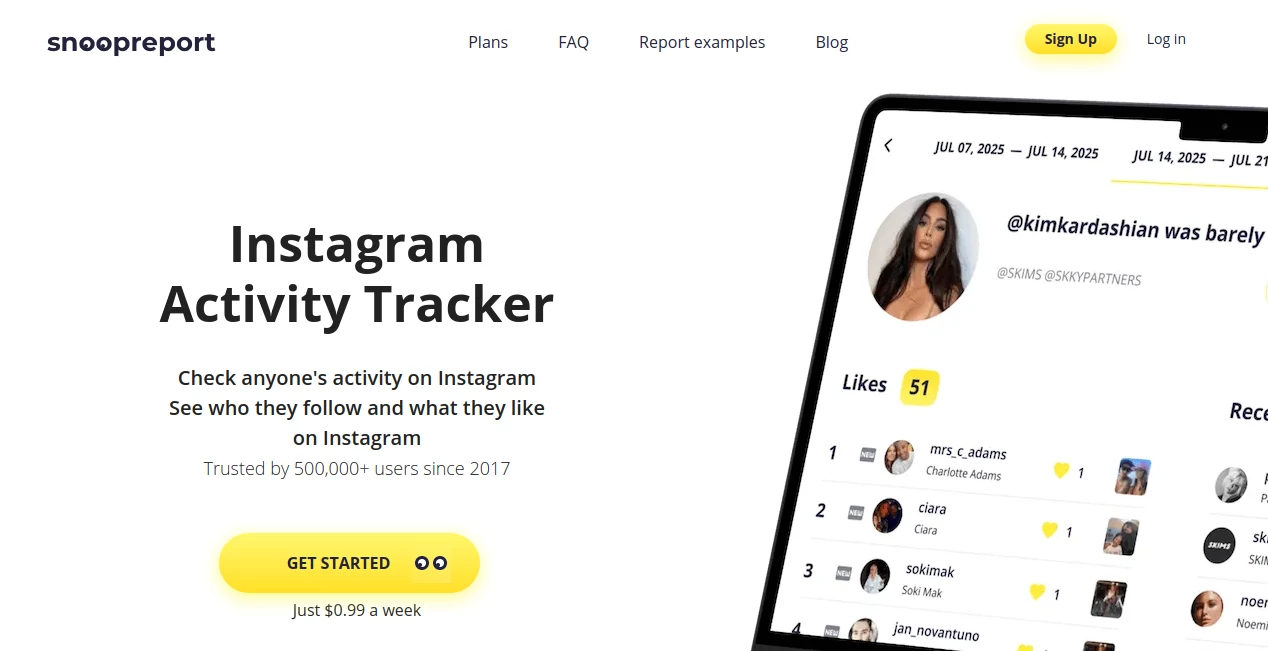
What is Snoopreport?
Understanding how people interact with content on Instagram can be surprisingly difficult. The platform no longer provides the kind of activity feed that once made it easy to see likes and new follows, leaving individuals, marketers, creators, and researchers with very little visibility into public activity patterns.
Snoopreport takes a different approach by collecting publicly available Instagram activity and organizing it into readable reports. Instead of manually checking profiles, keeping spreadsheets, or trying to remember changes over time, users can select public Instagram accounts and receive structured information about likes, follows, unfollows, hashtags, activity periods, and interests.
The service has been operating since 2017 and says it has been trusted by more than 500,000 users. It also does not require an app installation or the user's Instagram password, which makes the setup considerably simpler than many monitoring solutions.
What makes the platform particularly interesting is its AI-powered analysis. Beyond showing raw activity data, it can turn recent likes and follows into broader insights about interests, habits, personality characteristics, conversation ideas, and other profile-related observations.
Key Features
- Track likes on public Instagram profiles.
- Monitor new follows and unfollows.
- View liked photos and videos, including reels.
- Identify frequently liked hashtags.
- Review activity patterns and periods of higher activity.
- Receive weekly and monthly activity reports.
- Analyze interests based on observed public activity.
- Generate AI-powered summaries and profile insights.
- Access information through a centralized dashboard.
- Export detailed data in CSV format on supported plans.
- Track multiple accounts depending on the selected subscription.
- Use historical reporting options where available.
User Interface
The experience is built around a centralized dashboard rather than a complicated desktop application. After selecting the Instagram profiles to monitor, users can return to the dashboard to review the reports generated for those accounts.
This approach is useful for people who want information presented in one place. Rather than jumping between Instagram profiles and trying to record changes manually, activity is organized into reports that can be reviewed over a longer period.
The interface is especially practical for users who are interested in patterns rather than one isolated interaction. A weekly or monthly view can make changes in interests, follows, hashtags, and activity levels much easier to notice.
Accuracy & Performance
The service is designed around publicly available Instagram information rather than private account access. This is an important distinction because the platform cannot monitor private Instagram profiles or retrieve information that is not publicly available.
Reports are created from observed public activity and can include likes, follows, unfollows, liked media, hashtags, and activity periods. The resulting information is then organized into a format that is considerably easier to review than raw social media activity.
There is also a practical difference between continuous observation and instant results. Standard reporting may require time for activity to accumulate, while historical reporting options can help users obtain information from earlier periods. For people doing ongoing research or competitive monitoring, this reporting model is more useful than repeatedly checking an account by hand.
Capabilities
The strongest part of the platform is the combination of activity tracking and interpretation. Raw numbers can tell you how many accounts someone followed, but they do not necessarily explain what those actions might indicate.
Its AI summary feature attempts to bridge that gap by examining activity data and producing broader observations about interests, habits, and characteristics. Depending on the available data, these insights can include conversation starters, gift ideas, suggested places, and other contextual observations.
For businesses and social media professionals, the same information can be viewed from a different angle. Monitoring public activity around competitors, influencers, or relevant audiences can provide another source of research when planning content or understanding changing interests.
Security & Privacy
One of the notable aspects of the service is that it does not require users to connect their own Instagram account or provide an Instagram password. It operates using publicly available information and does not require an application to be installed on a phone.
There is also an important limitation worth remembering: public-data monitoring is not the same as access to a private Instagram account. Private profiles are outside the scope of the service, and users should always respect applicable privacy laws, platform rules, and the personal boundaries of others when interpreting social media information.
Use Cases
There are several practical ways to use this type of Instagram activity intelligence. A social media manager, for example, can monitor public activity around competitors and influencers to discover which topics, accounts, hashtags, or content styles appear repeatedly.
Creators can use the reports as a source of audience research. Instead of relying entirely on assumptions about what people are interested in, they can examine public engagement patterns and look for recurring themes.
Businesses can also use the information for competitive research. Following changes in public profiles can help reveal shifts in interests, new accounts followed by competitors, and content that attracts attention.
On the personal side, the platform can be useful for discovering gift ideas, conversation topics, or interests based on publicly visible activity. Researchers and data science students may also benefit from the service, as the company states that it provides datasets free of charge to eligible students and researchers.
Pros and Cons
- Pros: No app installation is required.
- Pros: No Instagram password or personal account connection is required.
- Pros: Reports combine likes, follows, hashtags, and activity patterns.
- Pros: AI-powered summaries add context to raw activity data.
- Pros: Weekly and monthly reporting makes long-term monitoring easier.
- Pros: Multiple account limits are available for different types of users.
- Cons: Only publicly available Instagram information can be monitored.
- Cons: Standard reports are not necessarily instant because activity needs to be collected over time.
- Cons: The usefulness of AI insights depends on the amount and quality of available public activity.
Pricing Plans
The current pricing structure offers standard reports as well as plans that include AI-powered interest analysis. The Personal plan starts at $4.99 per month and allows tracking of up to two accounts. The Small Business plan costs $14.99 per month for up to ten accounts, while the Professional plan costs $44.99 per month for up to 100 accounts.
Plans with AI Summary analytics start at $6.99 per month for two accounts. The Small Business AI plan is $19.99 per month for up to ten accounts, and the Professional AI plan is $69.99 per month for up to 100 accounts. The pricing page also lists savings on the larger plans compared with paying for equivalent individual tracking capacity.
Because pricing and promotional offers can change, users should check the current plan details before subscribing.
How to Use It
Getting started is straightforward. First, create an account and access the dashboard. From there, select the public Instagram profiles you want to monitor and choose the subscription that fits the number of accounts you need.
Once tracking begins, the system collects relevant public activity and prepares reports. Depending on the plan and reporting option, you can review likes, follows, unfollows, hashtags, activity patterns, and other available information.
For a deeper understanding, review the AI-generated summary alongside the underlying activity data. This gives you a better way to distinguish actual observed activity from broader interpretations generated from that activity.
Comparison with Similar Tools
Traditional Instagram analytics platforms are often designed around your own account, focusing on followers, engagement, reach, impressions, and content performance. This platform serves a different purpose by concentrating on publicly observable activity from selected profiles.
Manual monitoring is another alternative, but it quickly becomes inconvenient when several profiles need to be checked repeatedly. A spreadsheet can record changes, but someone still has to collect and organize the information. Automated reporting removes much of that repetitive work.
The AI analysis also creates a useful distinction. Instead of stopping at lists of likes and follows, the service attempts to interpret patterns and turn them into practical insights. That makes it particularly relevant for people who want both activity data and a clearer picture of what those patterns may suggest.
Conclusion
For anyone who needs a clearer view of public Instagram activity, this platform offers a focused alternative to manual monitoring. Its combination of likes, follows, unfollows, hashtags, activity periods, reports, and AI-generated insights gives users considerably more context than simply visiting profiles one by one.
Its biggest strength is simplicity. There is no application to install, no Instagram password to provide, and no need to maintain a complicated tracking spreadsheet. Choose the public profiles, let the system collect the available information, and return to the dashboard when the reports are ready.
It is not a solution for private accounts, and its insights should be treated as interpretations of publicly observed behavior rather than definitive statements about a person. Used with that distinction in mind, it can be a useful research and monitoring tool for creators, marketers, businesses, researchers, and individuals who want to understand Instagram activity from a broader perspective.
Frequently Asked Questions (FAQ)
Can it track private Instagram accounts?
No. The service relies on publicly available Instagram information and cannot monitor private profiles.
Does it require an Instagram password?
No. Users do not need to provide their Instagram password or connect their personal Instagram account to begin monitoring selected public profiles.
What Instagram activity can be tracked?
Depending on the available public data and selected plan, reports can include likes, liked photos and videos, follows, unfollows, hashtags, activity periods, and other related information.
Does it provide AI-generated insights?
Yes. Plans with AI Summary analytics can analyze collected activity and provide insights related to interests, habits, characteristics, conversation ideas, and other contextual observations.
How many Instagram accounts can be tracked?
The available limits depend on the subscription. Current plans include options for up to 2, 10, or 100 monitored accounts.
Can the reports be downloaded?
Supported reporting options can provide downloadable data, including CSV reports with additional activity information on applicable plans.
Is the service free?
The current subscription plans are paid, with standard tracking starting at $4.99 per month. The company also states that it provides datasets free of charge to eligible data science students and researchers.
AI Instagram Assistant , AI Social Media Assistant , AI Analytics Assistant .
These classifications represent its core capabilities and areas of application. For related tools, explore the linked categories above.

Snoopreport Alternatives Product
Apify

zGEO Ranker

Carouzel AI

DemoDash

Pixelied
Website Audi…
TokTools

RichlyAI

Maestra