


















SocialCrawl
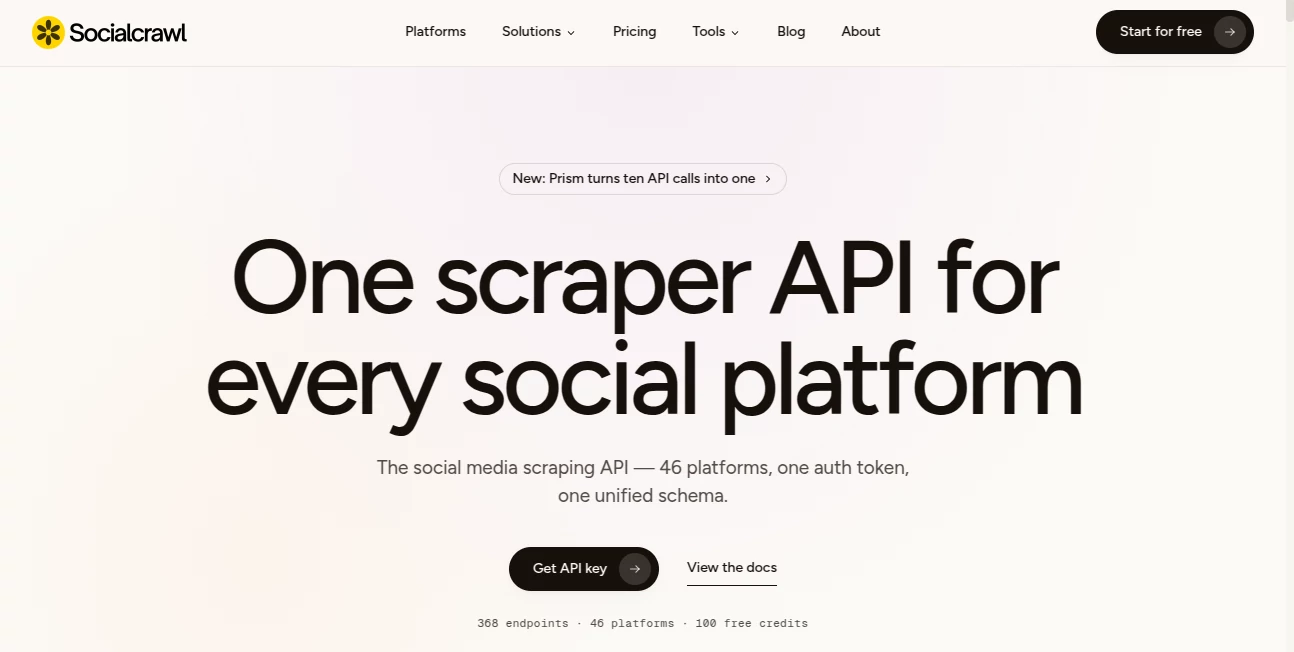
What is SocialCrawl?
Collecting public data from dozens of social platforms usually means maintaining different APIs, response formats, authentication methods, and parsing logic. This platform removes that complexity by providing a single API that delivers standardized data from a wide range of social networks, content platforms, and online communities through one consistent interface.
Instead of building separate integrations for every service, developers can write their code once and access profiles, posts, comments, search results, transcripts, analytics, and many other datasets using the same response structure. The unified schema dramatically reduces development time while making applications easier to maintain as platforms evolve.
Whether the goal is monitoring brand mentions, powering AI agents, building social analytics dashboards, researching online communities, or creating marketing automation tools, the platform offers a reliable foundation that helps teams focus on creating valuable products instead of maintaining fragile scraping infrastructure.
Key Features
- Unified API covering 46 social and online platforms.
- One authentication method for every supported service.
- Consistent JSON schema across all endpoints.
- Hundreds of endpoints for profiles, posts, comments, search, transcripts, and more.
- Computed metrics such as engagement rate and estimated reach where available.
- Credit-based pricing with pay-as-you-use billing.
- Built-in caching for improved efficiency.
- Safe retry support with idempotent requests.
- Developer-friendly documentation and examples.
- Easy integration with AI agents and automation workflows.
User Interface
The documentation is exceptionally well organized, allowing developers to move from authentication to production within minutes. Interactive examples, structured references, and practical integration guides make the onboarding process straightforward even for teams working with multiple programming languages. Navigation is clean, and every endpoint follows the same logical structure, making exploration simple and intuitive.
Accuracy & Performance
One of the strongest aspects of the platform is its data normalization process. Instead of returning different field names for every social network, responses follow a unified schema that remains predictable across platforms. This consistency minimizes parsing errors, reduces maintenance costs, and enables applications to scale without continuously rewriting integration logic. Intelligent caching and optimized infrastructure also help improve response speed while reducing unnecessary requests.
Capabilities
The API supports an impressive range of social data operations. Developers can retrieve user profiles, collect public posts, search conversations, access comments, analyze engagement, discover trending content, work with transcripts, and build cross-platform monitoring systems using one implementation. Optional computed fields further enrich the returned data, making it easier to generate reports, perform analytics, or feed structured information into machine learning applications.
Security & Privacy
Authentication is intentionally simple while following modern security practices. API requests are authenticated using a single API key, making deployment and key management uncomplicated. Features such as secure key handling, request validation, retry protection, and predictable error responses contribute to a reliable developer experience. Since the service focuses on publicly available information, organizations can build compliant data workflows while remaining responsible for following applicable platform terms and regional regulations.
Use Cases
- Building AI agents that require structured social media data.
- Monitoring brand mentions across multiple platforms.
- Competitor research and market intelligence.
- Influencer discovery and performance analysis.
- Marketing analytics dashboards.
- Social listening applications.
- Academic and public data research.
- Content aggregation platforms.
- Business intelligence systems.
- Automation workflows requiring normalized social data.
Pros and Cons
Pros
- One integration replaces dozens of platform-specific implementations.
- Consistent response schema across supported services.
- Excellent documentation for developers.
- Wide platform coverage.
- Computed metrics reduce additional processing.
- Flexible usage-based pricing.
- Fast onboarding with simple authentication.
Cons
- Advanced usage depends on available API credits.
- Some computed values depend on source data availability.
- Public data availability varies between supported platforms.
Pricing Plans
The platform follows a credit-based pricing model that allows developers to pay only for the requests they make. New accounts receive free welcome credits for testing before upgrading to larger credit packages. Since costs are tied directly to API usage, the pricing structure works well for both small projects and large production environments.
How to Use SocialCrawl
Create an account, generate an API key, and authenticate requests using the provided header. After authentication, developers can call any supported endpoint using the same request pattern regardless of the underlying platform. Because every response follows the same schema, applications require only one parser to consume data from dozens of different services. This significantly simplifies development, testing, and long-term maintenance.
Comparison with Similar Tools
Many data providers specialize in only one social network or require developers to maintain different integrations for every platform. Others return inconsistent response structures that increase development complexity. This solution stands out by offering one authentication method, one response format, and broad platform coverage within a unified ecosystem. For companies building analytics products, AI applications, or monitoring solutions, this approach reduces engineering effort while improving scalability and maintainability.
Conclusion
For developers who need reliable access to public social media data, this platform delivers a remarkably efficient solution. The unified schema removes much of the repetitive engineering work associated with traditional integrations, while extensive platform coverage makes it suitable for analytics, automation, AI, research, and marketing applications. Its thoughtful developer experience, consistent architecture, and scalable design make it an outstanding choice for modern software projects that depend on structured social data.
Frequently Asked Questions (FAQ)
What type of data can be accessed?
The API provides access to public profiles, posts, comments, search results, transcripts, engagement metrics, and additional structured information depending on the selected endpoint.
Is coding experience required?
Yes. The platform is designed primarily for developers who want to integrate social data into applications, services, or AI systems.
Does it support multiple social platforms?
Yes. A single implementation can retrieve normalized data from dozens of supported platforms through one unified API.
Can it be integrated with AI applications?
Yes. The standardized schema makes it particularly suitable for AI agents, automation systems, analytics platforms, and large language model workflows.
Is there a free way to test the service?
New users receive free credits, allowing them to evaluate the API before purchasing additional usage.
AI Web Scraping , AI API Design , AI Analytics Assistant , AI Developer Tools .
These classifications represent its core capabilities and areas of application. For related tools, explore the linked categories above.
SocialCrawl details
Website unavailable — View Alternatives
Pricing
- Free Trial
Apps
- Web App
Categories

SocialCrawl Alternatives Product

ttanonviewer

PatentFig AI

Pixelied

Fina Money
MyToolster W…

Website Traf…

Luma AI

Liftburst

LocaFlow
