
Suprmind
What is Suprmind?
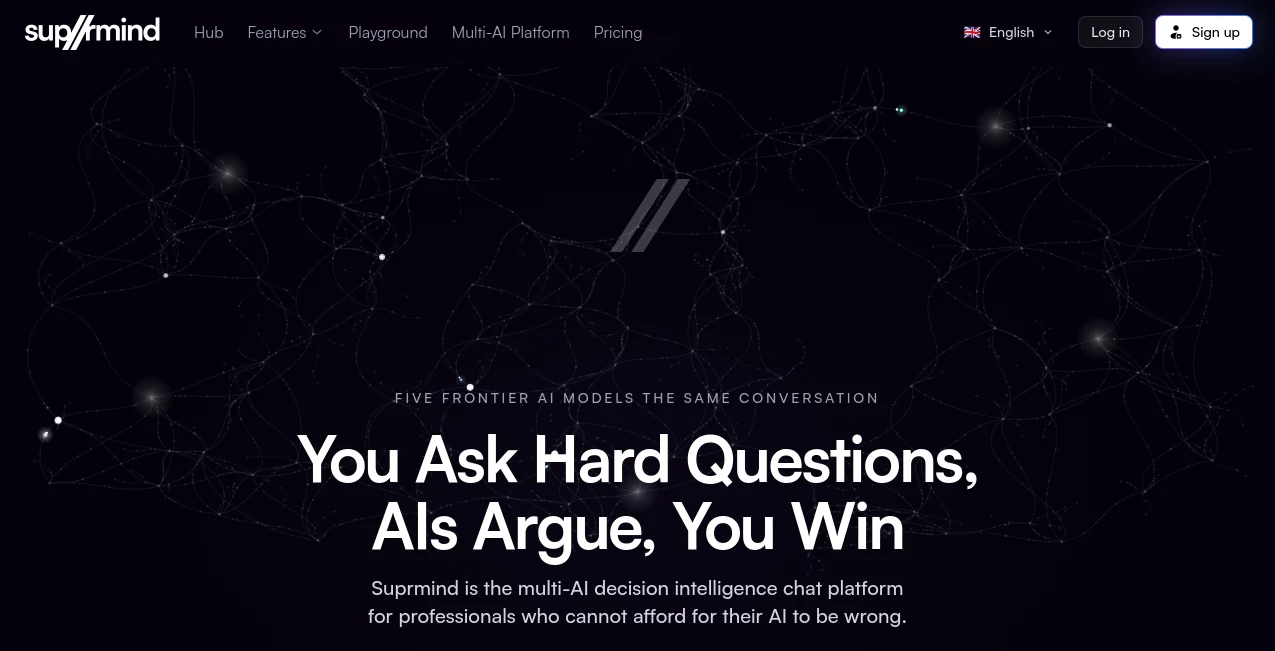
There's a moment every heavy AI user eventually hits: five browser tabs open, the same question typed into each one, and a growing pile of contradictory answers with no obvious way to tell which model actually got it right. This platform was built specifically for that moment. Instead of treating each AI as an isolated assistant, it puts GPT, Claude, Gemini, Grok, and Perplexity into a single shared thread where they read each other's responses, challenge weak reasoning, and call out fabricated claims in real time. The pitch is blunt and a little provocative: one confident AI answer is the most dangerous kind, and five models arguing with each other is safer than one model sounding certain.
Key Features
User Interface
The interface is built around a single conversation thread rather than separate windows per model. You type a question once, optionally tag which AIs should weigh in, and watch the responses stack up in sequence — each one visibly building on, or pushing back against, what came before. Disagreements aren't buried in separate tabs; they're surfaced and indexed inline, so you can actually see Claude contradict GPT's read on a contract clause or watch Perplexity's sourced research challenge a Grok assumption, all in the same scroll.
Accuracy & Performance
What stands out here isn't a single accuracy number — it's the mechanism. In one documented session, Grok was asked to retrieve a specific passage from an uploaded novel and confidently produced a fluent paragraph that sounded exactly like the source material. It wasn't real; Grok had invented it. Claude, reading the same thread, ran eight separate verification searches, found nothing, and flagged four distinct signs of fabrication before declaring it a confabulation dressed up as a citation. That kind of cross-model fact-checking is the actual performance claim: not that any one model is infallible, but that errors get caught by peers before they reach your decision.
Capabilities
Six orchestration modes give you different ways to pressure-test a question. Sequential mode has each AI read and build on everything before it — the default for deep analysis. Super Mind runs all five in parallel and adds a sixth model to synthesize consensus and divergence. Debate assigns each AI a position and has them argue it out with rebuttals. Red Team attacks a plan from six angles — financial, technical, regulatory, reputational, operational, and edge cases. Research Symphony runs an automated pipeline that retrieves sources, fact-checks, and produces long-form reports with citations. First Principles strips a question down to its underlying assumptions and rebuilds the analysis from there. You can switch modes mid-conversation without losing context, and at the end, the Master Document Generator exports the whole thread into one of more than 25 templates — decision briefs, SWOT analyses, research papers — as Markdown, PDF, or DOCX.
Security & Privacy
Project files feed into a structured knowledge graph so every model works from the same evidence base instead of guessing from training data alone, and a Context Fabric layer keeps full conversation history and uploaded documents available across turns without re-explaining anything. Standard account authentication gates access, and exported documents stay entirely in your control once generated, so a sensitive client memo or investment analysis doesn't linger as an open thread you have to remember to clean up.
Use Cases
- Strategy consultants building an M&A pre-mortem before a partner meeting, with fabrications caught before slides go out
- Founders running a pricing experiment through Debate mode to see retention, elasticity, and benchmark arguments collide
- Investment analysts assembling a defensible IC memo by building the strongest case for and against a deal
- Heavy AI users replacing several separate subscriptions with one shared-context conversation
- Legal or compliance teams pressure-testing contract language across multiple model perspectives before signing off
Pros and Cons
Pros:
- Five models from different providers genuinely catch each other's mistakes instead of just agreeing politely
- Six distinct orchestration modes cover everything from quick fact-checks to six-angle risk pre-mortems
- One-click export turns a messy conversation into a polished, shareable deliverable in over 25 templates
- Context carries across the whole thread, so there's no re-explaining background to each model separately
- Published original research on model disagreement rates adds a layer of transparency rare in this category
Cons:
- Running five models per question costs more in time and credits than a single quick chat
- The depth of Sequential and Debate modes means some answers take noticeably longer than a one-shot query
- It doesn't eliminate hallucinations entirely — it reduces the chance one slips through unnoticed
- The pricing scales up quickly for users who want the full Frontier feature set
Pricing Plans
All paid tiers start with a 7-day free trial and no credit card required.
- Spark — $19/month: entry-level access for individuals starting to explore multi-model orchestration.
- Pro — $45/month: expanded access suited to regular professional use.
- Frontier — $95/month: the full feature set, positioned as a replacement for separately subscribing to multiple individual AI tools.
- Enterprise — custom pricing: tailored for teams and organizations with larger-scale needs.
How to Use Suprmind
- Start a thread and type your question once
- Tag the specific AIs you want to weigh in, or let all five respond
- Choose an orchestration mode — Sequential, Super Mind, Debate, Red Team, Research Symphony, or First Principles
- Watch the models read each other's responses, agree, disagree, and flag weak claims
- Export the finished conversation as a decision brief, SWOT analysis, or other document template in Markdown, PDF, or DOCX
Comparison with Similar Tools
Most multi-AI tools take the easy route: fire the same prompt at several models in parallel and hand you five disconnected answers to compare yourself. That still leaves you as the synthesis layer, manually weighing contradictions at the end of a long day. The sequential approach here is the meaningful difference — each model actually reads what the others said and responds to it, so the fifth answer in the thread is shaped by the first four rather than being a blind duplicate. Combined with built-in disagreement tracking and document export, it sits closer to a structured advisory process than a side-by-side model comparison tool.
Conclusion
For anyone making decisions where a single confident-but-wrong AI answer carries real cost — a contract, an acquisition, a six-figure pricing call — the value isn't in having access to five models. It's in watching them disagree productively and catch each other's blind spots before that mistake reaches a spreadsheet or a client. The exportable documents turn what could be an ephemeral chat into something you can actually hand to a partner or a board and say, here's how we got here.
Frequently Asked Questions (FAQ)
Does using five models eliminate hallucinations entirely?
No tool can claim that. But when models from different providers fact-check each other live, fabricated claims get caught far more often than with a single model working alone.
How is this different from just switching between separate AI apps?
Switching tools resets context every time. Here, every model reads the full thread, including what the others contributed, so corrections happen live instead of being missed entirely.
Can I export a conversation as a finished document?
Yes, one click generates a professional document from more than 25 templates, exportable as Markdown, PDF, or DOCX, and you can choose which AI writes the final version.
Is there a free trial?
Yes, a 7-day free trial is available with no credit card required before choosing a paid plan.
What's the difference between the orchestration modes?
Sequential and Debate modes have models build on or argue against each other in order, Super Mind runs them in parallel with a synthesis layer, Red Team attacks a plan from multiple risk angles, and Research Symphony automates deep, citation-backed research reports.
AI Documents Assistant , AI Research Tool , AI Content Detector , AI Consulting Assistant .
These classifications represent its core capabilities and areas of application. For related tools, explore the linked categories above.

Suprmind Alternatives Product

The #1 Compa…

Ecom Mediate…
Serplux

Domain Rank …

Roipad

Chrome Sidek…

SEO Tools Hu…

Greek Numero…

Rename files…