
TaroTown
What is TaroTown?
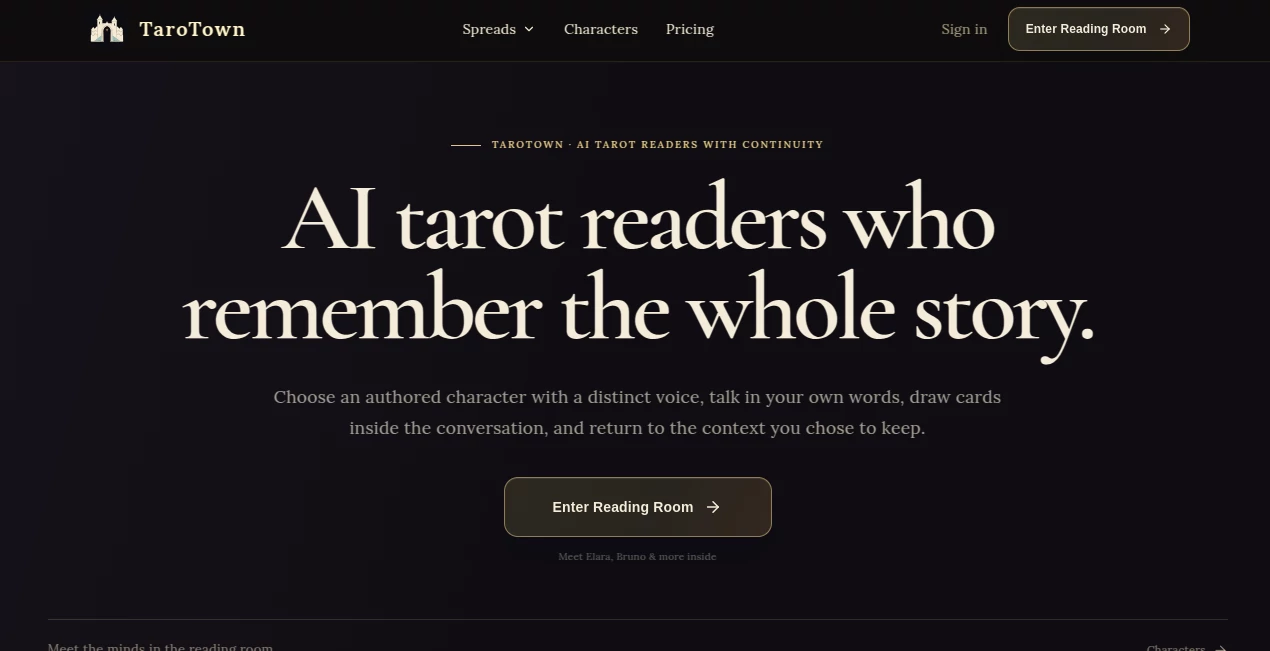
TaroTown is an AI tarot reading platform designed around conversation, reflection, and continuity rather than one-off card predictions. Instead of simply selecting a few cards and receiving a generic interpretation, users can speak naturally about what is happening in their lives, bring tarot into the conversation when it adds value, and return to the same context later.
The platform features authored AI readers with distinct personalities and approaches. Elara, for example, is presented as a warm and perceptive reader who separates what is known from what is inferred. This makes the experience feel closer to an ongoing reflective conversation than a traditional automated fortune-telling page.
A particularly interesting aspect is the way new information can change an earlier interpretation. If circumstances develop differently from what was initially discussed, the conversation can be revisited rather than forcing the original reading to remain valid. The platform clearly positions tarot as a tool for interpretation and self-reflection, not as a guaranteed prediction or substitute for professional advice.
Key Features
- Conversational AI tarot readers with distinct personalities and authored backgrounds.
- Live tarot card draws directly inside the conversation.
- A complete tarot deck with structured spreads, card positions, and orientations.
- Conversation continuity across sessions for signed-in users.
- Optional long-term memory with separate controls for collection and usage.
- Temporary conversations for situations where information should not carry forward.
- The ability to continue an earlier reading when new information becomes relevant.
- Interpretations that distinguish cards, user-provided information, inference, and uncertainty.
User Interface
The interface is built around a reading-room concept rather than a complicated dashboard. Users can enter a conversation, describe their situation in ordinary language, and interact with an AI character. Tarot cards can then be introduced directly into the conversation when they are useful.
This conversational approach is one of the platform's strongest design choices. Someone who has never learned traditional tarot terminology does not need to understand complicated spreads before beginning. The experience starts with the user's actual question or situation and lets the conversation develop naturally.
Accuracy & Performance
Tarot cannot objectively verify another person's thoughts or guarantee future events, and the platform is refreshingly clear about that limitation. Its approach focuses instead on keeping the interpretation grounded in the actual cards drawn and the information provided by the user.
The card system preserves details such as the selected card, its position, orientation, and the context in which it was drawn. This is important because it reduces the chance of a reading becoming a collection of disconnected generic card descriptions.
Another thoughtful feature is revision. When new facts appear, the reader can reconsider an earlier interpretation instead of pretending that the original conclusion was always correct. For users who enjoy reflective journaling or returning to the same question over time, this can make the experience considerably more useful.
Capabilities
The platform combines conversational AI with an interactive tarot system. Users can ask questions in their own words, discuss relationships or difficult choices, request a tarot spread, reveal cards, and continue the discussion around the resulting interpretation.
Its reading system can work with structured spreads and preserves the context surrounding each draw. Users can also return to previous conversations and continue from where they left off, depending on their selected memory settings.
The character-based approach adds another layer. Different readers can have different personalities and perspectives, giving the experience more personality than a single generic chatbot. Elara, for instance, is designed to value evidence over certainty and can openly acknowledge when something remains unknown.
Security & Privacy
Privacy controls are built into the experience rather than treated as an afterthought. Users can separately control whether long-term context is collected and whether an AI reader is allowed to use that context.
Temporary conversations are also available for situations where users do not want information to become part of their longer-term context. This gives users more control over how personal conversations are handled and whether information should carry into future sessions.
The platform also makes an important distinction between an AI character and a real professional. Its readers are not presented as human psychics, therapists, or credentialed professionals, and the service should not replace medical, legal, financial, or emergency assistance.
Use Cases
- Personal reflection: Explore thoughts, emotions, recurring concerns, and situations that are difficult to put into perspective.
- Relationship questions: Use tarot symbolism as a way to examine communication, uncertainty, expectations, and personal patterns.
- Difficult decisions: Discuss competing choices and use a structured reading to approach the situation from another angle.
- Ongoing situations: Return to a previous conversation after circumstances change and reconsider the interpretation with new information.
- Tarot exploration: Learn through conversation without needing to master tarot terminology beforehand.
- Journaling companion: Use conversations and card interpretations as prompts for deeper self-reflection.
Pros and Cons
Pros
- Natural conversational approach instead of simple automated card descriptions.
- Distinct AI readers with different personalities and perspectives.
- Live tarot draws take place inside the conversation.
- Structured card information helps keep readings connected to the actual draw.
- Optional and controllable long-term memory.
- Temporary conversations are available.
- Encourages reflection rather than presenting predictions as guaranteed facts.
Cons
- The experience is intended for reflection and interpretation rather than factual prediction.
- Some continuity and memory features depend on using a signed-in account and the selected settings.
- Users looking specifically for a human tarot reader may prefer a traditional professional reading.
- The platform is not designed to replace professional guidance for serious medical, legal, financial, or emergency matters.
Pricing Plans
No public pricing plan or subscription price is prominently presented on the main website at the time of review. The core experience is presented through the online reading room, with users able to explore the AI readers, conversations, tarot draws, and memory controls directly.
Because pricing and access policies can change, users should check the platform's current account and reading options before making a purchase decision.
How to Use the Platform
- Enter the reading room: Begin a conversation with one of the available AI tarot characters.
- Explain your situation: Describe what happened, what you are wondering about, or what keeps coming back to your mind.
- Choose when to use tarot: The conversation can introduce a card draw when it adds useful context.
- Explore the cards: Use a suitable spread and examine the cards, positions, and orientations presented in the conversation.
- Discuss the interpretation: Ask follow-up questions and explore how the symbolism relates to the situation you described.
- Return later: Continue the same conversation when circumstances change, subject to your selected memory and continuity settings.
- Manage memory: Decide whether long-term context should be collected or used, or switch to a temporary conversation when appropriate.
Comparison with Similar Tools
Many AI tarot services focus primarily on selecting cards and producing an immediate interpretation. This platform takes a different route by putting the conversation itself at the center of the experience.
Instead of treating every reading as an isolated event, it is designed around continuity. A user can discuss a situation, draw cards, return after several weeks, introduce new information, and revisit the earlier interpretation. That makes it particularly interesting for people who want tarot to function as an ongoing reflective practice rather than a one-time answer generator.
The distinction between evidence and inference is another notable difference. The AI reader can acknowledge uncertainty, disagree with an assumption, or revise its position when new information changes the context. For users who prefer thoughtful interpretation over dramatic predictions, this approach gives the experience a more grounded character.
Conclusion
TaroTown offers a thoughtful take on AI-powered tarot by combining conversational AI, live card draws, distinctive reader personalities, and optional memory. Its strongest quality is not simply the ability to interpret tarot cards, but the way it allows a reading to become an ongoing conversation.
The platform is especially appealing for people who enjoy tarot as a method of reflection and want to examine the same questions as their circumstances evolve. The ability to revisit previous conversations, introduce new evidence, and revise interpretations gives the experience a level of continuity that many basic AI tarot tools do not provide.
It is best approached with the same mindset the platform itself encourages: use the cards to explore possibilities, questions, and personal patterns rather than treating an AI interpretation as an unquestionable prediction. For that purpose, the combination of conversation, structured tarot draws, and user-controlled memory makes this a compelling addition to the growing category of AI-powered self-reflection tools.
Frequently Asked Questions (FAQ)
What is an AI tarot reader?
An AI tarot reader combines conversational artificial intelligence with a structured tarot system. It can discuss a user's situation, introduce tarot cards into the conversation, and interpret the cards in relation to the context provided.
Can tarot cards be drawn inside the conversation?
Yes. Cards can be drawn directly within the conversation using the platform's structured card-drawing system. The system preserves information such as the cards, positions, and orientations associated with the reading.
Does the platform remember previous conversations?
Signed-in conversations can continue across sessions. Long-term memory collection and the use of long-term context are controlled separately, and temporary conversations are available when information should not carry forward.
Is the AI tarot reader a real person?
No. The readers are original AI characters with authored personalities and backgrounds. They are not presented as real human psychics or credentialed professionals.
Can users turn off long-term memory?
Yes. Users can control whether long-term information is collected and whether readers can use long-term context. Temporary conversations can also be used when users do not want information to carry forward.
Is an AI tarot reading guaranteed to predict the future?
No. Tarot interpretations cannot independently verify another person's thoughts or guarantee future outcomes. The experience is designed for interpretation, conversation, and self-reflection.
Can an earlier reading be changed when new information appears?
Yes. One of the platform's notable features is the ability to revisit an interpretation when circumstances change. New information can lead to a revised view rather than forcing the original interpretation to remain unchanged.
Can it replace professional advice?
No. The platform explicitly distinguishes its reflective experience from professional services and should not be used as a replacement for medical, legal, financial, or emergency assistance.
AI Life Assistant , AI Religion , AI Mental Health , AI Chatbot .
These classifications represent its core capabilities and areas of application. For related tools, explore the linked categories above.

TaroTown Alternatives Product

Face Symmetr…

Ryne AI

HealCycle

StarBattle O…

Astrology Bot

FortuneTelle…

Snow day Cal…

SciSpace

Middle Name …