
The Academic Digest
What is The Academic Digest?
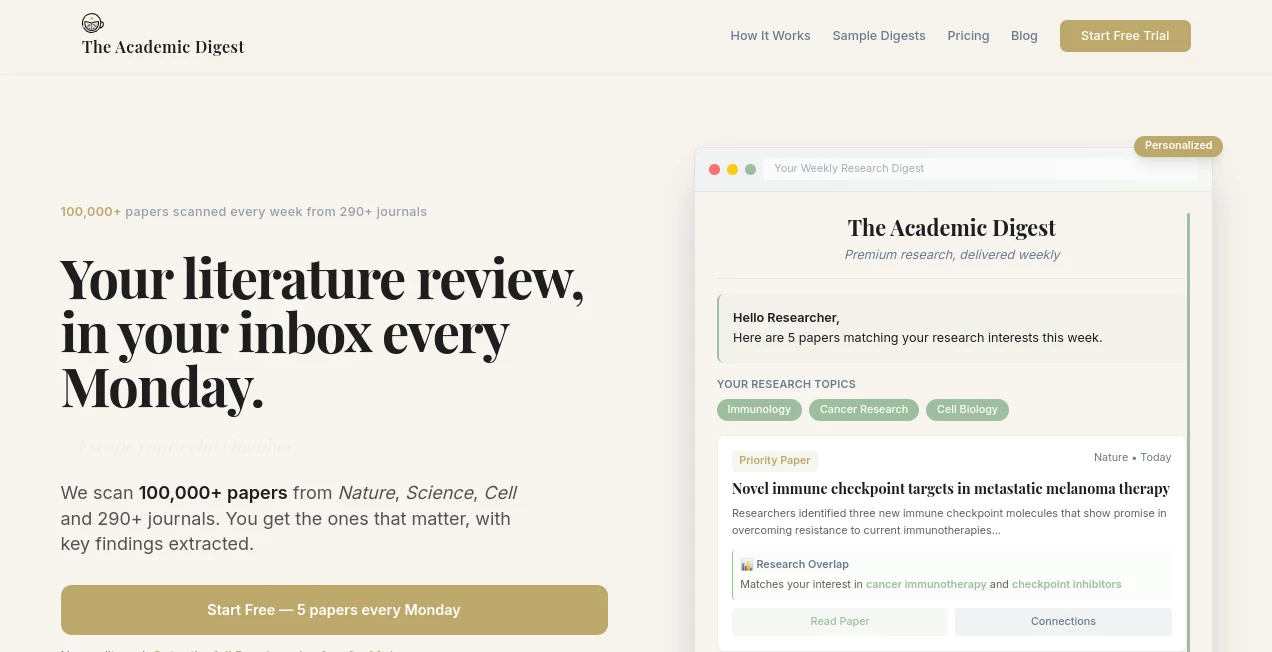
I remember spending entire afternoons trying to extract the key points from a 40-page research paper, only to realize later I’d missed something important. Then I started using this tool and my whole approach to literature review changed. You drop in a PDF or paste the link, and it delivers a concise, well-structured digest that actually captures the essence — not just bullet points, but context, methodology, findings, and limitations. It feels like having a very sharp research assistant who never gets tired.
Introduction
Academic papers are packed with value, but they’re rarely written for quick consumption. Researchers, students, and professionals often need to digest multiple studies quickly without losing accuracy. This platform does exactly that. It reads complex academic content and produces clear, thoughtful summaries that respect the original work while making it far more accessible. Whether you’re preparing for a literature review, staying current in your field, or simply trying to understand a new topic, it saves hours while improving comprehension. The best part? It doesn’t oversimplify — it distills.
Key Features
User Interface
The design is clean and purposeful. You can upload a PDF, paste a DOI or URL, or even forward an email with a paper attached. The output appears in a beautifully formatted layout with clear sections: key takeaways, methodology overview, main findings, limitations, and practical implications. You can highlight passages in the original and ask targeted questions. Everything feels calm and academic — no flashy distractions, just useful information presented professionally.
Accuracy & Performance
It excels at understanding academic nuance — correctly identifying research questions, methodologies, statistical significance, and limitations. Summaries stay faithful to the source material while cutting through the jargon. Processing is fast even with longer papers, and the AI rarely hallucinates or misrepresents findings. In my experience, the outputs consistently match what a careful human reader would highlight, which is rare in this space.
Capabilities
Beyond basic summarization, you can generate different lengths (quick overview, detailed digest, or deep analysis), compare multiple papers side-by-side, extract specific data points, and even create citation-ready notes. It handles various disciplines well — from hard sciences to social sciences and humanities. You can also ask follow-up questions about the paper in natural language, making it feel like a conversation with the research itself.
Security & Privacy
Your uploaded papers and generated summaries remain private. The platform is built with academic users in mind and doesn’t use your documents for training unless you explicitly allow it. For researchers handling unpublished work or sensitive data, this respectful approach to privacy is genuinely appreciated.
Use Cases
A PhD student processes 15 papers for their literature review in one evening instead of two weeks. A professor quickly digests new publications in their field before teaching a seminar. A policy analyst compares findings across multiple studies to prepare a briefing. A curious reader explores a complex scientific topic without getting lost in technical language. It serves anyone who needs to absorb academic content efficiently without sacrificing depth.
Pros and Cons
Pros:
- Produces summaries that feel intelligent and faithful to the original research.
- Saves enormous amounts of reading time while improving understanding.
- Excellent at handling different academic disciplines and paper types.
- Clean, professional output that’s easy to reference later.
- Strong privacy practices suitable for academic work.
Cons:
- Very new or highly specialized papers sometimes need more context from the user.
- Free tier has reasonable daily limits; heavy academic users benefit from paid plans.
Pricing Plans
It offers a solid free tier that lets you process several papers per day — enough for most students and casual researchers. Paid plans remove limits, unlock longer documents, advanced comparison features, and priority processing. The pricing feels fair considering how much time and mental energy it returns, especially during intense research periods.
How to Use TheAcademicDigest
Go to the homepage and either upload a PDF, paste a link/DOI, or forward an email. Choose your preferred summary depth. Wait a short moment while it processes, then read the clear, structured output. Highlight any section and ask specific follow-up questions if you need deeper clarification. Save or export the digest for your notes or literature review. The entire flow is smooth enough that it becomes part of your regular research routine.
Comparison with Similar Tools
Many AI summarizers produce generic bullet points that miss nuance. This one stands out by delivering thoughtful, well-structured digests that respect academic standards and actually help you understand the research. It balances brevity with depth better than most alternatives, making it especially valuable for serious academic and professional work.
Conclusion
Academic knowledge should be accessible, not buried in dense prose. This tool helps bridge that gap without compromising quality or accuracy. It respects both the research and the reader’s time, making it one of the most genuinely useful AI tools available for students, researchers, and lifelong learners. If you regularly engage with academic papers, it’s likely to become one of your favorite daily companions.
Frequently Asked Questions (FAQ)
How accurate are the summaries?
Very high — they preserve methodology, findings, and limitations while making the content much more readable.
Can it handle very long papers?
Yes, including those over 50 pages, though very dense technical papers may benefit from focused questions.
Is it suitable for published research only?
It works with preprints, conference papers, and PDFs you upload as well.
Can I export the summaries?
Yes, in multiple formats suitable for notes or literature reviews.
AI Education Assistant , AI Summarizer , AI Research Tool , AI Writing Assistants .
These classifications represent its core capabilities and areas of application. For related tools, explore the linked categories above.
The Academic Digest details
Website unavailable — View Alternatives
Pricing
- Free
Apps
- Web App
Categories

The Academic Digest Alternatives Product

Sorank

Greek Numero…

Youshow IELTS

DiRe-RAPIDS
RewriteBar

Manus

SuperAI

Humanize AI …

Zloth