CoachArc
What is CoachArc?
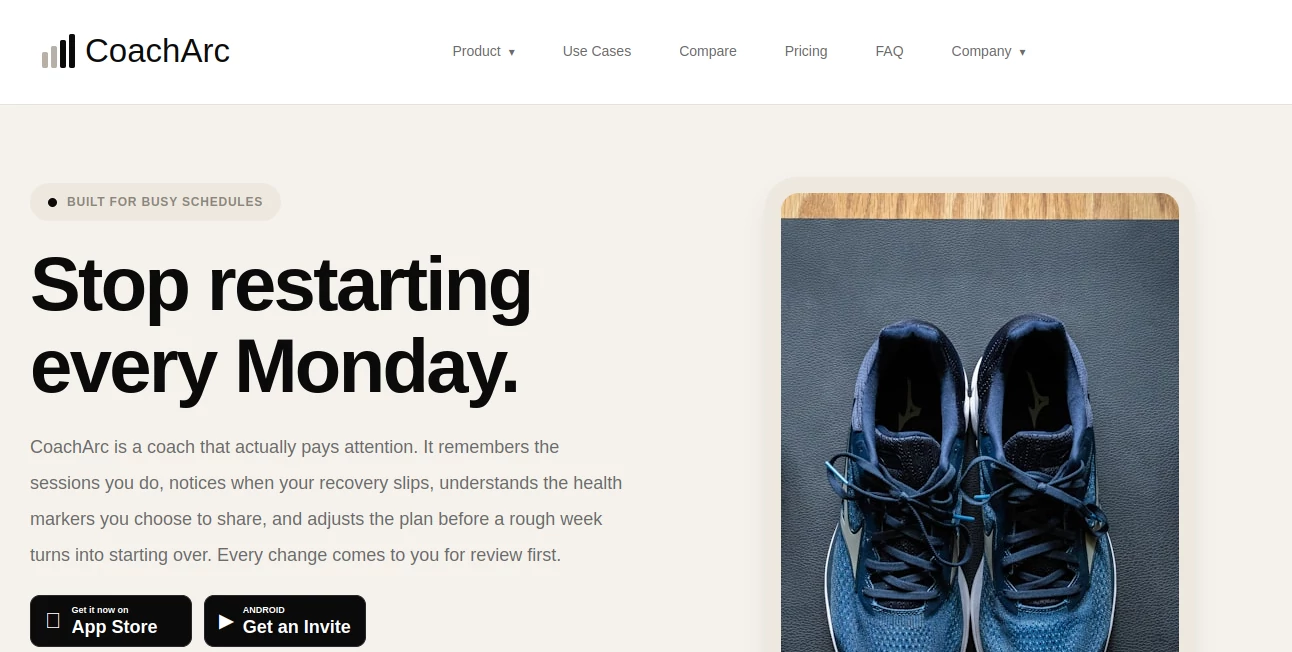
CoachArc is an adaptive fitness coaching app designed for people who want their training, food choices, and daily guidance to remain useful even when life does not go according to plan. Instead of treating a workout schedule as something fixed, it focuses on helping users make the best next decision based on their current situation.
That approach is especially useful for busy people. A late meeting, poor night's sleep, travel, low energy, or a missed workout should not automatically mean starting the entire fitness plan again. The platform is designed around that reality, bringing daily planning, guided workouts, food guidance, reminders, progress information, and AI coaching into one connected experience.
The idea is refreshingly practical: rather than giving users another complicated dashboard to manage, the experience focuses on what matters today and how to keep moving forward. For someone who has struggled with the familiar cycle of starting strong, missing a few days, and abandoning the plan altogether, this can make fitness feel much more manageable.
Key Features
- Adaptive daily workout planning
- AI coaching with context from the user's plan and progress
- Practical food and meal guidance
- Adjustments for missed workouts and changing schedules
- Recovery-aware training support
- Progress tracking and workout history
- Reminders that help maintain consistency
- Body composition context
- Goal-based fitness tracks
- Community sharing and progress rewards
User Interface
The interface is designed around the idea of reducing decisions rather than adding more of them. The daily experience gives users a clearer picture of what they should focus on instead of requiring them to piece together information from several different screens or applications.
This makes the product particularly appealing for people who do not want fitness to become a second job. Someone with only a short window available for training can make adjustments without throwing away the structure of the broader plan. The experience feels more like checking in with a coach than opening a traditional workout tracker.
Accuracy & Performance
The value of the coaching approach comes from using more than the workout itself. Training decisions can be influenced by factors such as schedule changes, energy, soreness, recovery, food, and previous progress. This allows recommendations to be more relevant to the circumstances of the day rather than relying entirely on a static routine.
The platform also emphasizes continuity. Instead of treating every question as a brand-new conversation, its coaching system is designed to work with information from the user's existing plan, goals, schedule, and history. That context can make everyday adjustments more practical and less repetitive.
Capabilities
The platform combines workout planning and nutrition guidance rather than treating them as unrelated tasks. Food recommendations are designed to remain practical and portion-oriented, with an emphasis on useful meal choices rather than making mandatory macro counting the center of the experience.
Different fitness goals can also lead to different approaches. Available tracks include strength, lean cutting, lean bulking, longevity, athletic conditioning, and returning to consistency. This gives users a way to select a direction that matches what they are actually trying to accomplish.
Another useful capability is adaptive recovery. If a user misses a workout or has a difficult week, the system is designed to help find the next useful action instead of simply marking the plan as failed. That small distinction can make a significant difference for people who struggle with all-or-nothing fitness routines.
Security & Privacy
Because a fitness coaching application can involve personal information, privacy is an important consideration. The service provides dedicated privacy and consumer health data privacy documentation alongside its terms of use. Users should review those policies to understand how their information is handled before sharing personal fitness, nutrition, or wellness information.
The service also makes clear that its coaching is intended for general fitness, nutrition, recovery, reminder, tracking, and wellness purposes rather than medical diagnosis or treatment. Users with medical concerns should rely on qualified healthcare professionals for medical guidance.
Use Cases
This platform is a strong fit for people whose schedules make rigid fitness programs difficult to maintain. A busy professional who suddenly has only 20 minutes for training can benefit from having a more practical next step instead of simply skipping the entire day.
It can also help after missed workouts. Rather than encouraging users to compensate for lost sessions by cramming everything into the next few days, the adaptive approach is built around recovering momentum and continuing the plan.
Another useful scenario is travel. Changes in equipment, meal options, sleep, and available time can quickly make a conventional workout program difficult to follow. Having training and food guidance connected makes it easier to adapt without abandoning the overall goal.
The system can also appeal to people returning to exercise after a break. Instead of pretending that the user can immediately return to their previous routine, a gradual return-to-consistency approach can make the process feel less intimidating and more sustainable.
Pros and Cons
Pros:
- Adapts fitness guidance to changing real-life circumstances.
- Combines workouts and food guidance in one system.
- Provides coaching with context from the user's plan and history.
- Useful for busy schedules and missed workout days.
- Supports several different fitness goals.
- Reduces the need to manage multiple separate fitness tools.
- Offers a practical alternative to rigid workout routines.
Cons:
- Android access is currently being introduced through closed testing.
- Users looking for advanced manual tracking may prefer a more traditional tracker.
- The coaching experience depends on users providing enough useful information for meaningful guidance.
- It is designed for general fitness and wellness rather than medical or rehabilitation care.
Pricing Plans
The service currently offers a monthly membership at $29.99 per month. An annual option is listed at $269.99 per year, equivalent to $22.50 per month when billed annually, with the annual plan positioned as a discounted option.
The membership includes adaptive daily coaching, workout and food guidance, contextual AI coaching, progress insights, workout history, track-aware planning, and future core updates. Pricing and introductory offers can change, so users should check the current membership details before subscribing.
How to Use the App
- Start by choosing a fitness direction that matches your current goal.
- Set up the information needed to establish your training and nutrition context.
- Review the daily plan to see what should be done today.
- Complete the suggested workout and record relevant progress.
- Use the food guidance to make practical choices throughout the day.
- Ask the AI coach when your schedule, energy, recovery, or training needs change.
- Allow the plan to adjust when you miss a session rather than abandoning the routine.
- Review progress over time and use the feedback to keep improving your approach.
Comparison with Similar Tools
Traditional fitness trackers are excellent at recording what happened. They can show completed workouts, sets, repetitions, and historical activity, but users are often still responsible for deciding what should happen next.
Generic AI assistants have the opposite strength. They can answer questions and generate workout ideas quickly, but they may require users to repeatedly explain their goals, schedule, training history, and previous conversations.
The approach here sits between those two models. The emphasis is not simply on recording workouts or generating isolated answers. Training, food guidance, progress, reminders, and coaching are intended to remain connected so that a change in one part of the routine can influence the next recommendation.
That difference becomes most noticeable when a week goes wrong. A rigid tracker may simply show a missed session, while a generic chatbot may require a new prompt explaining the situation. An adaptive coaching system aims to turn that same problem into a practical adjustment and keep the larger plan intact.
Conclusion
Fitness becomes much easier to maintain when the plan can survive ordinary life. Not every week will contain perfect workouts, consistent sleep, ideal meals, and unlimited free time. A useful coaching system needs to account for those moments rather than treating them as failures.
By connecting adaptive workouts, food guidance, recovery, progress, reminders, and contextual AI coaching, this platform offers a thoughtful approach for people who want structure without excessive rigidity. Its strongest idea is simple but important: missing one day should not require starting over.
For busy adults, people returning to exercise, and users who want their training and nutrition decisions to work together, the adaptive model provides a compelling alternative to conventional tracker-first fitness apps.
Frequently Asked Questions (FAQ)
What is this fitness app designed for?
It is designed for adaptive fitness coaching, combining workouts, food guidance, recovery support, reminders, progress tracking, and AI coaching in one connected system.
Can the training plan adapt after a missed workout?
Yes. The platform is designed to adjust after missed workouts, schedule changes, travel, low energy, or other disruptions so users can continue without rebuilding the entire plan.
Does it require calorie or macro counting?
No. The food guidance is designed around practical portions, protein-focused choices, vegetables or fruit, useful carbohydrates, meal ideas, and everyday decision-making rather than mandatory macro counting.
What fitness goals are supported?
The available approaches include strength, lean cutting, lean bulking, longevity, athletic conditioning, and returning to consistency.
Is it available on Android?
iPhone access is currently available through the App Store. Android access is being introduced through Google Play closed testing, with users able to join the waitlist for access.
How much does the membership cost?
The current listed public price is $29.99 per month, while the annual membership is listed at $269.99 per year.
Is the coaching medical advice?
No. The service provides general fitness, nutrition, recovery, and wellness guidance and does not replace diagnosis, treatment, rehabilitation, or individualized medical advice from a qualified healthcare professional.
These classifications represent its core capabilities and areas of application. For related tools, explore the linked categories above.
CoachArc details
Website unavailable — View Alternatives
Pricing
- Free
Apps
- Web App
- iOS App
- Android App
Categories

CoachArc Alternatives Product

core level

Pelaris

Visual Field…

GetFIT App

Alter

TDEE Calcula…
Pontefuerte …

GetFIT App