
THEO Strategist
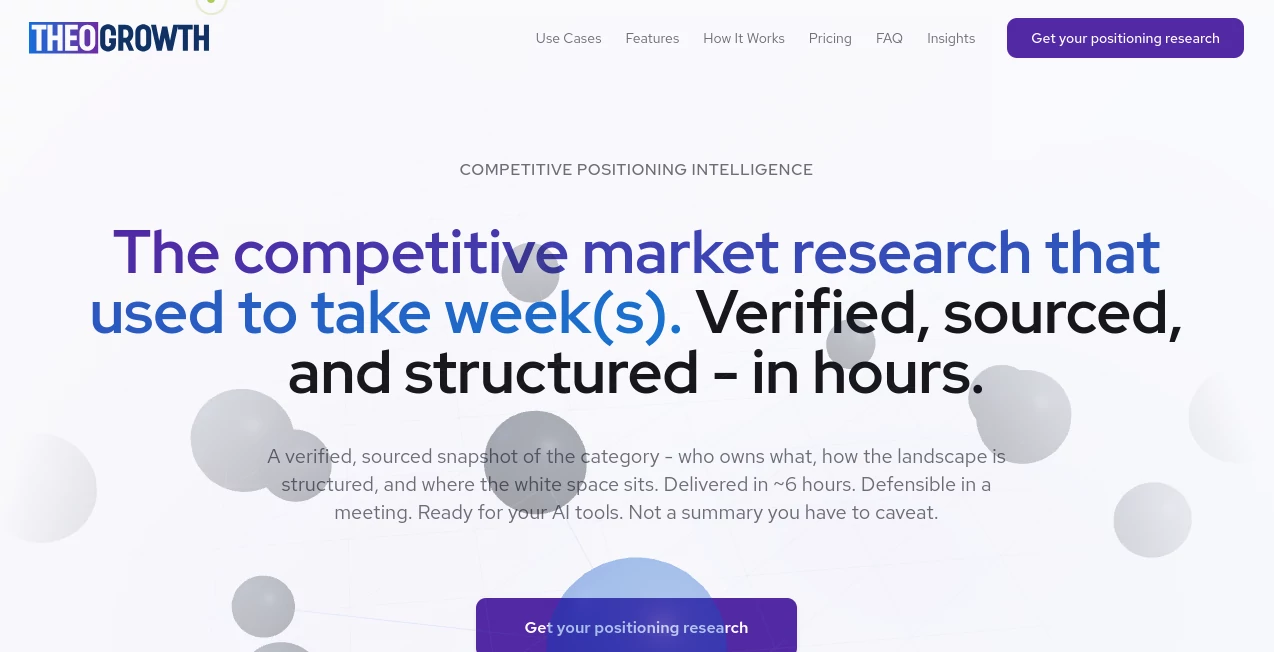
What is THEO Strategist?
THEO Strategist is a competitive positioning intelligence platform designed for brand strategists, consultants, and marketing teams that need a deeper understanding of their market landscape. Instead of providing simple competitor lists or surface-level summaries, it creates structured positioning research that helps teams understand why competitors succeed, how they communicate, and where new opportunities exist.
Modern brands often struggle with crowded markets where many companies sound similar and compete for the same audience. This platform helps uncover the strategic patterns behind a category, revealing positioning territories, competitor relationships, messaging trends, and potential areas of opportunity.
Built for professionals who need reliable strategic insight, the platform combines research automation with evidence-backed analysis. It helps reduce hours of manual competitor research and gives strategists more time to focus on creative decisions, differentiation, and market direction.
Key Features
- Competitive Landscape Mapping: Analyze competitors and understand how different brands position themselves within a market.
- Positioning Territory Analysis: Discover owned, contested, and unoccupied spaces within a category.
- Strategic Competitor Comparison: Compare brands across important positioning dimensions and identify market patterns.
- White Space Discovery: Find overlooked opportunities where a brand can create stronger differentiation.
- Brand Messaging Analysis: Study competitor promises, communication styles, and customer-facing narratives.
- Visual Identity Insights: Identify common design patterns and branding approaches across competitors.
- Evidence-Based Reports: Receive structured insights supported by research sources rather than unsupported assumptions.
- AI-Ready Research Outputs: Use reports with modern AI workflows and strategic tools.
User Interface
The platform focuses on clarity rather than overwhelming users with unnecessary dashboards. Research findings are organized into structured reports, maps, and strategic comparisons that make complex market information easier to understand.
For brand professionals, this approach feels closer to working with a research partner than browsing through disconnected analytics. The information is arranged around strategic questions, helping users quickly identify patterns and opportunities.
Accuracy & Performance
A major strength of the platform is its focus on verified research and structured analysis. Instead of generating generic AI summaries, it emphasizes evidence-backed insights and traceable information.
This makes the results more useful for client presentations, internal strategy meetings, and important positioning decisions where accuracy matters. Teams can explore competitor claims, market signals, and category movements with greater confidence.
Capabilities
The platform is built to support a wide range of strategic activities, including market research, product launches, brand repositioning, and competitive analysis. It can identify competitor groups, analyze positioning patterns, and highlight areas where markets are becoming crowded or where new opportunities appear.
Whether a company is entering a new industry or refining an existing brand identity, the generated research provides a strategic foundation for making better decisions.
Security & Privacy
Professional research workflows require responsible handling of information. The platform is designed around structured research processes and focuses on delivering strategic intelligence while maintaining transparency about sources and findings.
Use Cases
Brand Strategy: Marketing teams can use the research to understand category dynamics and create stronger brand positioning.
Consulting Projects: Consultants can prepare more detailed client recommendations by quickly understanding competitive environments.
Product Launch Planning: Companies launching new products can identify competitor strengths, market gaps, and differentiation opportunities.
Market Entry Research: Businesses exploring new industries can analyze existing players before investing resources.
Agency Work: Creative and branding agencies can use structured insights to support strategy presentations and client discussions.
Pros and Cons
Pros
- Provides deeper strategic insights than basic competitor research tools.
- Focuses on positioning rather than only collecting data.
- Creates structured reports that are easier to present and discuss.
- Helps identify market opportunities and differentiation areas.
- Reduces time spent on repetitive research tasks.
Cons
- Best suited for strategy professionals rather than casual users.
- May require marketing knowledge to fully interpret insights.
- Custom research projects can be more expensive than simple AI tools.
Pricing Plans
The platform offers project-based pricing designed for professional research needs. Users can choose different levels of competitive positioning research depending on their requirements.
- Competitive Positioning Research: Starts with individual research reports for specific projects.
- Custom Research: Available for businesses requiring tailored strategic analysis.
- Enterprise Programs: Designed for organizations managing multiple brands, markets, or ongoing research needs.
- AI Chat Integration Add-on: Available for teams that want to connect research outputs with AI assistants.
How to Use THEO Strategist
Using the platform begins by defining your brand, market, and research goals. The system then identifies relevant competitors and analyzes their positioning strategies.
After the research process is complete, users receive structured insights covering competitor landscapes, positioning patterns, market territories, and potential opportunities. These findings can then support strategy workshops, presentations, and business decisions.
Comparison with Similar Tools
Traditional research tools often focus on collecting metrics, traffic data, or general competitor information. This platform takes a different approach by focusing on strategic positioning and explaining the reasons behind competitor behavior.
Compared with general AI assistants, it provides a more organized research framework designed specifically for brand strategy. Instead of receiving a simple answer, users get a structured view of an entire category and how different players compete within it.
For teams that need strategic depth rather than quick summaries, this approach offers a more focused solution.
Conclusion
THEO Strategist offers a valuable solution for teams that need to move beyond basic competitor research and understand the deeper forces shaping their market. By combining structured analysis, competitive intelligence, and positioning insights, it helps brands make more informed strategic decisions.
For brand strategists, consultants, and marketing professionals, having a clear view of the competitive landscape can make the difference between blending into a crowded market and creating a distinctive position. This platform provides the research foundation needed to discover opportunities, refine messaging, and build stronger strategies.
Frequently Asked Questions (FAQ)
What is this platform mainly used for?
It is used for competitive positioning research, helping brands understand competitors, market categories, messaging patterns, and strategic opportunities.
Who can benefit from using it?
Brand strategists, marketing teams, consultants, agencies, and businesses planning new products or market expansion can benefit from its insights.
How is it different from general AI research tools?
It focuses specifically on structured positioning intelligence, competitor analysis, and strategic market understanding rather than general-purpose answers.
Can it help with product launches?
Yes. Teams can use the research to understand competitors, identify market gaps, and develop stronger launch positioning.
Does it provide evidence-backed insights?
Yes. The platform emphasizes sourced research and structured findings to help users make confident strategic decisions.
AI Marketing Plan Generator , AI Research Tool , AI Analytics Assistant .
These classifications represent its core capabilities and areas of application. For related tools, explore the linked categories above.
THEO Strategist details
Website unavailable — View Alternatives
Pricing
- Free
Apps
- Web App
Categories

THEO Strategist Alternatives Product

CitedSpy

CapyQR

Prelight

ChatFlowchart

TrueSource AI

StatMate

Supawazap

Analyse

Schedpilot