
TornadoAPI
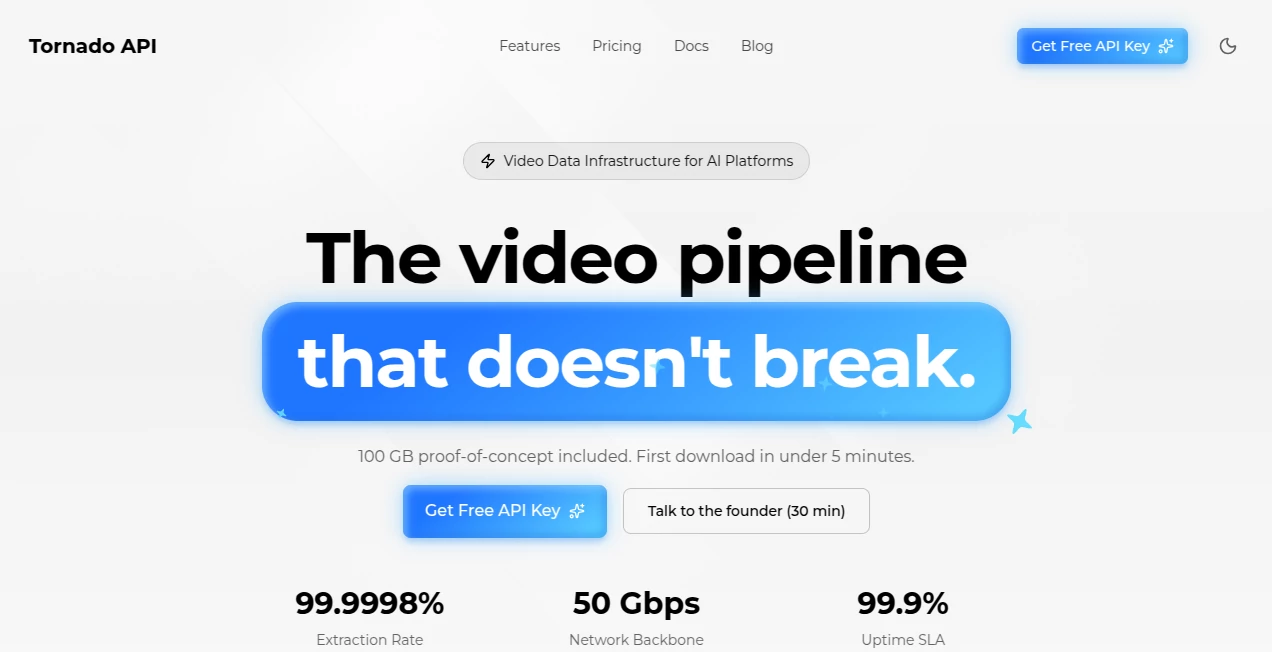
What is TornadoAPI?
When you're building something that needs thousands or millions of videos, the usual download tools fall apart fast. Rate limits hit, proxies get blocked, and suddenly your pipeline stops. This service changes the game entirely. It delivers industrial-strength video extraction that just keeps running, no matter how hard you push it. Teams working on AI training data, content archives, or large-scale analysis finally get infrastructure that matches their ambition instead of fighting against it. The reliability is impressive—once it's running, you stop worrying about the download layer and focus on what matters: your actual product.
Introduction
Most video download solutions work fine for casual use or small scripts, but they crumble under real production loads. Tornado API was built specifically for heavy workloads. It handles YouTube and Spotify at massive scale with intelligent proxy rotation, anti-detection systems, and a backbone designed to sustain high throughput without breaking. Whether you're pulling terabytes for AI datasets or archiving content libraries, it treats reliability as the baseline, not a nice-to-have. The team behind it comes from web access engineering, and that expertise shows in how smoothly everything flows even during peak demand.
Key Features
User Interface
The dashboard stays clean and developer-friendly. You get clear API key management, usage monitoring, and straightforward endpoints that feel intuitive from the first call. Documentation is practical rather than overwhelming, with good examples and quick-start guides. It's built for engineers who want to integrate fast and monitor easily without digging through layers of complexity. The whole experience feels engineered by people who actually ship at scale.
Accuracy & Performance
The extraction rate sits at an impressive 99.9998%, which translates to almost nothing slipping through the cracks. It sustains 50 Gbps network backbone capacity and delivers consistent performance even when pulling thousands of videos per hour. The system automatically handles rate limiting, CAPTCHAs, and other obstacles that kill most downloaders. In practice, once you set it up, the pipeline just works—predictable, fast, and stable.
Capabilities
It excels at bulk YouTube and Spotify downloads, supporting video + audio muxing, direct cloud storage delivery, and high-volume extraction without rate limits. You get full metadata, multiple quality options, and reliable handling of long or live content where possible. The infrastructure scales horizontally, making it suitable for both growing startups and established platforms that need terabytes of data flowing reliably. It's particularly strong for AI companies building training datasets or any team that treats video as core infrastructure.
Security & Privacy
Built with enterprise-grade practices, the service includes strong uptime SLAs, secure API access, and responsible data handling. Your keys and usage stay protected, and the system is designed to minimize unnecessary data retention. For teams dealing with large-scale content pipelines, that combination of performance and trustworthiness is essential.
Use Cases
AI research teams pull massive video datasets for training models without constantly fighting blocks. Media monitoring companies archive public content at scale for analysis. Educational platforms generate offline libraries for regions with poor connectivity. Content creators and agencies batch-download assets for editing and repurposing. The common thread is scale: wherever you need reliable, high-volume video access without the usual headaches, this infrastructure shines.
Pros and Cons
Pros:
- Truly no rate limits—designed for serious production workloads.
- Extremely high extraction success rate that you can actually rely on.
- Strong uptime SLA and founder-level support for enterprise users.
- Direct cloud delivery and clean muxing save significant post-processing time.
- Built by engineers who understand real-world scaling challenges.
Cons:
- Best suited for teams with genuine scale needs (smaller projects may not need this power).
- Pricing reflects enterprise-grade infrastructure.
- Focused primarily on YouTube and Spotify rather than every platform.
Pricing Plans
It starts with a free API key and proof-of-concept credits (including 100 GB to test seriously). Paid tiers are built around actual usage volume with predictable, usage-based pricing. Enterprise plans add dedicated SLAs, priority support, and custom infrastructure options. The model rewards teams that understand their scale requirements—paying for reliability and throughput rather than nickel-and-diming small downloads.
How to Use Tornado API
Sign up for your free API key, review the clear documentation, and make your first calls. Most teams start by testing a small batch to verify integration, then scale up to production volumes. You send URLs or search parameters, specify output options (quality, format, cloud destination), and the system handles the rest. Monitor usage in the dashboard and adjust as your pipeline grows. The whole setup is designed to go from idea to high-volume extraction faster than traditional approaches.
Comparison with Similar Tools
Many downloaders work for personal use or light automation but collapse under sustained load. This one was purpose-built for production scale from day one, with better success rates, stronger anti-blocking systems, and predictable performance. While some alternatives are cheaper for tiny volumes, the reliability and throughput here make it the stronger choice for teams that can't afford pipeline failures or constant maintenance.
Conclusion
When video data is central to your project, you need infrastructure that simply works at scale. Tornado API delivers that reliability with impressive performance and thoughtful engineering. It removes one of the biggest headaches in large-scale content work, letting teams focus on building great products instead of fighting download limitations. For anyone serious about video pipelines, it’s a refreshing upgrade that actually lives up to the promise of “set it and forget it.”
Frequently Asked Questions (FAQ)
How reliable is the extraction rate?
99.9998% success rate with contractual SLAs on higher tiers.
Do I need to manage proxies myself?
No—the system handles intelligent proxy rotation and anti-detection automatically.
What platforms are supported?
Primarily YouTube and Spotify, optimized for high-volume extraction.
Can I send videos directly to cloud storage?
Yes, with clean muxing and direct delivery options.
Is there a free way to test at scale?
Yes—free API key plus 100 GB proof-of-concept to validate before committing.
AI Data Mining , AI Research Tool , AI API Design , AI Developer Tools .
These classifications represent its core capabilities and areas of application. For related tools, explore the linked categories above.

TornadoAPI Alternatives Product

Best of AI

DiRe-RAPIDS

Gemini Omni

Standard Com…

Kimi K2.5

CodeSpy AI

Workik

Somnio

Website Clon…