
Travelscape
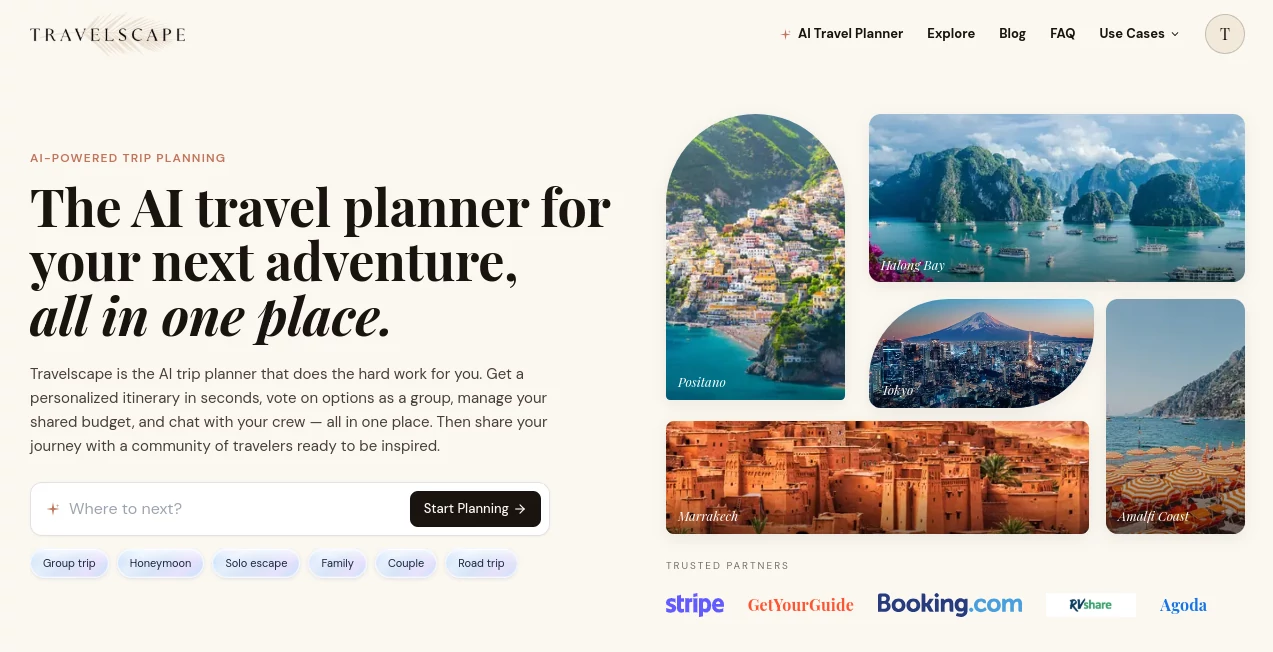
What is Travelscape?
Planning a great trip can be surprisingly time-consuming. Choosing where to stay, finding restaurants, comparing activities, working out a realistic budget, and then trying to turn everything into a sensible day-by-day schedule can easily turn a few hours of excitement into a pile of browser tabs.
Travelscape takes a different approach. Instead of making travelers piece everything together themselves, it uses AI to build personalized travel itineraries around a destination, budget, travel style, and the kind of experience someone actually wants. You can start with a clear destination, describe a particular travel vibe, or simply say that you want to get away and let the planning process develop from there.
What makes the platform particularly interesting is that it is not limited to creating an itinerary. Travelers can customize recommendations, save favorites, track trip costs, invite friends, vote on choices, chat with their group, and discover itineraries shared by other travelers. It is designed to cover the planning stage as well as the experience of traveling itself.
Key Features
The platform brings several useful parts of travel planning into one place. Its AI itinerary builder creates day-by-day plans with recommendations for accommodation, dining, activities, and experiences. Users can then replace anything that does not suit them rather than starting over from scratch.
Group planning is another strong part of the experience. Friends can work on the same trip, vote on destinations and activities, discuss decisions through chat, and keep an eye on their shared budget. This is especially useful for trips where everyone has a different opinion about where to eat, what to see, or how much to spend.
There is also a discovery and community side. Travelers can explore itineraries created by other people, find travelers nearby or at their destination, and share their own journeys, updates, and photos. The result feels less like a simple itinerary generator and more like a travel planning and discovery space.
User Interface
The planning experience is built around conversation rather than complicated forms. Users can describe their dream trip in ordinary language and provide information such as destination, dates, interests, budget, or preferred travel style. The AI then uses that information to begin building the plan.
This conversational approach is a welcome choice because travelers do not always know exactly what information they need to provide. Someone planning a family vacation, for example, can start with a simple idea and gradually refine it as recommendations appear.
The itinerary itself is organized by day, making it easier to understand the flow of a trip. Favorites can be saved, recommendations can be swapped, and the overall cost can be monitored while changes are made.
Accuracy & Performance
The value of an AI travel planner depends heavily on how relevant its recommendations are. The platform focuses on personalization rather than producing the same popular attractions for every traveler. Its planning process considers factors such as budget, interests, pace, destination, and travel style when creating an itinerary.
It also provides live destination intelligence, including weather, local events, trending restaurants, nightlife, travel advisories, and nearby discoveries. These real-time elements can make a plan more useful once a traveler is actually at the destination.
Still, travelers should treat AI-generated travel information as a planning aid rather than a substitute for checking important details directly. Opening hours, availability, transportation schedules, local restrictions, and prices can change, so important arrangements deserve a final verification before booking.
Capabilities
The capabilities go beyond basic itinerary generation. A trip can be created from a destination, a particular type of experience, a budget, or even a vague desire to travel. The system can then turn that starting point into a structured itinerary covering different parts of the trip.
Road trips are also supported, with routes, stops, accommodation, dining, activities, and estimated driving times organized into a complete travel plan. Multi-stop journeys can be customized, making the feature useful for everything from short weekend drives to longer international adventures.
For groups, the platform adds voting, shared budgeting, chat, and collaborative editing. Travelers can also discover people with similar interests and explore journeys shared by members of the travel community.
Security & Privacy
Travel planning can involve personal information such as destinations, dates, budgets, and travel preferences. Users should therefore review the platform's current privacy and account policies before sharing information they consider sensitive.
The social features also make it important to understand what is being shared publicly and what remains limited to a group or private trip. Travelers who publish itineraries, photos, or updates should take a moment to review their sharing choices, particularly when a trip contains detailed information about their movements.
Use Cases
The platform fits a wide range of travel scenarios. A solo traveler can describe an ideal destination and receive a personalized itinerary without spending an evening researching dozens of travel blogs.
Couples planning a honeymoon or weekend escape can use their interests and budget to shape a trip around restaurants, experiences, sightseeing, and relaxation rather than following a generic tourist checklist.
Families can use the planning process to organize activities around their available time and preferences. For groups of friends, the collaborative features are particularly useful because everyone can vote, chat, and keep track of the shared cost in the same planning space.
Road-trip travelers can also use the route planning capabilities to organize multiple stops and build a more complete journey rather than simply finding the fastest route between two points.
Pros and Cons
Pros
- Creates personalized day-by-day travel itineraries.
- Works with destinations, budgets, interests, and travel styles.
- Supports collaborative group trip planning.
- Includes voting, group chat, and shared budget tracking.
- Provides recommendations for hotels, restaurants, activities, and experiences.
- Includes road-trip planning with multiple stops.
- Offers travel discovery and community features.
- Provides live destination information such as weather and local events.
- Itineraries can be customized instead of being treated as fixed plans.
Cons
- AI-generated recommendations should still be checked before important bookings.
- The large number of planning and community features may feel unnecessary for travelers who only want a basic itinerary.
- Live travel information can change quickly, so travelers should verify critical details directly with providers.
- Users who prefer completely manual trip planning may find an AI-first workflow less appealing.
Pricing Plans
The current public-facing information emphasizes starting and planning trips with the AI rather than presenting a clearly defined set of paid subscription tiers. Because pricing and access policies can change as the product develops, travelers should check the current offering before making a purchasing decision.
For someone evaluating the service, the most important point is that the core experience is centered around creating and customizing trips, while additional functionality such as group collaboration, discovery, and live travel information adds value beyond a simple itinerary generator.
How to Use Travelscape
Getting started is straightforward. Begin by describing the trip you have in mind. You can provide a destination, dates, budget, interests, travel companions, or simply explain the type of experience you want.
The AI then develops a personalized itinerary organized by day. Review the recommendations and make changes wherever necessary. You can save options you like, replace activities that do not fit, and adjust the plan until the pace feels right.
If you are traveling with friends, invite them into the trip so everyone can participate. Group members can vote on options, chat about decisions, and keep track of shared spending.
Once the trip begins, the itinerary can continue serving as a travel companion, with access to relevant destination information, travel updates, weather, and nearby discoveries. Offline access is also designed to keep important trip information available when connectivity is limited.
Comparison with Similar Tools
Traditional travel websites are excellent sources of individual information, but they often leave travelers responsible for connecting the pieces. One site may handle hotels, another restaurants, another attractions, and a separate app may be needed for navigation or group communication.
Basic AI itinerary generators solve part of that problem by creating a schedule from a prompt. The stronger distinction here is the attempt to combine itinerary creation with collaborative planning, budgeting, group communication, travel discovery, and live destination information.
For example, a group planning a week in Italy could use the AI to create an initial route, vote on hotels and activities, discuss the choices together, monitor the shared budget, and later share the completed journey with other travelers. That broader workflow is more useful than simply receiving a list of places to visit.
Conclusion
Travelscape is a compelling option for travelers who want more than a generic list of attractions. Its biggest strength is the way it connects personalized AI planning with the practical realities of traveling with other people.
The combination of customized itineraries, budget tracking, group voting, shared conversations, road-trip planning, live destination information, and a traveler community gives the experience considerably more depth than a basic itinerary generator.
It is particularly well suited to people who enjoy the idea of traveling but would rather spend their time imagining the trip than researching it across countless tabs. Give the system a destination, a budget, a mood, or simply a reason to escape, and it can turn that starting point into something much closer to a real travel plan.
Frequently Asked Questions (FAQ)
What is an AI travel planner?
An AI travel planner uses artificial intelligence to create travel recommendations and itineraries based on information such as destination, budget, interests, dates, and travel preferences. Instead of manually assembling every part of a trip, travelers can begin with a natural-language description and refine the resulting plan.
Can I use it for group trips?
Yes. Group planning is one of its central features. Travelers can invite friends, vote on destinations, accommodation, restaurants, and activities, communicate through a shared chat, and track the group's budget.
Can I plan a road trip?
Yes. The road-trip planning functionality can create multi-stop routes with accommodation, dining, activities, stops, and estimated driving times organized into a day-by-day itinerary.
Can I customize the AI-generated itinerary?
Yes. Travelers can save favorites, replace recommendations, adjust details, and fine-tune the itinerary so it better matches their preferred pace, interests, and budget.
Does it provide information while traveling?
Yes. The platform is designed to provide live destination information such as weather, travel advisories, local events, trending restaurants, nightlife, and nearby experiences. It also aims to keep important itinerary information available offline.
Can I discover other travelers?
Yes. The community features allow users to discover like-minded travelers near them or at their destination, based on travel interests and styles.
Can I share my travel itinerary?
Yes. Travelers can share itineraries and publish parts of their journey, including updates and photos, with other people or the wider travel community depending on their sharing preferences.
Should I verify AI travel recommendations?
Yes. AI is useful for building and organizing a trip, but important details such as booking availability, opening hours, prices, transportation schedules, entry requirements, and travel restrictions should be confirmed before making final arrangements.
AI Life Assistant , AI Trip Planner .
These classifications represent its core capabilities and areas of application. For related tools, explore the linked categories above.
Travelscape details
Website unavailable — View Alternatives
Pricing
- Freemium
Apps
- Web App
Categories

Travelscape Alternatives Product

Omoglow

GetFIT App

Meet in the …

Stinglo

Japanese Nam…

AuraMeaning

Hall Of Tarot

KronoPrompt

Schengen Cal…