
Evergreen AI
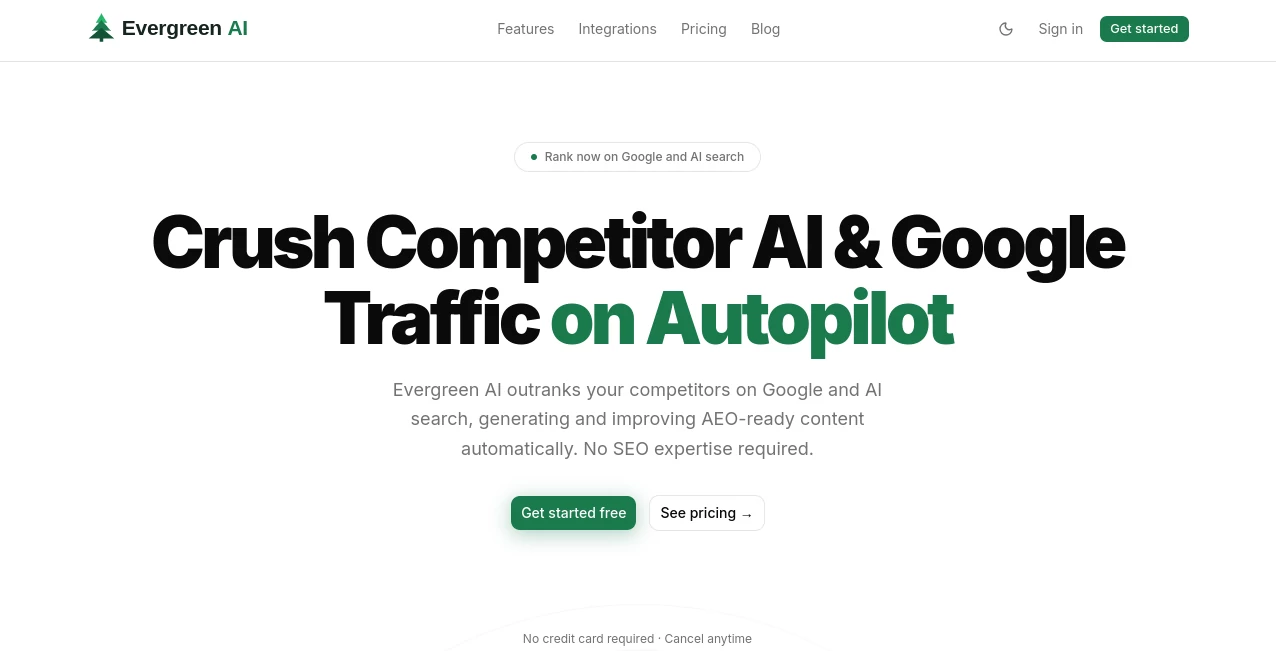
What is Evergreen AI?
Evergreen AI is an automated SEO and content platform built for businesses that want to grow their visibility across Google and AI-powered search without building a large SEO team. Instead of simply generating articles on demand, it continuously watches competitors, researches search opportunities, creates content, and identifies existing pages that could perform better.
The idea is refreshingly practical: find where competitors are winning, understand why, create something worth publishing, and keep improving the site as search performance changes. For a small business owner who does not have hours every week for keyword research and content planning, that ongoing process can remove a surprisingly large amount of manual work.
The platform is designed around an always-on workflow. It can identify content gaps, research high-intent keywords, produce articles designed for traditional search and answer engines, and publish them directly to supported content management systems.
Key Features
- Competitor tracking and content-gap discovery
- Keyword research focused on high-intent opportunities
- Automated content creation and publishing
- Existing-page auditing and enhancement
- Google Search Console integration
- AEO-ready content with structured, answer-focused formatting
- Daily automated content workflows
- Competitor gap analysis
- CMS publishing integrations
- Markdown and HTML export
- Continuous ranking monitoring
- AI-slop filtering and multi-step content analysis
User Interface
The experience is built around automation rather than a complicated SEO dashboard. Users can connect their website, choose competitors, and configure how the system approaches content production. Those who already understand SEO can also influence the process by selecting competitors and adjusting writing preferences such as voice, formality, and reader level.
This approach makes the platform particularly appealing to small teams. Instead of jumping between a keyword research tool, content brief, writer, CMS, and analytics dashboard, much of the workflow is brought into one continuous system.
Accuracy & Performance
One of the more interesting parts of the system is the research process behind each article. The platform states that 35 separate steps run before an article is produced, including live SERP analysis, competitor research, format scoring, AEO structuring, and filtering intended to reduce generic AI-style writing.
Its published case study for TubTabs reports a 650% increase in organic clicks, 9.5 times more ranking keywords, and a rise in impressions of 1,257% over a 12-month period. These figures come from the company's own case study, so they should be viewed as an example rather than a guaranteed result for every website.
SEO results naturally depend on competition, website quality, search demand, and the usefulness of the published content. The platform itself notes that SEO is a compounding process rather than an overnight switch.
Capabilities
The core strength is the combination of research, creation, and optimization. It can identify keywords competitors rank for while a customer's website does not, research those opportunities, generate on-brand articles, and publish them to a connected CMS.
It can also work on pages that already exist. Rather than treating SEO as a blog-only activity, the system can audit service pages, homepages, and older articles, identify pages that are losing visibility, and refresh or expand them.
For businesses trying to build visibility in both conventional search and newer AI search experiences, the AEO-oriented output is another notable capability. Content is structured to provide direct answers and supporting information that can be easier for answer engines to understand and potentially cite.
Security & Privacy
According to the published privacy policy, customer content is processed on the user's behalf and is not used by the company to train its own AI models. The service also states that submitted content is not used to train the underlying AI provider's models under its commercial agreement.
Connected Google Search Console and CMS credentials are encrypted at rest, with application-level encryption for connected-account credentials. Traffic and stored data are encrypted, and database-level access controls are used to restrict records to the appropriate organization.
Users should still review generated material before publishing. The privacy policy explicitly notes that AI-generated output can sometimes be inaccurate, outdated, or unintentionally similar to existing material.
Use Cases
- Small businesses: Build a consistent organic content strategy without hiring a full SEO department.
- Marketing teams: Automate repetitive research and content production while keeping control over strategy.
- Agencies: Reduce manual work involved in competitor research, content planning, and page optimization.
- Local businesses: Discover search opportunities around services, customer questions, and commercial keywords.
- E-commerce companies: Improve organic visibility around products, categories, comparisons, and buyer-intent searches.
- Content-heavy websites: Keep an expanding library of existing pages fresh instead of constantly starting from scratch.
Pros and Cons
- Pros: Automated competitor research, continuous SEO monitoring, content generation, existing-page enhancement, AEO-focused output, Google Search Console integration, and direct CMS publishing.
- Pros: The workflow is suitable for businesses that want ongoing SEO activity rather than occasional content generation.
- Pros: A single plan includes competitor tracking, articles, page enhancements, integrations, and export options.
- Cons: The $149 monthly price may be higher than what very small websites want to spend on an entry-level writing tool.
- Cons: AI-generated content still requires human review before publication.
- Cons: SEO improvements cannot be guaranteed because rankings depend on many factors outside any content platform's control.
Pricing Plans
There is one main subscription plan priced at $149 per month, billed monthly with no long-term contract. The plan includes tracking for three competitors, up to 30 articles per month, and 10 page enhancements per month.
The subscription also includes competitor gap analysis, Google Search Console integration, AEO-ready output, CMS publishing, and Markdown or HTML export. Customers can cancel at any time, and the service states that published articles and enhancements remain theirs to keep.
A free start is available without requiring a credit card. There is also a managed service for businesses that prefer to have the entire content engine handled for them.
How to Use It
- Connect your website and relevant content management system.
- Connect Google Search Console if you want search performance data incorporated into the workflow.
- Select competitors whose search visibility you want to monitor.
- Let the system identify keyword and content gaps.
- Review the opportunities and configure the desired writing preferences.
- Allow the platform to research and create new content or improve existing pages.
- Publish directly through a supported CMS or export the content as Markdown or HTML.
- Monitor ranking changes and continue improving pages as new opportunities appear.
Comparison with Similar Tools
Many AI writing platforms focus primarily on producing text after a user provides a topic or prompt. This platform takes a broader approach by connecting content creation with competitor monitoring, keyword research, ranking data, page enhancement, and publishing.
That distinction matters for businesses that do not simply need another writing assistant. If the real problem is maintaining a complete organic-growth workflow every week, combining research, production, optimization, and publishing can be considerably more useful than generating isolated articles.
It is also aimed at a different need than traditional SEO agencies. Instead of paying a large monthly retainer for ongoing manual work, businesses can use an automated system at a fixed monthly price, while still having the option of a managed service when they want a more hands-off approach.
Conclusion
For businesses that want SEO to become a regular operating process rather than a collection of occasional tasks, this platform offers a compelling approach. Its strongest point is not simply that it can write articles. The more valuable proposition is the complete loop around those articles: monitor competitors, uncover opportunities, research the topic, create content, publish it, watch performance, and improve pages that start slipping.
The combination of Google search optimization and AEO-focused content also makes it relevant as search behavior continues to change. It will not eliminate the need for judgment, editing, or a strong understanding of the business, but it can take much of the repetitive work off a marketing team's plate.
Frequently Asked Questions (FAQ)
Do I need SEO experience to use it?
No. The platform is designed to handle competitor research, content creation, and on-page optimization automatically. More experienced SEO users can still configure competitors and writing preferences.
Can it improve existing website pages?
Yes. It can monitor existing pages, identify pages that are losing rankings, and refresh, expand, and re-optimize them rather than focusing exclusively on new blog content.
Does it publish content automatically?
Yes. Content can be published directly to supported CMS platforms. The available integrations include WordPress, Shopify, Sanity, Webflow, Wix, and Ghost, while Markdown and HTML export are also available.
What is AEO?
AEO stands for Answer Engine Optimization. It focuses on structuring information so that AI-powered search and answer systems can understand, extract, and potentially cite useful answers from the content.
Can I cancel the subscription?
Yes. The main plan is billed monthly, has no long-term contract, and can be canceled at any time.
Should AI-generated content be reviewed before publishing?
Yes. Human review is recommended because generated content can contain inaccuracies, outdated information, or similarities to existing material. Reviewing important claims and ensuring the content accurately represents the business remains essential.
AI Blog Writer , AI Content Generator , AI SEO Assistant , AI General Writing .
These classifications represent its core capabilities and areas of application. For related tools, explore the linked categories above.

Evergreen AI Alternatives Product

Aiso

AI Bypass Hub

Jasper

Schedpilot

MaxAEO

SEO Tools Hu…

KwaKwa Cours…

UPDF AI

Translate a …