














Translate a Book with AI
Verified Blue CheckMark
Verified Blue CheckMark products are featured above free or unverified listings.
This badge indicates authenticity and builds trust, giving your product higher visibility across the platform.
Upgrade to get verified
Verified Blue CheckMark products are featured above free or unverified listings. This badge indicates authenticity and builds trust, giving your product higher visibility across the platform.
Upgrade to get verified
What is Translate a Book with AI?
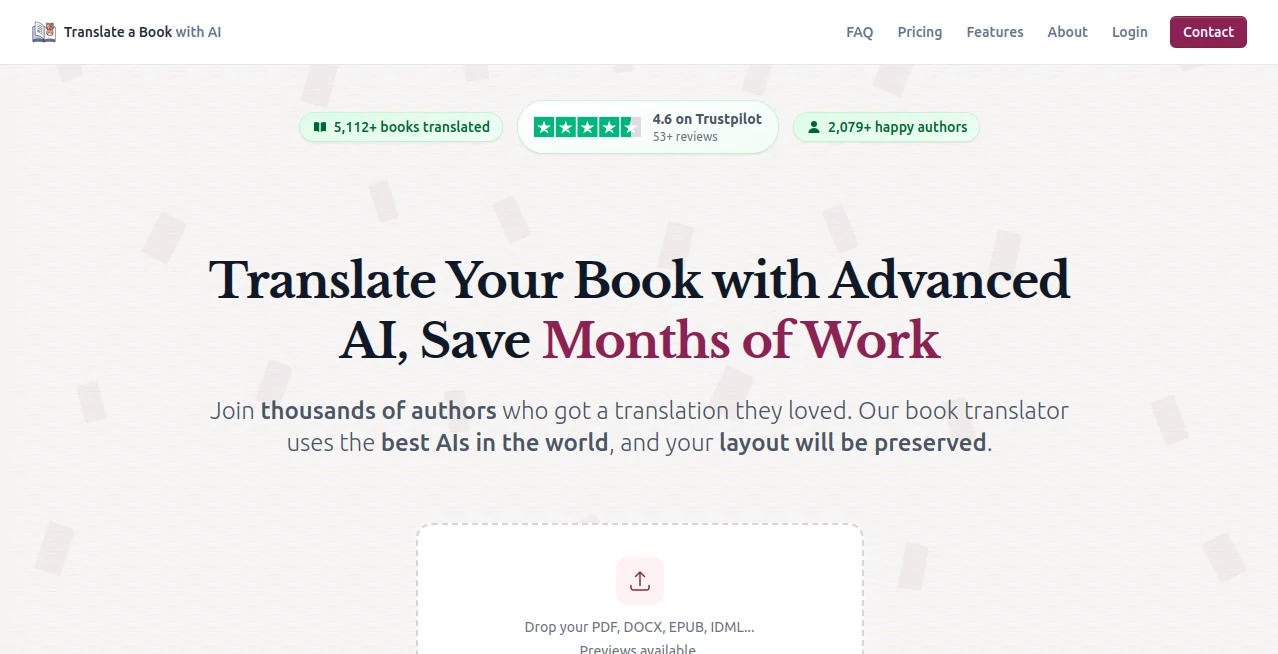
Bringing a book to readers in multiple languages has traditionally been one of the most expensive and time-consuming parts of publishing. For independent authors, publishers, educators, and businesses, the process often requires months of coordination, editing, formatting, and review. This platform takes a refreshingly different approach by combining advanced artificial intelligence with a workflow specifically designed for complete book translation.
Unlike generic translation tools that focus on short documents or isolated text, this solution is built for full-length manuscripts. It analyzes the entire book before translation begins, helping maintain consistent terminology, character references, tone, and writing style throughout the project. The result feels far more coherent than typical machine-generated translations.
One of the most impressive aspects is its ability to preserve formatting and layout across multiple file types. Authors can upload their manuscript and receive a translated version that remains visually close to the original, significantly reducing post-translation production work.
Key Features
User Interface
The platform offers a clean and straightforward workflow that makes large translation projects surprisingly accessible. Users can upload files, receive an instant quote, select target languages, review translation settings, and manage the entire process without technical expertise.
The translation guide editor is particularly useful. Before translation begins, users can review AI-generated insights about characters, terminology, audience, and writing style, allowing greater control over the final result.
Accuracy & Performance
Instead of translating content section by section without context, the system evaluates the entire manuscript first. This broader understanding helps maintain consistency across hundreds of pages, reducing common issues such as changing terminology, shifting character descriptions, or inconsistent narrative tone.
The platform is especially effective for nonfiction books, business publications, educational materials, self-help content, and many fiction genres where consistency and readability are essential.
Capabilities
- Full book translation across multiple languages.
- AI-generated translation guides for consistency.
- Support for EPUB, DOCX, PDF, IDML, and other formats.
- Layout and formatting preservation.
- Preview generation before purchase.
- Custom style and terminology instructions.
- Built-in proofreading and error-correction workflows.
- Fast processing for large manuscripts.
Security & Privacy
Privacy is treated seriously. Uploaded files are not used to train AI models, and manuscripts remain under the author's ownership. Automatic file deletion policies add an extra layer of protection for sensitive publishing projects, making the platform suitable for both independent writers and professional publishers.
Use Cases
- Independent authors expanding into international markets.
- Publishers translating book catalogs into multiple languages.
- Educational organizations localizing textbooks and learning materials.
- Businesses translating training manuals and professional publications.
- Researchers distributing academic work to wider audiences.
- Self-published writers preparing multilingual releases for online marketplaces.
Pros and Cons
Pros
- Designed specifically for complete book translation.
- Preserves document layout and formatting.
- Translation guide improves consistency across long manuscripts.
- Supports numerous file formats.
- Significantly faster than traditional translation workflows.
- Offers affordable pricing compared to conventional services.
- Provides preview options before committing to a project.
Cons
- Poetry and highly stylized literary works may still require expert human review.
- Final proofreading by a native speaker remains recommended for publication-ready results.
- Translation quality may vary depending on language pairs and manuscript complexity.
Pricing Plans
The platform offers several translation modes designed for different needs and budgets.
- Standard Mode: Fast and affordable translations for general projects.
- Pro Mode: Enhanced consistency and language quality for professional use.
- Author Mode: Deep manuscript analysis with advanced translation guidance and maximum quality.
Pricing varies according to document length, language combination, and selected mode, making it flexible for both small and large publishing projects.
How to Use Translate A Book With AI
Getting started is straightforward and requires only a few steps.
- Upload your manuscript in a supported format.
- Choose the target language or languages.
- Review the automatically generated translation guide.
- Edit terminology, style preferences, and character information if needed.
- Start the translation process.
- Download the translated manuscript while maintaining its original layout.
- Perform a final review before publishing.
This workflow removes much of the complexity typically associated with multilingual publishing.
Comparison with Similar Tools
Many translation services focus on documents, web pages, or short text segments. While those solutions can handle basic translation tasks, they often struggle with long-form content that requires context across hundreds of pages.
This platform stands out because it approaches translation as a publishing workflow rather than a simple text conversion process. Features such as manuscript-wide analysis, translation guides, formatting preservation, and specialized book support provide advantages that general-purpose translation tools rarely offer.
For authors and publishers, these capabilities can save considerable time while reducing the need for extensive post-processing and formatting corrections.
Conclusion
For anyone looking to make books available to a global audience, this platform offers an impressive combination of speed, affordability, and publishing-focused functionality. Its manuscript analysis system, formatting preservation, and consistency controls address many of the challenges that have historically made book translation difficult and expensive.
While professional human translators still play an important role for highly creative literary works, this solution provides a practical and efficient option for the vast majority of publishing projects. Authors seeking to expand internationally will find it a valuable addition to their publishing toolkit.
Frequently Asked Questions (FAQ)
Can it translate entire books?
Yes. The platform is specifically designed to handle complete manuscripts rather than small text fragments.
Does it preserve formatting?
Yes. One of its core strengths is maintaining layout, images, headings, and overall document structure.
Which file formats are supported?
It supports popular publishing formats including EPUB, DOCX, PDF, IDML, and several others.
Is the content used to train AI models?
No. Uploaded manuscripts are not used for AI training, and privacy measures are in place to protect user content.
Do I still need human proofreading?
For professional publishing, a final review by a native speaker is recommended to ensure the highest possible quality.
Can I preview a translation before purchasing?
Yes. Preview options are available, allowing users to evaluate translation quality before committing to a full project.