
Prefer
What is Prefer?
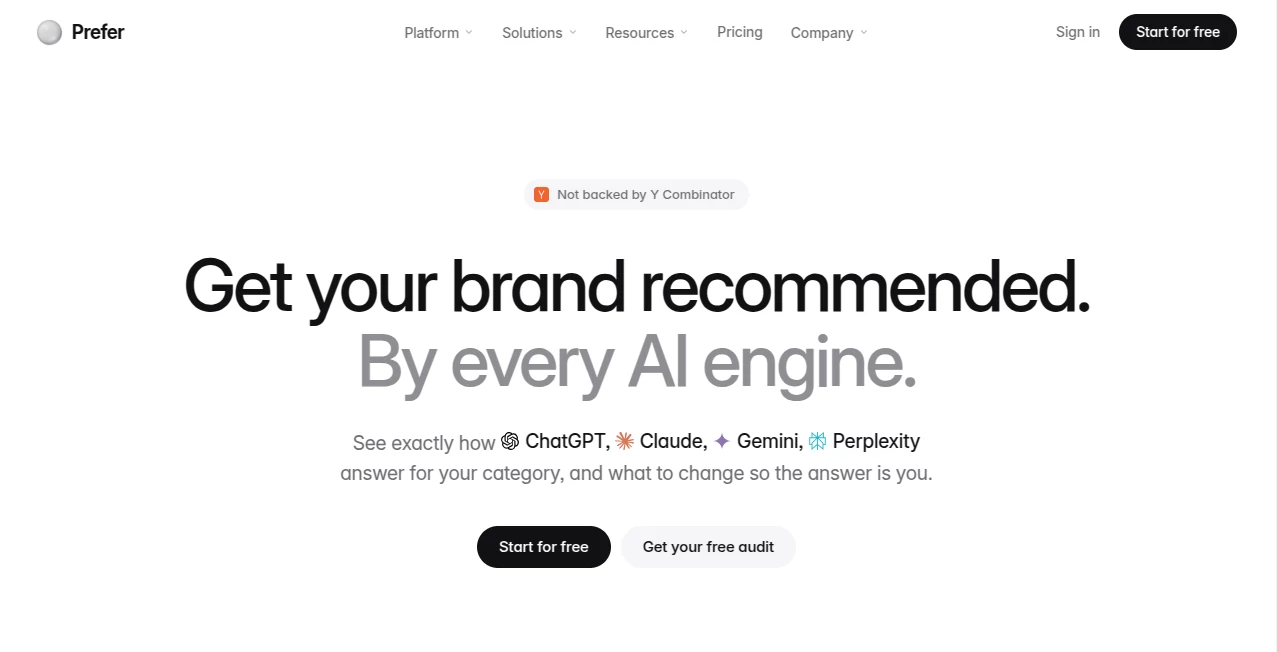
People no longer type a few keywords into Google and scroll through ten blue links. They ask ChatGPT, Claude, Gemini or Perplexity what the best tool is for their problem and take the first solid answer they get. If your brand never shows up in those answers, you are invisible to a growing share of buyers. This platform was built exactly for that new reality. It shows you how the major answer engines talk about your category, where you stand against competitors, and what concrete changes will make them start recommending you instead.
Introduction
Search has shifted. The questions that used to live in search boxes now live in chat windows, and the brands that win are the ones the models actually name. Traditional SEO tools still focus on rankings and backlinks, but they cannot tell you why Claude prefers one expense tool over another or which of your pages Perplexity has never even crawled. This system closes that gap. It tracks the exact prompts real buyers type, measures your visibility and sentiment across engines, spots the content gaps that competitors already fill, and then helps you create or fix the pages that get cited. The result is not another vanity dashboard. It is a practical way to move from “we hope AI mentions us” to “we know how to make it happen.”
Key Features
User Interface
The dashboard feels calm and purposeful. You open it and immediately see visibility scores, recent AI answers about your brand, and a prioritized list of actions ranked by expected impact. Charts stay readable, tables are clean, and the important numbers sit at the top so you do not have to dig. Switching between prompt tracking, competitor views and content recommendations is fast. Even the first-time user can orient themselves in a few minutes without needing a long training session.
Accuracy & Performance
The platform runs real prompts against the major models on a daily schedule and records the actual answers, not estimates. Citation sources, sentiment and share of voice are pulled from live responses, so the data reflects what users actually see. When it recommends a technical change or a new page, the suggestion comes with the evidence that produced it. Teams that have used it report that the highest-impact actions often deliver measurable lifts in mentions within weeks, which is the only accuracy that ultimately matters.
Capabilities
It tracks the prompts buyers use in your category and shows when the answer names you. Citation analysis reveals which types of pages (listicles, product pages, review sites, comparison articles) drive visibility and where you are missing. Agent analytics surface in real time which of your URLs ChatGPT, Claude, Perplexity and others are reading. Content agents can draft new pages or refresh existing ones using the same citation patterns the models already reward. An action center ranks every opportunity by expected impact and can even execute many of the technical fixes automatically. Competitor tracking shows exactly where rivals beat you and what content is carrying them. Integrations with CMS tools, analytics platforms and Slack keep the workflow inside the systems your team already uses.
Security & Privacy
Brand data and crawl information stay inside your workspace. Access can be limited by role, and enterprise plans add SSO and more granular controls. The system is designed so marketing teams can work with sensitive competitive insights without exposing them more broadly than necessary.
Use Cases
A SaaS marketing team discovers that ChatGPT almost never mentions them for the core “best tool for X” queries. They use the gap analysis to create three comparison pages and update schema on key product pages. Within a month the share of voice in those prompts rises noticeably. An agency managing several clients runs separate workspaces, pulls weekly visibility reports, and shows each client exactly which content changes moved the needle. A growth lead at a fintech startup watches agent crawls in real time, unblocks previously disallowed paths in robots.txt, and sees new pages start getting cited. In each case the platform turns vague “we should do something about AI search” into a clear, measurable program.
Pros and Cons
Pros:
- Focuses specifically on answer engines rather than treating them as an afterthought to traditional SEO.
- Combines monitoring, prioritization and content creation in one place so insights do not sit unused.
- Daily prompt refreshes and real citation data give a reliable picture of current visibility.
- Action center scores opportunities by impact, which helps teams avoid busywork.
- Works with existing CMS and analytics tools instead of forcing a new publishing workflow.
Cons:
- Full value requires consistent follow-through on the recommended actions; the tool cannot publish for you without integrations.
- Higher-tier plans are needed for larger prompt volumes and more competitors.
- Results still depend on how quickly the answer engines recrawl and update their knowledge.
Pricing Plans
Plans start with a Starter tier aimed at solo marketers and small brands, then move through Growth and Scale for larger teams, with custom Enterprise options for multi-region or agency needs. Pricing is structured around the number of tracked prompts, competitors, content drafts and team seats. Annual billing brings a discount. A free AI visibility report is available so teams can see their current standing before committing. There is usually a trial period and a straightforward money-back window on paid plans.
How to Use Prefer
Begin with the free visibility audit by entering your brand and category. Review the initial report to see how the major engines currently describe you and where the biggest gaps sit. Once inside the full platform, set up the prompts that matter most to your buyers and add the main competitors. Check the action center for the highest-impact technical and content fixes. Use the content agents or the scoring tools to draft or refresh pages that fill the gaps. Connect your CMS if you want drafts to move straight into your publishing workflow. Monitor the visibility and citation metrics over the following weeks and adjust the prompt list as new questions appear in your market. The rhythm is straightforward: measure, prioritize, act, measure again.
Comparison with Similar Tools
Most traditional SEO platforms still treat answer engines as a minor extension of classic search rankings. Pure monitoring tools can show you mentions but stop short of helping you create the content that earns them. This platform sits in the middle: it measures visibility across ChatGPT, Claude, Gemini, Perplexity and related surfaces, then ranks concrete actions and supports the content work needed to improve those numbers. Teams that have tried both pure monitors and broad SEO suites often find the combination of prompt-level tracking, citation insight and prioritized execution more directly useful for the new search reality.
Conclusion
Answer engines are already shaping how people discover and choose products. Brands that treat this shift as optional will slowly lose share to those that treat it as a core channel. This system gives marketing teams a clear view of what the models currently say, a ranked list of what to change, and practical help creating the pages that get cited. Used consistently, it turns AI visibility from a vague hope into a managed, measurable part of the growth stack. For any company that depends on being recommended when buyers ask for the best solution, that is a meaningful advantage.
Frequently Asked Questions (FAQ)
What exactly is answer engine optimization?
It is the practice of understanding and improving how large language models and AI search products describe and recommend your brand when users ask category questions.
Which AI engines does it track?
The main ones include ChatGPT, Claude, Gemini, Perplexity, Google AI Overviews and related surfaces, with additional models available on higher plans.
How quickly can results appear?
Technical fixes such as allowing crawlers can show impact once the engines recrawl. Content changes often take a few weeks to start influencing answers, depending on the topic and competition.
Do I need a large content team to use it?
No. The action center and content agents are designed to surface the highest-leverage work so even small teams can focus on the changes that matter most.
Is there a way to try it before paying?
Yes. A free visibility report is available, and paid plans typically include a trial period so teams can evaluate the data against their own category.
AI SEO Assistant , AI Content Generator , AI Research Tool , AI Analytics Assistant .
These classifications represent its core capabilities and areas of application. For related tools, explore the linked categories above.

Prefer Alternatives Product

Orchestra

SEO Tools Hu…

SupaTraffic

LinkedIn Spe…

DidYouSEO

Analyse

PostingCat

LinkedIn Spe…

MaxAEO