














UpSearch
What is UpSearch?
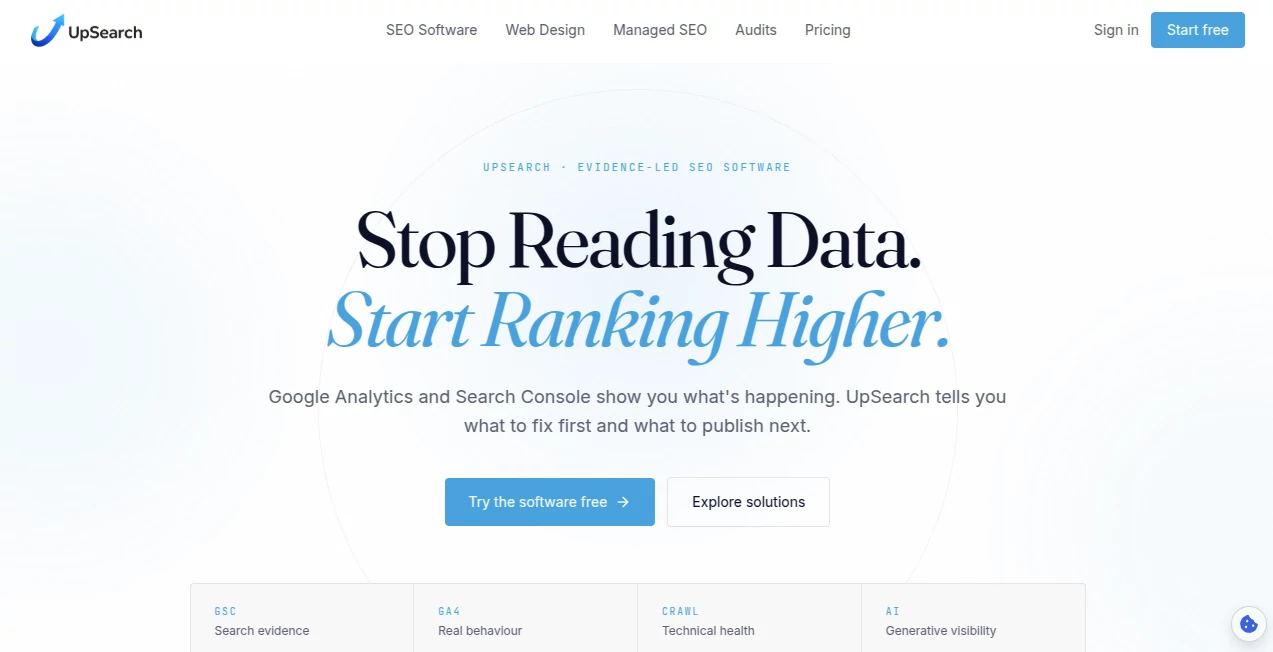
UpSearch is an evidence-led SEO and AI visibility platform built for businesses, marketing teams, agencies, and consultants that want to turn search data into practical decisions. Instead of leaving users with a long list of technical findings, the platform brings together Google Search Console, Google Analytics 4, website crawl data, SERP information, and AI visibility signals to help identify what deserves attention first.
The idea is straightforward: find the problem, understand why it matters, take action, and then measure what changed. For someone managing a growing website, that approach can make SEO work feel much less scattered. A marketer can move from discovering a traffic opportunity to improving a page and monitoring its results without constantly switching between unrelated tools.
Key Features
User Interface
The platform is designed around priorities rather than overwhelming dashboards. Its workspace connects search performance, website health, content opportunities, and visibility signals in one place. Users can ask questions in plain English through the specialised SEO assistant and receive recommendations grounded in available website data.
The workflow also includes saved findings and task-oriented features, making it easier to keep track of problems that need attention. This is particularly useful when SEO is an ongoing responsibility rather than a one-time audit.
Accuracy & Performance
A major strength is its emphasis on evidence. The system can work with Search Console queries, clicks, impressions, click-through rates, and search positions, while GA4 contributes information about sessions, engagement, journeys, and conversions. Crawl and SERP data add another layer by examining content, metadata, indexation, and competitors.
When important information is unavailable, the platform is designed to identify that limitation rather than simply filling the gap with an unsupported recommendation. This evidence-first approach is valuable for teams that want their SEO decisions tied to actual website performance.
Capabilities
The platform covers much more than traditional site auditing. Its SEO Check Engine can identify technical and content-related problems, while the AI Analyst helps users understand what to fix and what to work on next.
Content Studio can turn real keyword and performance information into content workflows, and eligible plans support publishing integrations for platforms such as WordPress, Ghost, Webflow, Shopify, Wix, LinkedIn, and websites connected through webhooks.
Other capabilities include backlink management, technical SEO tools, focused SEO reports, marketing planning, SEO monitoring, content generation, and AI search visibility analysis. The system can also help identify weak pages, unmet search demand, technical issues, and opportunities that may otherwise be buried inside separate reports.
Security & Privacy
Because the platform can connect to services such as Google Search Console and Google Analytics 4, account access and connected data are important considerations. Users should review the permissions requested during setup and connect only the properties required for their work.
The service also distinguishes between software customers and clients using its managed services. According to its FAQ, an account is required for customers using the SEO software, while web design, managed SEO, and audit clients work directly with the team.
Use Cases
For a small business owner, the platform can help answer a simple but important question: what should be fixed first? Rather than manually reviewing dozens of reports, the user can work from prioritised findings and connect them to actual search and website behaviour.
In-house marketing teams can use it to organise recurring SEO work, monitor visibility, investigate changes in organic traffic, and plan content around real opportunities. An agency can use the multi-site capabilities to research, report, monitor, and organise SEO work for several clients.
Content teams can also benefit from the connection between search evidence and content creation. Instead of choosing topics solely from generic keyword lists, they can use available performance data to identify areas where new or improved content has a stronger business case.
Pros and Cons
- Pros: Combines SEO analysis, search data, website crawling, content workflows, and AI visibility in one platform.
- Pros: Recommendations are designed around real evidence from connected data sources.
- Pros: Includes practical tools for turning findings into tasks and content.
- Pros: Supports direct publishing through several integrations on eligible plans.
- Pros: Suitable for individual website owners as well as agencies and larger teams.
- Cons: The wider feature set may take some time to learn if you are new to professional SEO.
- Cons: The quality of some recommendations naturally depends on the amount and quality of connected website data.
- Cons: Higher-volume workflows require paid plans with larger site and credit limits.
Pricing Plans
The SEO software has a free starting option, allowing users to begin without a payment card. The paid Solo plan starts at €29.99 per month and supports two sites with 100 monthly credits. It includes the full SEO Check Engine, evidence-backed AI Analyst, Marketing Hub, SEO reports, backlink and technical SEO tools, Content Studio, publishing integrations, and a monthly SEO Intelligence email.
The Growth plan costs €69.99 per month and supports up to five sites with 200 monthly credits. It adds weekly evidence-led content generation, saved drafts, backlink profile and authority reports, monthly SEO monitoring, and direct publishing integrations.
The Business plan is €99.99 per month and supports up to ten sites with 300 monthly credits. It adds wider backlink reporting, ranking and traffic-drop alerts, higher usage limits, weekly SEO operations reporting, and priority support.
Additional credits are available when needed. Users can purchase 100 credits for €10 or 200 credits for €20, and purchased credits do not expire. Annual billing is also available for the software plans.
Beyond the software, the company offers web design, managed SEO, and independent SEO, AI visibility, analytics, and advertising audits. These services have separate pricing and scopes.
How to Use the Platform
- Create an account and start with the available software option.
- Connect Google Search Console and Google Analytics 4 when available to provide stronger performance evidence.
- Allow the platform to crawl and analyse the website.
- Review the prioritised findings and identify the issues with the greatest potential impact.
- Use the SEO assistant and specialist tools to investigate specific problems or opportunities.
- Turn important findings into tasks and work through them in a practical order.
- Use Content Studio when a content opportunity has been identified from real search data.
- Publish through a supported integration when the selected plan allows it.
- Monitor search visibility, traffic, engagement, and conversions to see whether the changes produced useful results.
Comparison with Similar Tools
Many SEO platforms are primarily built around keyword tracking, backlink databases, technical audits, or reporting. This platform takes a broader approach by connecting several evidence sources and then focusing on what should happen next.
For example, a conventional audit may identify a technical issue and leave the user to decide what to do with it. Here, the intended workflow goes further by connecting findings with tasks, content opportunities, performance data, and ongoing monitoring.
That makes it particularly interesting for teams that do not simply want another SEO dashboard. If the main goal is to understand why a website is changing, decide where effort should go, and keep the work connected to measurable outcomes, its integrated approach can be a practical alternative to using several disconnected services.
Conclusion
UpSearch takes a practical view of SEO: data is useful only when it leads to a better decision. By bringing together Search Console, GA4, crawl information, SERP data, content workflows, and AI visibility signals, the platform gives website owners a more connected way to investigate and improve organic performance.
It is a strong fit for marketers and teams that want more than a collection of reports. The combination of evidence-backed recommendations, prioritised tasks, content tools, publishing options, and ongoing monitoring makes it possible to move from diagnosis to action without losing sight of the original business objective.
Frequently Asked Questions (FAQ)
What is the platform mainly used for?
It is primarily used for SEO analysis, website optimisation, content planning, search visibility monitoring, and AI search visibility. It combines several data sources to help users decide what to improve first.
Can it connect to Google Search Console?
Yes. Google Search Console can provide search queries, clicks, impressions, click-through rates, and position data that the platform uses as part of its evidence base.
Does it support Google Analytics 4?
Yes. GA4 can provide information about organic sessions, engagement, user journeys, and conversions. Connecting it can give the platform stronger evidence for prioritising SEO work.
Does the platform have a free option?
Yes. The free software option includes one connected site, five one-time starter credits, limited chat, and three free toolkits. No payment card is required to start.
Can it generate SEO content?
Yes. Eligible plans include evidence-led content generation through Content Studio, using real keyword and performance data to support content creation.
Can content be published directly?
Yes. Eligible plans support publishing integrations for platforms including WordPress, Ghost, Webflow, Shopify, Wix, LinkedIn, and other websites through webhooks.
Is it suitable for SEO agencies?
Yes. The higher software plans support multiple connected websites, while the platform also provides reporting, backlink analysis, monitoring, content workflows, and tools that can fit agency-oriented SEO operations.
Does it guarantee higher Google rankings?
No. The company explicitly states that it does not guarantee rankings or AI citations because search engines and generative AI systems are controlled by third parties.
AI SEO Assistant , AI Productivity Tools , AI Research Tool , AI Analytics Assistant .
These classifications represent its core capabilities and areas of application. For related tools, explore the linked categories above.
UpSearch details
Pricing
- Freemium
Apps
- Web App
Categories
UpSearch Alternatives Product

FormRoyale

OnlyTraction

Kol find

Rierino

Betula AI

Zivy

Website Traf…

PineBill
Yorph AI