Verified.fyi
What is Verified.fyi?
Before entering your credit card details, creating an account, or sharing personal information with an unfamiliar website, it is worth taking a moment to check whether the site deserves your trust. The problem is that modern scams can look surprisingly convincing. A polished design, HTTPS connection, and professional-looking branding are no longer enough to tell a legitimate website from a risky one.
verified.fyi offers a straightforward way to investigate a website before interacting with it. Users simply paste a web address and receive a trust report built from more than 200 signals. Instead of presenting a confusing collection of technical results, the service turns those findings into a trust score and a plain-English explanation.
The service is particularly useful when you encounter an unfamiliar online store, SaaS product, financial website, blog, download page, or link shared through social media. There is no software to install and no account is required, so checking a suspicious domain takes only a few moments.
Key Features
- Free website trust checks with no sign-up requirement.
- Analysis based on more than 200 signals.
- Trust scores ranging from 0 to 100.
- Plain-English explanations of the findings.
- Cross-checking through sources such as Google Safe Browsing, VirusTotal, WHOIS, Trustpilot, and certificate logs.
- Analysis covering security, identity, reputation, infrastructure, and other trust-related signals.
- Recent website checks that allow users to explore reports generated for other domains.
- Industry-based comparisons showing how websites perform against average scores in their category.
- Detailed reports for users who want to investigate individual trust signals.
- Regularly updated checks designed for the changing risks of the modern web.
User Interface
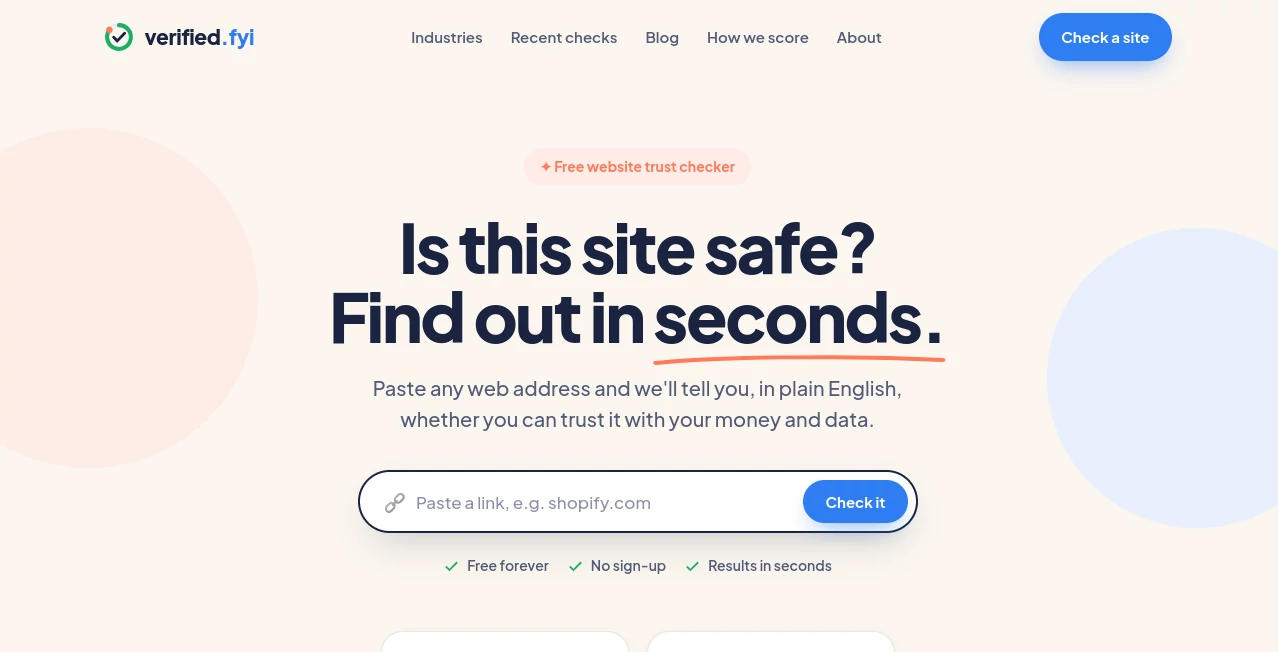
The interface keeps the process refreshingly simple. The main action is immediately visible: paste a website address and start the check. There are no complicated settings to configure and no technical knowledge required before running a report.
After the analysis is complete, the result is presented as a numerical trust score alongside a short explanation. This is a practical approach for everyday users because it provides an immediate overview while still allowing people who want more detail to examine the individual signals behind the result.
Accuracy & Performance
Website safety cannot realistically be determined by one database or a single technical test. That is where the multi-signal approach becomes useful. The service combines information from numerous sources and evaluates different aspects of a domain before producing its final assessment.
Its reports can examine security characteristics, ownership information, DNS and infrastructure details, reputation indicators, website content, historical information, and other signals. The scoring system weighs these findings and converts them into a result that is easier for a non-technical user to understand.
A useful detail is that the service does not treat a high score as a guarantee of safety. Its reports are intended to provide another layer of information before a user decides whether to trust a website. That distinction matters, especially when dealing with new domains or websites requesting sensitive information.
Capabilities
The platform is more than a basic SSL checker. Its reports can bring together technical and reputation-related information that would otherwise require visiting several different services and interpreting the results individually.
Users can see signals related to domain ownership, SSL certificates, DNS configuration, email records, security headers, blacklists, website reputation, structured data, robots.txt, sitemap availability, and other infrastructure details. Depending on the website, additional sources can contribute to the assessment.
The service also provides industry context. Websites can be viewed alongside average scores for categories such as SaaS, e-commerce, finance, education, government, and other industries. This gives the final number a little more meaning than simply seeing an isolated score.
Security & Privacy
The primary purpose of the platform is to help people make safer decisions when browsing the web. Its analysis focuses on publicly observable website and domain signals rather than requiring users to install browser software or provide an account.
No registration is required to run a check, which makes the service convenient for one-off investigations. Users should still remember that a trust report is an informational aid rather than a substitute for their own judgment, particularly before making significant financial or legal decisions.
The service also makes its scoring methodology available for users who want to understand how different signals contribute to the result. This transparency is valuable because trust scores are much more useful when users can see the reasoning behind them.
Use Cases
- Online shopping: Check an unfamiliar store before entering payment information.
- SaaS research: Investigate a new software service before creating an account or uploading business data.
- Suspicious links: Examine an unfamiliar domain received through email, messaging apps, or social networks.
- Business research: Perform a quick credibility check before working with an unfamiliar company.
- Freelancers: Evaluate websites belonging to prospective clients or services.
- Digital security: Add another layer of verification when a website appears unusual.
- Research: Compare websites and explore their security, reputation, and infrastructure signals.
- Content creators: Check unfamiliar sources before recommending them to an audience.
For example, imagine receiving a message recommending an online store with an unusually attractive discount. Rather than immediately deciding that the offer is legitimate or fraudulent based on appearance alone, you can run the domain through a trust report and look at its security, identity, reputation, and infrastructure signals before proceeding.
Pros and Cons
Pros
- Free to use.
- No account or registration required.
- Fast results.
- More than 200 signals can be considered in a check.
- Easy-to-understand trust score.
- Plain-English explanations make technical findings accessible.
- Uses multiple external data sources.
- Useful for both casual users and people who want deeper technical details.
- Industry averages provide additional context.
Cons
- A trust score should not be treated as an absolute guarantee that a website is safe.
- Brand-new legitimate websites may naturally have fewer historical or reputation signals.
- Some automated checks can be limited by a website's configuration or anti-bot protections.
- Users dealing with highly sensitive transactions should still perform additional verification.
Pricing Plans
The service is available for free and does not require users to create an account before checking a website. The homepage describes the service as free forever, with results available in seconds and no sign-up required.
This makes the pricing model particularly appealing for people who only need an occasional safety check. There is no need to commit to a subscription simply to investigate a single unfamiliar domain.
How to Use It
- Copy the website address you want to investigate.
- Paste the address into the website checker.
- Start the check.
- Wait for the automated analysis to complete.
- Review the overall trust score.
- Read the plain-English explanation of the result.
- Examine individual signals if you want to understand why the score was assigned.
- Use the findings together with your own judgment before sharing information or making a payment.
Comparison with Similar Tools
Traditional website safety services often concentrate on one particular area, such as malware detection, domain registration information, or browser security warnings. Those services can be useful, but users may need to consult several sources to build a broader picture.
This platform takes a more consolidated approach by combining many different signals into a single report. Instead of asking users to interpret isolated technical results, it organizes the information into categories and produces a 0–100 trust score.
That makes it especially convenient for everyday decisions. Someone who simply wants to know whether an unfamiliar website deserves further attention can get a quick overview, while a more experienced user can go deeper into the underlying checks.
Conclusion
Online trust is becoming harder to judge by appearance alone. Scam websites can have polished interfaces, valid certificates, professional branding, and convincing copy. A broader look at a site's identity, history, infrastructure, security, and reputation can therefore be much more useful than relying on a single visual clue.
verified.fyi makes that investigation considerably easier by bringing hundreds of signals together and turning the results into a simple trust score with an understandable explanation. The combination of free access, no registration, fast checks, and deeper report details makes it a practical addition to an everyday online safety routine.
It is not a replacement for careful judgment, but it can provide a valuable second opinion before you hand an unfamiliar website your money, credentials, or personal information.
Frequently Asked Questions (FAQ)
Is the website checker free?
Yes. The service is presented as free to use, with no account required to run a website check.
How many signals are checked?
Each check can analyze more than 200 signals covering areas such as security, identity, reputation, infrastructure, and website-related information.
What does the trust score mean?
The score ranges from 0 to 100. Scores from 80 to 100 are classified as Trusted, 60 to 79 as Mostly Safe, 40 to 59 as Use Caution, 20 to 39 as Suspicious, and 0 to 19 as Dangerous.
Does a high score guarantee that a website is safe?
No. A trust score is an assessment based on available signals and should be used as one part of your decision-making process. Important financial or personal decisions may require additional verification.
Do I need to create an account?
No. A website can be checked without signing up or installing anything. The process starts by pasting the address into the checker and reviewing the resulting report.
What information is used to create a report?
The analysis can draw on sources including Google Safe Browsing, VirusTotal, WHOIS, Trustpilot, certificate logs, DNS information, security indicators, reputation data, and other publicly available signals.
Other , AI Research Tool , AI Search Engine .
These classifications represent its core capabilities and areas of application. For related tools, explore the linked categories above.

Verified.fyi Alternatives Product

Grok

Manus

pixel flow g…

ChatView-AI …

AlphaTax

DiRe-RAPIDS

ColoringWell

AiToolsObser…

Grow A Garde…