


















Vidima AI
What is Vidima AI?
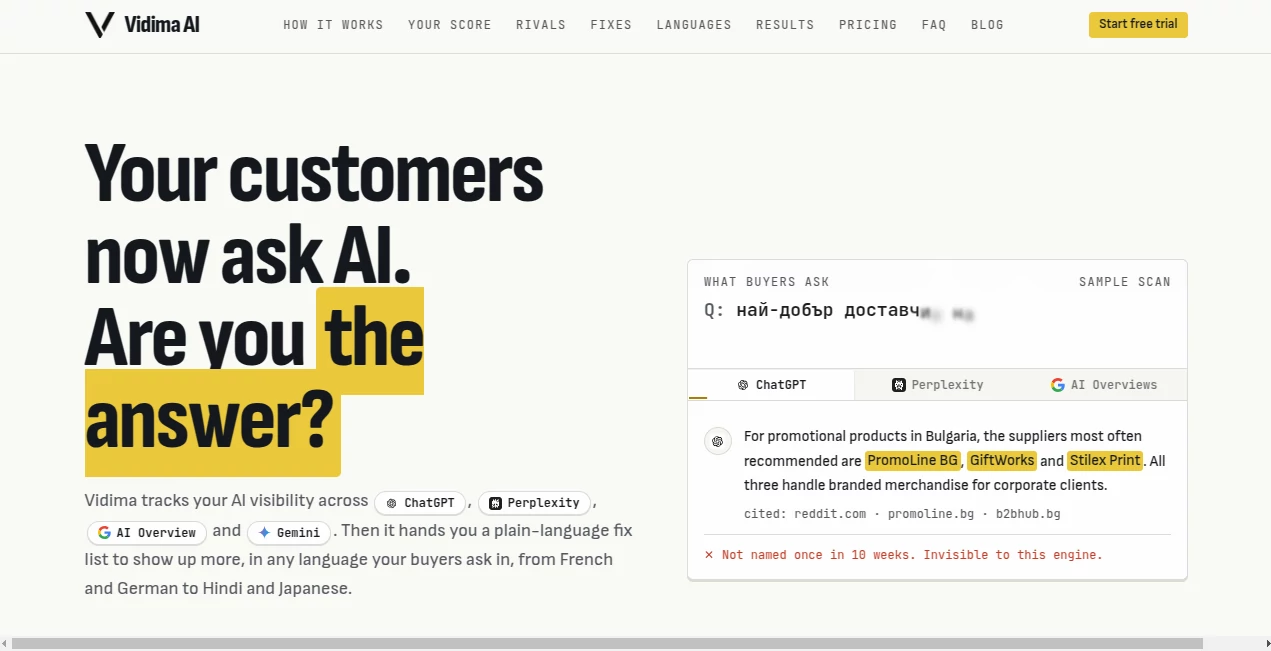
Search is changing quickly. Instead of browsing several pages of Google results, customers increasingly ask ChatGPT, Perplexity, Gemini, or Google AI Overviews for a direct recommendation. For businesses, that creates a new challenge: being visible in traditional search is no longer the whole story.
Vidima is built around this shift. It monitors how a business appears in AI-generated answers, measures how frequently it gets mentioned, identifies competitors that are being recommended instead, and turns those findings into practical actions. Rather than simply presenting another SEO dashboard, the platform focuses on a question that is becoming increasingly important for modern brands: when potential customers ask AI for a recommendation, does your business appear?
The platform runs recurring searches using buyer-oriented questions and checks the results across multiple AI engines. It then keeps the answers as evidence, allowing businesses to see whether their visibility is improving over time rather than relying on a single snapshot.
Key Features
- AI visibility monitoring across ChatGPT, Perplexity, Gemini, and Google AI Overviews.
- Weekly or scheduled prompt tracking to measure visibility over time.
- A 0–100 AI visibility score with the underlying answers available for inspection.
- Competitor and share-of-voice comparisons across different AI engines.
- Rival research showing signals associated with businesses that are repeatedly recommended.
- Prioritized recommendations explaining what should be changed and where.
- Outreach assistance for fixes that require action on external websites.
- Multilingual monitoring for markets where customers search in languages other than English.
- Google Analytics integration for measuring identifiable traffic arriving from AI assistants.
- API access and expanded monitoring options on the Enterprise plan.
User Interface
The interface is designed around answers rather than complicated SEO reports. A visibility score gives users an immediate overview, while individual results can be opened to see what an AI engine actually said, which businesses were mentioned, and which sources were cited.
This approach makes the information easier to act on. A marketing manager, for example, can move from a disappointing visibility score to the exact prompt where a competitor was recommended, then inspect the suggested fix instead of spending hours interpreting a collection of technical metrics.
Accuracy & Performance
AI-generated answers can change from one run to another, so checking a prompt once does not provide much context. The platform addresses this by asking the same buyer questions repeatedly and preserving the resulting answers. This creates a historical record that can reveal whether a business is being mentioned more often, less often, or simply moving between AI engines.
The service currently monitors four major AI search environments: ChatGPT, Perplexity, Google AI Overviews, and Gemini. Its sample reporting demonstrates how a visibility score can move from 34 to 61 over six weeks after recommended improvements, although actual results naturally vary between businesses, markets, queries, and industries.
Google Analytics can also be connected to identify sessions that still carry an AI assistant referral. The platform correctly treats these numbers as a floor rather than a complete measurement because copied links, in-app visits, and some Google AI traffic may not retain a recognizable AI referral.
Capabilities
The strongest part of the platform is the connection between monitoring and action. Instead of stopping at “your visibility is low,” it provides a prioritized work order describing what needs attention.
Some recommendations can involve changes on the business's own website, such as adding structured data or publishing a clearer FAQ. Others may involve external sources. In those cases, the service can identify potential outreach opportunities and prepare a message in the relevant site's language.
Competitor analysis is another useful component. Businesses can see which rivals are repeatedly appearing in AI answers, compare their share of voice, and examine information such as cited sources, estimated search traffic, domain metrics, and publicly filed financial information when available.
Multilingual monitoring is particularly valuable for companies operating across several countries. Prompts can be adapted to the language customers actually use, with support for languages including French, German, Spanish, Bulgarian, Czech, Greek, Hindi, and Japanese.
Security & Privacy
The published privacy policy states that waitlist information is limited to details such as an email address, consent information, language, and signup form. The service also uses Google Analytics for website usage information, including approximate city-level location, device, browser, and visited pages.
Waitlist information is stored using Supabase, while analytics data is processed by Google. The privacy policy states that personal data is not sold or shared with other parties beyond these processors. Users can also request access, correction, or deletion of their information.
For businesses considering a monitoring platform, it is still sensible to review the current privacy policy and terms before connecting analytics or using the service with sensitive business information.
Use Cases
Local businesses: A local company can monitor questions such as “best dentist in Sofia” or similar location-specific searches and discover whether AI assistants recommend it or competing businesses.
SEO and marketing agencies: Agencies can use recurring visibility reports to show clients how their brands perform in AI search and demonstrate the effect of ongoing optimization work.
E-commerce brands: Online stores can monitor product-related questions and discover which competitors and third-party sources are influencing AI recommendations.
Multi-market businesses: Companies operating internationally can track customer questions in several languages instead of assuming that English-language prompts accurately represent every market.
Competitive research: Marketing teams can identify competitors that repeatedly appear in AI answers and investigate the sources and signals surrounding those mentions.
GEO and AEO campaigns: Businesses working on Generative Engine Optimization or Answer Engine Optimization can use recurring measurements to complement traditional search-engine metrics.
Pros and Cons
Pros
- Tracks several major AI search engines from one place.
- Focuses on actual AI answers instead of relying only on abstract visibility metrics.
- Recurring scans make it possible to monitor changes over time.
- Competitor share-of-voice reporting adds useful market context.
- Recommendations are written in practical, plain language.
- Multilingual monitoring is a strong advantage for international businesses.
- External outreach suggestions can reduce the manual work involved in implementing recommendations.
- Google Analytics integration provides another way to understand AI-driven visits.
Cons
- AI visibility can naturally fluctuate, so meaningful conclusions require repeated measurements.
- The platform is primarily focused on businesses that already have a reason to monitor AI search visibility.
- Some AI traffic cannot be attributed perfectly because referral information may be missing.
- The more advanced plans can be expensive for very small businesses with limited monitoring needs.
Pricing Plans
The pricing structure is based on the number of buyer prompts being tracked. The Starter plan costs €49 per month and includes 20 tracked prompts, 15 monitored rivals, a GEO report every two weeks, unlimited ranked fixes, and access to the four supported engines. A 7-day free trial is available.
The Growth plan costs €79 per month and increases monitoring to 50 tracked prompts and 25 rivals, with weekly GEO reports. It also includes unlimited keyword discovery and priority support.
The Enterprise plan uses custom pricing and is intended for larger organizations managing multiple brands or markets. It offers custom prompt and rival limits, daily GEO reports, unlimited websites, API access, additional users, onboarding sessions, and invoice billing.
Annual billing offers two months free according to the current pricing page. Prices are displayed in euros and exclude VAT.
How to Use It
Start by creating an account and setting up the business you want to monitor. Define the buyer questions that matter to your market, including relevant products, services, locations, and commercial searches.
The platform then sends those prompts to the supported AI engines on the selected schedule. Review the resulting answers to see whether your business was mentioned, where it appeared, which competitors were recommended, and which sources were cited.
Next, work through the ranked recommendations. Some improvements may involve your own website, while others can require building relationships with external directories, publications, or other sources that AI engines rely on.
Continue running the scans after making changes. Over several weeks, the historical results can help you distinguish a meaningful improvement from a temporary change in an AI-generated answer.
Comparison with Similar Tools
Traditional SEO platforms are generally built around rankings, backlinks, search traffic, keywords, and other signals from conventional search engines. GEO and AI visibility platforms approach the problem differently by asking what happens after a customer turns a search query into a conversational question.
The distinction is important. A business can rank well in conventional search and still fail to appear when an AI assistant gives a direct recommendation. Conversely, a company can discover that certain third-party pages, directories, reviews, or discussions are influencing AI answers even when those sources are not obvious from a standard ranking report.
This platform stands out by combining visibility tracking with competitor analysis and actionable recommendations. The recurring prompt methodology also makes it more useful for monitoring trends than tools that provide only a one-time AI search snapshot.
Conclusion
AI search is creating a new visibility layer for businesses, and measuring it requires a different mindset from traditional SEO. Instead of asking only where a website ranks, marketers increasingly need to know whether AI systems recognize the business, recommend it, cite it, and place it alongside its competitors.
This platform provides a practical way to monitor that shift. Its combination of recurring AI searches, answer-level evidence, competitor comparisons, multilingual prompts, visibility scoring, and prioritized fixes makes it particularly appealing to businesses that want to take GEO seriously rather than treating AI visibility as another vague marketing buzzword.
For companies already investing in SEO and content, the service can serve as an additional measurement layer. The real value comes from watching the same buyer questions over time, making targeted improvements, and then checking whether AI answers actually change.
Frequently Asked Questions (FAQ)
What is AI visibility?
AI visibility describes how often and how favorably AI search engines mention a business when customers ask questions related to its products or services. The platform represents this performance with a 0–100 score and keeps the underlying answers as evidence.
Which AI engines are monitored?
The platform currently monitors ChatGPT, Perplexity, Google AI Overviews, and Gemini using recurring buyer-oriented prompts.
Is this the same as traditional SEO?
No. Traditional SEO focuses heavily on rankings in search results, while AI visibility focuses on whether a business is included in an AI-generated answer. There is considerable overlap between the two disciplines, but the measurement is different.
What is GEO?
GEO stands for Generative Engine Optimization. It refers to the process of improving the likelihood that AI systems will mention and cite a business in generated answers.
What does AEO mean?
AEO stands for Answer Engine Optimization. It is closely related to GEO and focuses on making information more likely to be selected as a direct answer by answer-oriented search systems.
Can it monitor competitors?
Yes. Competitors discovered in AI answers can be monitored and compared through share-of-voice reporting. The platform can also provide additional information about rivals and the sources associated with their visibility.
Does it support multiple languages?
Yes. Multilingual monitoring is a central part of the service, with localized prompts and reporting for markets where customers use languages such as French, German, Spanish, Bulgarian, Czech, Greek, Hindi, and Japanese.
Do I need technical SEO knowledge to use it?
No. Recommendations are presented as plain-language instructions explaining what to change, where to make the change, and why it may matter. This makes the workflow accessible to marketers and business owners as well as SEO specialists.
How quickly can AI visibility improve?
Results generally take time because AI systems need to revisit websites and the external sources they use. The service recommends measuring changes over weeks rather than expecting an immediate shift after making a single website update.
Does it show traffic from AI assistants?
Yes, when Google Analytics is connected, it can identify sessions that arrive with recognizable AI assistant referrals. However, these numbers should be treated as a minimum because some AI visits do not preserve referral information.
Is there a free trial?
Yes. The current pricing page offers a 7-day free trial, allowing businesses to evaluate the monitoring workflow before committing to a paid plan.
AI SEO Assistant , AI Marketing Plan Generator , AI Research Tool , AI Analytics Assistant .
These classifications represent its core capabilities and areas of application. For related tools, explore the linked categories above.

Vidima AI Alternatives Product

Shufaf

etsyseotools

PatentFig AI

CheckAEO

Analyse
zGEO Ranker

PromptZerk

Rate My Prof…

Beamtrace
