


















Visibility Mesh
What is Visibility Mesh?
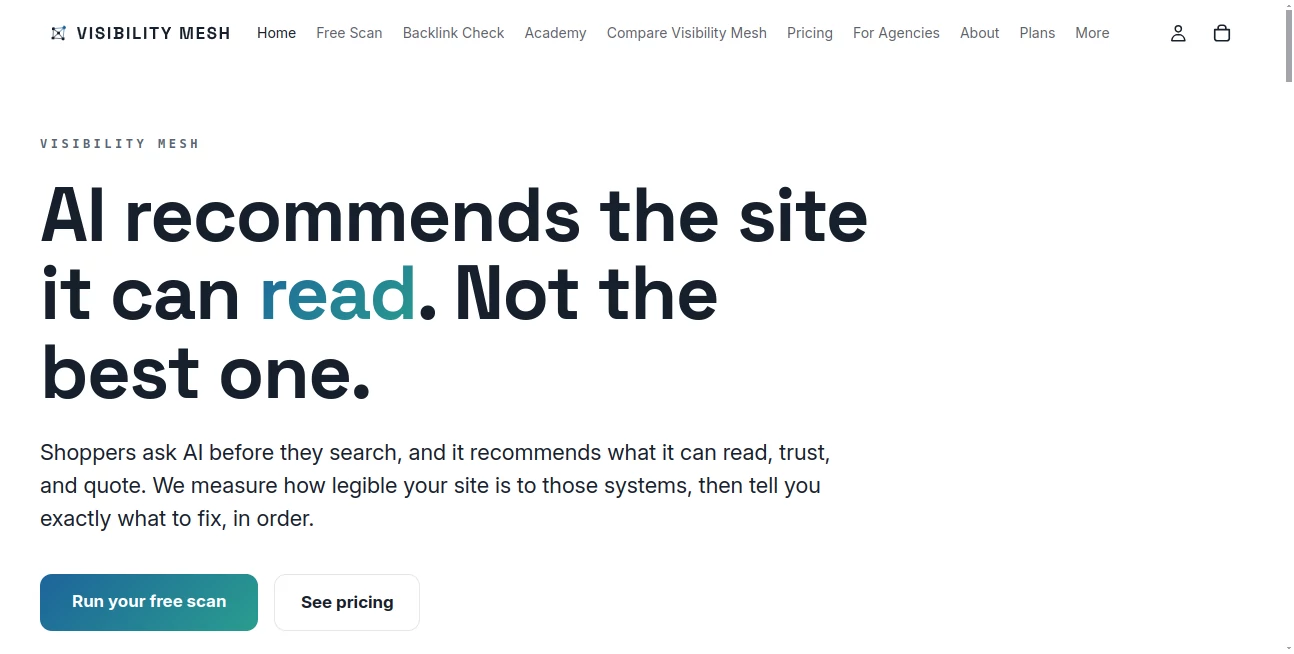
As shoppers increasingly ask AI systems for product recommendations, simply having a well-designed website is no longer enough. A website also needs to be understandable, accessible, and easy for AI crawlers to interpret. Visibility Mesh is built around this problem, measuring how well a website can be found, read, followed, quoted, and trusted by AI systems.
The platform approaches AI visibility as something that can be measured and improved rather than treated as a vague SEO concept. It scans a website, identifies weaknesses, explains the issues in plain English, and creates a prioritized path for fixing them. This makes it useful for businesses that want their content and products to have a better chance of appearing in AI-driven search and recommendation experiences.
Key Features
- AI visibility scoring across five important areas: discoverability, readability, site structure, quotability, and trust.
- Website crawling that examines how AI crawlers can access and interpret pages.
- Structured-data analysis to identify problems that may prevent machines from understanding a site correctly.
- Prioritized findings that explain what needs attention first and why.
- Detailed audits with severity levels and practical fix directions.
- Progress tracking through repeated scans so improvements can be measured.
- White-label scorecards and multi-client monitoring for agencies.
- Catalog assessments designed to evaluate product data across large ecommerce catalogs.
User Interface
The experience is deliberately straightforward. Instead of forcing users through a complicated technical dashboard, the service centers the workflow around a scorecard and clearly explained findings. A website URL is provided, the pages are analyzed, and the resulting report shows where problems exist and what should be addressed.
The maturity model is particularly useful for non-technical teams because it gives the website a position on a four-stage ladder, ranging from Starting Point to Leading. That makes the results easier to discuss with marketing managers, developers, and company leadership without everyone having to interpret the same technical metrics differently.
Accuracy & Performance
The analysis is designed around the way AI crawlers interact with websites rather than relying solely on conventional search-engine metrics. Five areas form the core of the assessment: whether AI can find a site, whether it can read the information, whether it can understand the site's structure, whether it can extract useful content, and whether it can identify the business as a trustworthy entity.
This approach is valuable because a website can perform reasonably well in traditional SEO while still presenting obstacles to AI systems. Re-scanning after changes also provides a practical way to see whether technical or content improvements have actually moved the site's score in the right direction.
Capabilities
The platform goes beyond producing a single visibility number. Its reports can include detailed findings, severity levels, maturity information, and an ordered roadmap for implementation. Paid plans also provide more extensive crawling and monitoring, while agency-oriented features support white-label scorecards and multiple client websites.
For ecommerce businesses, catalog assessments offer another useful option. Instead of sampling a handful of products, the service can assess uploaded product catalogs for structured-data quality. This can be especially helpful for larger stores where manually reviewing product information would quickly become impractical.
There is also a useful distinction between diagnosis and proof. The workflow encourages users to fix identified problems and then measure the website again, making the before-and-after result part of the process rather than simply accepting an initial audit as the final answer.
Security & Privacy
The service operates on Shopify, and its privacy policy explains that personal information may include account, contact, transaction, device, and usage information depending on how the services are used. Shopify and other service providers may process information as part of delivering the service.
The published policy also outlines security and fraud-prevention practices, data-retention considerations, international data transfers, and privacy rights that may apply depending on the user's location. It notes that no security measure can guarantee perfect protection, so users should avoid sending sensitive information through unsecured communication channels.
Use Cases
- Ecommerce stores: Identify technical and content barriers that may make product pages harder for AI systems to understand and recommend.
- SEO and marketing teams: Add an AI-visibility layer to an existing search optimization strategy.
- Website owners: Discover whether important pages are accessible, structured, and extractable for AI crawlers.
- Content teams: Find content that is difficult for AI systems to quote or extract and identify opportunities to make information more answer-ready.
- Agencies: Produce branded scorecards, monitor multiple clients, and turn AI-visibility analysis into a repeatable service.
- Large catalogs: Review structured data across substantial numbers of products instead of manually checking individual listings.
Pros and Cons
Pros:
- Focused specifically on AI visibility and answer-engine readiness.
- Uses plain English instead of presenting users with an unexplained technical score.
- Separates findings into five understandable areas.
- Provides prioritized recommendations rather than an unorganized list of problems.
- Offers free scanning for users who want to see their starting position before paying.
- Useful agency features such as white-label reporting and multi-client monitoring.
- Includes dedicated catalog assessments for ecommerce businesses.
Cons:
- The service is primarily valuable to businesses that have a genuine interest in AI-driven discovery and ecommerce visibility.
- Some of the more advanced monitoring, reporting, and agency features require paid plans.
- A strong score does not guarantee that an AI system will recommend a particular website, since recommendation behavior also depends on the AI platform and its own sources.
- Businesses with very large catalogs may need a higher-priced assessment or a custom arrangement.
Pricing Plans
The pricing structure is based on pages crawled and products assessed rather than credits or tokens. A free scan covers five pages and provides a scorecard, five-category assessment, and maturity level, with a free rescan available after 30 days.
For ongoing monitoring, the Starter plan costs $79 per month and covers up to 100 pages per month with monthly scanning. The Pro plan costs $249 per month and covers up to 400 pages with weekly scanning, progress tracking, and full findings on each scan. The Agency plan costs $799 per month and covers up to 1,500 pages, along with white-label scorecards and a multi-client dashboard.
One-time options are also available. A Full Assessment + Roadmap costs $149, while catalog assessments cost $299 for up to 1,000 products and $799 for up to 5,000 products. Larger catalogs can be handled through a custom arrangement. The pricing page also states that there are no credits or tokens to calculate at checkout.
How to Use It
Getting started is simple. Enter the website you want to evaluate and run the available scan. The service reads the site's pages from an AI-crawler perspective and produces a scorecard covering its five main assessment areas.
Review the findings and pay particular attention to issues marked as higher priority. The roadmap is designed to help teams decide what should be fixed first rather than attempting to change everything at once. After making improvements, run another scan to compare the new results with the previous assessment.
For an ecommerce business with a substantial product catalog, a catalog assessment can be used instead of relying only on a traditional website crawl. Agencies can take the process further by using white-label reporting and multi-client monitoring for their customers.
Comparison with Similar Tools
Traditional SEO auditing platforms generally concentrate on search-engine crawling, rankings, backlinks, page optimization, and technical SEO. This service takes a narrower but increasingly relevant angle by asking whether AI systems can actually understand and use the information published on a website.
That difference makes it more complementary than interchangeable with conventional SEO software. An SEO platform can tell a team that a page has a technical issue, while an AI-visibility assessment can help explain whether that issue affects how an AI crawler discovers, interprets, or extracts information from the site.
It also stands apart from tools that simply track brand mentions in AI answers. Instead of focusing only on whether a brand appears, the workflow examines the underlying website and provides actionable recommendations intended to improve the conditions that make AI visibility possible in the first place.
Conclusion
AI-driven discovery is changing the way people find products, companies, and information. For website owners, that creates a new question alongside traditional SEO: can AI systems actually understand the website well enough to use it as a source?
This platform offers a practical way to investigate that question. Its combination of AI-crawler analysis, five-category scoring, plain-English findings, prioritized roadmaps, and repeat measurements makes the process easier to turn into real website improvements. Ecommerce stores and agencies may find the catalog and client-focused features particularly useful.
It is not a magic button for appearing in every AI answer, and no platform can guarantee that outcome. What it does well is turn a relatively new and complicated area of digital visibility into something that can be measured, discussed, fixed, and measured again.
Frequently Asked Questions (FAQ)
What does the platform measure?
It evaluates website legibility across five areas: whether AI can find the site, read it, follow its architecture, quote its content, and trust the entity behind it.
Is there a free option?
Yes. The free scan covers five pages and provides a scorecard, five-category assessment, and maturity level. A free rescan is available after 30 days.
Is it useful for ecommerce websites?
Yes. Ecommerce is one of its strongest use cases, particularly for businesses concerned with how AI systems understand and recommend their products. Dedicated catalog assessments can evaluate structured-data quality across up to 1,000 or 5,000 products, with custom options for larger catalogs.
Does it replace traditional SEO tools?
No. It is better viewed as a complementary layer. Traditional SEO tools remain useful for search rankings, backlinks, technical SEO, and other conventional optimization tasks, while this service focuses specifically on AI visibility and machine-readable website quality.
Can agencies use it for clients?
Yes. The Agency offering includes white-label scorecards and a multi-client dashboard, making it suitable for agencies that want to include AI-visibility assessments in their client services.
Does a higher score guarantee AI recommendations?
No. A better score indicates stronger website legibility according to the assessment methodology, but AI recommendations depend on many factors outside the website itself, including the behavior and sources of individual AI systems.
How often can a website be monitored?
Monitoring frequency depends on the plan. Starter provides monthly scanning, while Pro and Agency provide weekly scanning, along with progress tracking.
AI SEO Assistant , AI Analytics Assistant , AI E-commerce Assistant .
These classifications represent its core capabilities and areas of application. For related tools, explore the linked categories above.
Visibility Mesh details
Website unavailable — View Alternatives
Pricing
- Free
Apps
- Web App
Categories

Visibility Mesh Alternatives Product

CitedSpy
AI Product P…

SupaTraffic

Yorph AI

ModelsLab

PropFade
zGEO Ranker
CartLens

Website Traf…
