
What Is My Rock
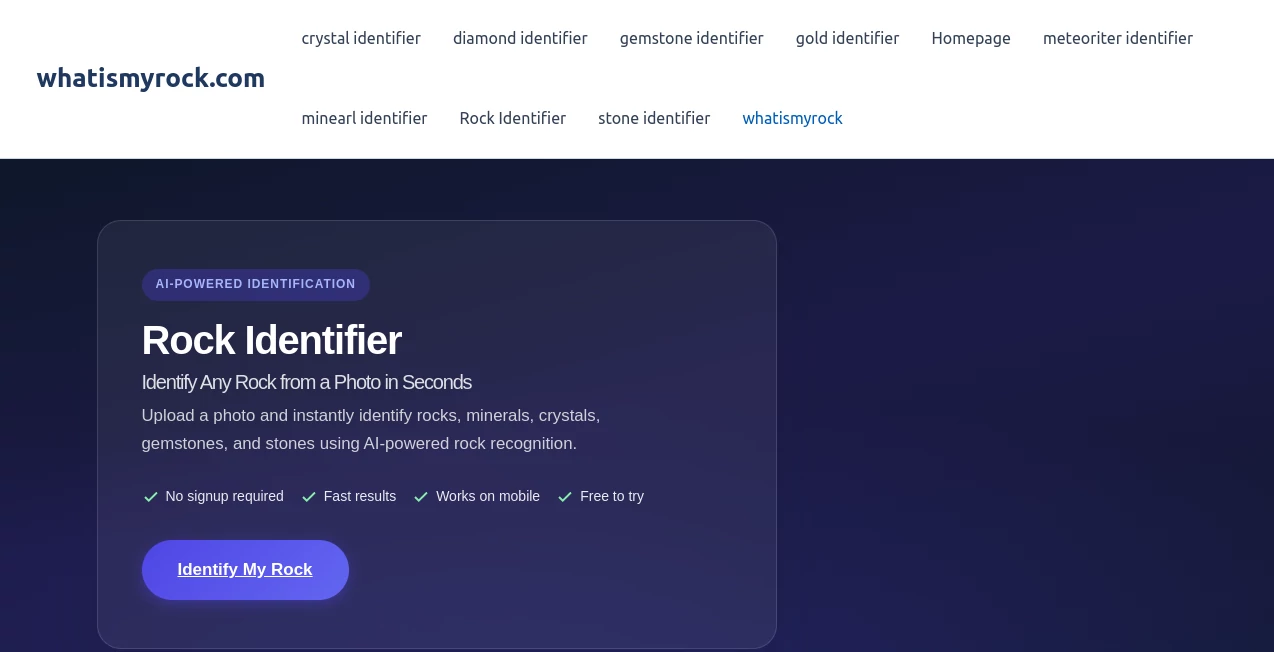
What is What Is My Rock?
Finding an unusual stone during a hike, on the beach, or in your own backyard often raises one simple question: what exactly is it? This intelligent identification platform turns that curiosity into an educational experience by analyzing a photo and providing a detailed identification within seconds. Instead of relying on field guides or spending hours comparing images online, users receive practical information instantly.
The platform combines computer vision with a large geological database to recognize rocks, minerals, crystals, gemstones, and even fossils. Beyond simply naming a specimen, it explains important characteristics such as classification, hardness, formation process, and notable properties. Whether someone enjoys collecting minerals, studies geology, or simply wants to learn more about nature, the experience feels fast, informative, and surprisingly enjoyable.
Key Features
User Interface
The interface is refreshingly straightforward. Users only need to upload a clear image or take a new photo, and the analysis begins automatically. Results are presented in an organized layout, making geological information easy to understand even for complete beginners. Navigation remains clean without unnecessary distractions, allowing visitors to focus entirely on discovering their findings.
Accuracy & Performance
The identification engine evaluates visible characteristics such as texture, grain size, color, crystal habit, transparency, luster, and surface patterns. Within a few moments, it delivers likely matches together with supporting geological information. Performance is strongest when photos are taken in natural lighting with the specimen filling most of the frame, helping users achieve highly reliable results for many common rocks and minerals.
Capabilities
- Identify rocks from uploaded photographs.
- Recognize minerals, gemstones, crystals, and fossils.
- Display geological classifications.
- Provide Mohs hardness information.
- Explain formation history and composition.
- Offer estimated value ranges for many specimens.
- Help distinguish between visually similar materials.
- Support hobbyists, students, educators, and collectors.
Security & Privacy
User privacy is handled responsibly. Uploaded images are transmitted through encrypted connections during analysis, and the service states that photos are processed only to generate identification results rather than being permanently stored for unrelated purposes. This approach allows users to explore the service with greater confidence while keeping personal data exposure to a minimum.
Use Cases
- Identifying rocks discovered while hiking.
- Learning about gemstones before purchasing or collecting them.
- Supporting geology classes with quick visual identification.
- Helping children explore science through real-world discoveries.
- Building personal mineral and crystal collections.
- Recognizing fossils during outdoor adventures.
- Comparing similar-looking minerals before further testing.
- Expanding geological knowledge without specialized equipment.
Pros and Cons
Pros
- Very easy to use for beginners.
- Fast photo-based identification.
- Supports multiple geological specimen types.
- Provides educational explanations alongside results.
- Useful on both desktop and mobile devices.
- Helpful for collectors, travelers, and students alike.
Cons
- Photo quality significantly affects identification accuracy.
- Very rare specimens may require expert verification.
- Visual analysis cannot completely replace laboratory testing.
- Some advanced features may require the mobile application.
Pricing Plans
The browser version offers a free daily identification, making it easy for occasional users to test unknown specimens without any upfront cost. Mobile applications provide additional scanning capabilities, while subscription options are available for users who require unlimited identifications and enhanced collection features.
How to Use What Is My Rock?
Start by placing the specimen in good natural lighting. Capture a sharp image that clearly shows its texture, colors, and visible crystal structures. Upload the photo, wait a few seconds while the AI performs its analysis, then review the identification report. The results include the likely specimen name, geological classification, hardness information, formation details, and additional educational insights that help users better understand their discovery.
Comparison with Similar Tools
Compared with general image recognition applications, this platform focuses entirely on geological identification rather than broad object detection. Instead of returning generic search results, it delivers specialized information about minerals, rocks, gemstones, and fossils, including scientific characteristics and educational context. This dedicated approach makes it especially valuable for outdoor enthusiasts, collectors, educators, and anyone interested in earth sciences.
Conclusion
For anyone fascinated by geology or simply curious about unusual stones found during everyday adventures, this platform offers an impressive combination of convenience and scientific knowledge. The intelligent identification engine, educational reports, and beginner-friendly interface create an experience that feels both practical and enjoyable. Rather than replacing professional geological analysis, it serves as an excellent first step toward understanding the fascinating world beneath our feet.
Frequently Asked Questions (FAQ)
Can it identify crystals and gemstones?
Yes. The platform supports identification of crystals, gemstones, minerals, rocks, and many common fossils.
How can I improve identification accuracy?
Take clear, well-lit photographs using natural light, ensuring the specimen occupies most of the image.
Is the service suitable for beginners?
Absolutely. The interface is designed to be simple enough for users without geological experience while still providing detailed educational information.
Can the results replace professional geological testing?
No. The identification provides an excellent visual assessment, but laboratory analysis remains necessary for complete scientific verification, especially for valuable or rare specimens.
Does it work on mobile devices?
Yes. The service is available through the web and also offers dedicated mobile applications with additional features.
AI Image Recognition , AI Education Assistant , AI Healthcare .
These classifications represent its core capabilities and areas of application. For related tools, explore the linked categories above.
What Is My Rock details
Website unavailable — View Alternatives
Pricing
- Free
Apps
- Web App
Categories

What Is My Rock Alternatives Product

Mexty AI

Zush

Traecta

Period Calcu…

Peanut AI

PlateLens

Ultralytics

Ask Bishop

Visual Field…