
WhatsMyName
What is WhatsMyName?
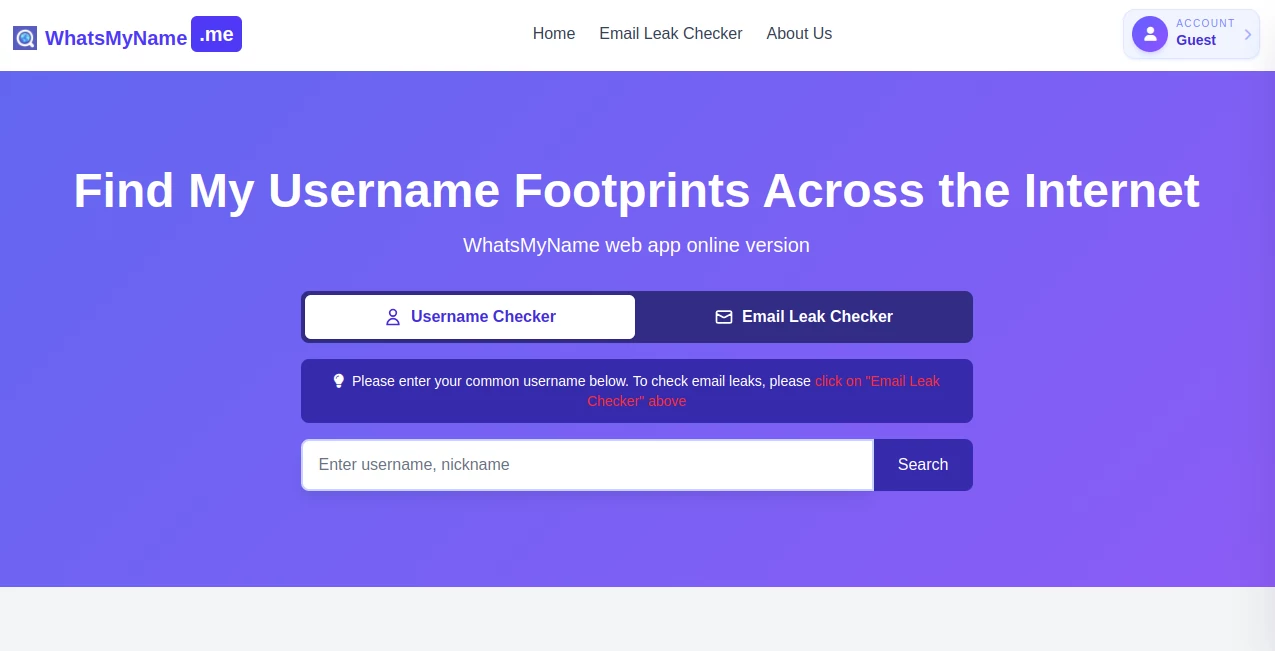
WhatsMyName.me is a practical online identity discovery tool designed for people who want to see where a username, nickname, or email address appears across the public web. Instead of checking social networks and online platforms one by one, users can enter a familiar identifier and let the service search across multiple sources.
The idea is simple but genuinely useful. A username that has been used for years can leave traces on social networks, forums, developer communities, code-hosting platforms, and other public websites. Bringing those results together in one place makes it much easier to understand an online identity and spot accounts that may otherwise be forgotten.
It can be useful for personal privacy checks, online identity research, social media investigations, or simply finding old accounts associated with a familiar nickname.
Key Features
- Username Search: Search for a username or nickname across multiple publicly available platforms.
- Email Search: The service also provides an email-focused search option for discovering relevant publicly available information and checking for potential exposure.
- Global Search: Coverage includes mainstream social networks, forums, code-hosting services, and other online platforms.
- AI-Powered Analysis: The platform incorporates AI analysis using technologies from OpenAI and Gemini to help process and interpret search information.
- Multi-Language Support: Multiple interface languages make the service more accessible to users around the world.
- Efficient Searching: Its search system combines real-time queries and cached information to provide results without requiring users to manually investigate every platform.
- Force Refresh: Users can request a fresh search when they need more recent results instead of relying only on cached information.
- API Access: API options are available for both free and commercial use, with custom solutions available for business requirements.
User Interface
The interface keeps the main task straightforward. Users are presented with a search field where they can enter a username or nickname and start a scan. The layout is responsive, making it suitable for different screen sizes, while the multilingual interface helps remove unnecessary friction for international users.
This simplicity is one of its strongest points. Someone who has never used an online identity research service can understand the basic workflow almost immediately. There is no complicated setup before starting a search.
Accuracy & Performance
The service is designed around efficient searches across multiple data sources. Its infrastructure uses distributed search capabilities and caching mechanisms to reduce repeated queries and improve response times.
Search freshness can vary depending on the source. The service explains that results are based on a combination of real-time queries and cached data, with many platforms generally updated within approximately 24 hours. A force-refresh option is available when a newer search is needed.
It is important to treat the results as useful leads rather than absolute proof. The service itself states that it aims for high accuracy but cannot guarantee that every result will be 100% accurate.
Capabilities
The platform goes beyond a simple username lookup. It can search usernames, nicknames, and email-related queries across different types of online sources, helping users build a broader picture of an online identifier.
Its AI-assisted analysis adds another layer to the experience by helping organize and analyze information gathered from searches. This can be particularly helpful when a query produces several results and the user needs to determine which findings are actually relevant.
For developers and businesses, API access also opens the door to integrating identity-search functionality into other workflows or applications. Commercial users can contact the service for suitable API arrangements and custom solutions.
Security & Privacy
Privacy is an important consideration when researching online identities. The service states that it focuses on publicly available information rather than presenting private information as part of its normal search purpose.
Its privacy policy explains that information such as search queries, IP addresses, device information, browser details, operating system information, and cookies may be collected when users interact with the service. It also states that personal information is not sold, although certain information may be shared with service providers or when legally required.
Users should therefore keep in mind that online identity research can involve sensitive information. The safest approach is to use the service for legitimate privacy, security, research, and account-discovery purposes.
Use Cases
One of the most useful applications is personal digital footprint research. A user can search an old nickname and discover accounts that may have been created years ago. This can be helpful when cleaning up an online presence or reviewing how consistently a username has been used.
It can also help researchers investigate public online identities. For example, someone researching a public username may want to compare appearances across social networks, forums, and developer platforms without opening each service individually.
Developers can also benefit from the API functionality when identity-related search capabilities are needed inside another application. Businesses may use the service as part of broader research workflows, subject to applicable laws and the provider's terms.
For privacy-conscious users, running a search against their own username can be a useful first step toward understanding what information is publicly discoverable about them.
Pros and Cons
- Pros: Searches across multiple categories of public platforms.
- Pros: Supports usernames, nicknames, and email-related searches.
- Pros: Includes AI-assisted analysis using OpenAI and Gemini technologies.
- Pros: Offers a simple interface that requires little technical knowledge.
- Pros: Provides multilingual support.
- Pros: Offers force-refresh functionality for users who need newer results.
- Pros: API access is available for free and commercial use.
- Cons: Search results cannot be guaranteed to be completely accurate.
- Cons: Results may depend on the availability and update frequency of individual platforms.
- Cons: Users looking for completely private or non-public information should not expect the service to provide it.
Pricing Plans
No traditional paid pricing plans are prominently presented on the public website for the main search experience. The core web interface is available for users to perform searches, while API access is offered with both free and commercial usage options.
Commercial API users can contact the provider to discuss their requirements, usage levels, and potential custom solutions. This approach makes the service more flexible for businesses that need capabilities beyond occasional personal searches.
How to Use the Tool
Getting started requires very little preparation. Open the web application and enter the username or nickname you want to investigate in the search field. Start the search and allow the system some time to scan its available data sources.
Review the returned accounts and matches carefully. A matching username does not automatically prove that every account belongs to the same person, so look for additional contextual information before drawing conclusions.
If the results appear outdated or you need the latest available information, use the force-refresh functionality when available. For larger technical projects, businesses can explore the API options instead of relying on manual searches.
Comparison with Similar Tools
Traditional username-checking services often focus on whether a particular username exists on a predefined list of websites. This approach can be useful, but it may require users to interpret results from many individual platforms themselves.
This service takes a broader approach by combining searches across social media, forums, code-hosting platforms, and other sources, while also incorporating AI-powered analysis. The combination makes it more suitable for users who want not only to find possible matches but also to examine the larger footprint associated with an online identifier.
Another practical distinction is the availability of email-related searching, multilingual support, force-refresh functionality, and API access. These additions give it more flexibility than a basic username availability checker.
Conclusion
Finding an online identity footprint can become surprisingly difficult when the same username has been used across many years and many different platforms. This service turns that otherwise repetitive research process into a single, accessible workflow.
Its combination of cross-platform searching, AI-assisted analysis, multilingual support, freshness options, and API availability makes it a compelling choice for personal digital-footprint checks as well as more structured research.
The most sensible way to use it is as an investigation and discovery aid rather than as an unquestionable source of identity verification. When results are interpreted carefully, it can provide a valuable overview of where a username, nickname, or related identifier appears across the public internet.
Frequently Asked Questions (FAQ)
What can I search for?
The service supports searches involving usernames, nicknames, and email-related queries, depending on the available search module.
Which platforms can it search?
Its coverage includes mainstream social media platforms, forums, code-hosting services, and other publicly accessible online sources.
Are the results always accurate?
No. The service aims to provide accurate results but explicitly notes that 100% accuracy cannot be guaranteed. Users should verify important findings using additional context.
How frequently are results updated?
The service combines real-time queries with cached information. Many sources are generally updated around every 24 hours, while some high-traffic platforms may be updated more frequently.
Can I force a new search?
Yes. A force-refresh option can be used when you want to perform a newer search instead of relying primarily on cached information.
Does it provide an API?
Yes. API access is available for both free and commercial usage. Businesses can contact the provider about commercial requirements and custom solutions.
Is the service available in multiple languages?
Yes. The interface supports multiple languages, making the search experience accessible to users from different regions.
Can I use it to check my own digital footprint?
Yes. Searching your own username or nickname can be a useful way to discover publicly visible accounts and understand how your online identity appears across different platforms.
Other , AI Research Tool , AI Search Engine .
These classifications represent its core capabilities and areas of application. For related tools, explore the linked categories above.
WhatsMyName details
Website unavailable — View Alternatives
Pricing
- Freemium
Apps
- Web App
Categories

WhatsMyName Alternatives Product

ttanonviewer

AiToolsObser…

AI Entity

Metal

UseWok
Preuve AI

Docubix

ZoraInsights

MBTI Compati…