
Whirl Interview
What is Whirl Interview?
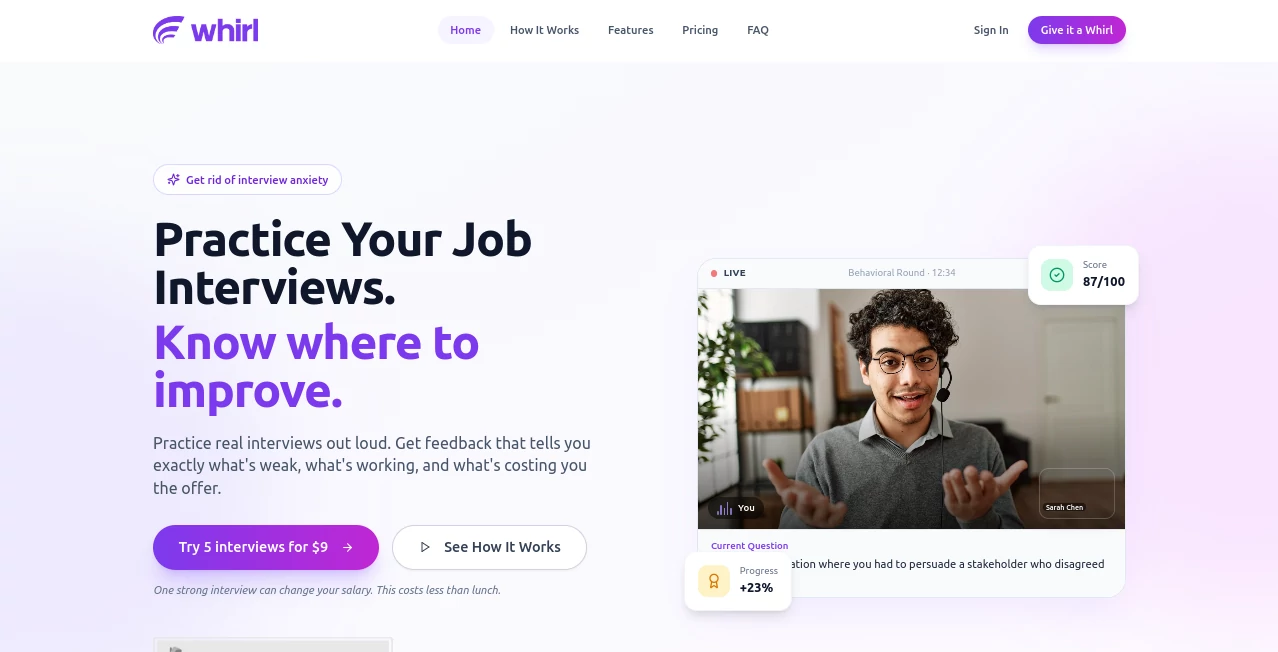
Whirl is an AI-powered interview practice platform designed for people who want to prepare for real job interviews by actually answering questions out loud rather than simply reading interview tips. It creates realistic interview scenarios, records practice sessions, and provides direct feedback on areas that can make a meaningful difference during an interview.
The idea is refreshingly practical: instead of wondering whether an answer sounds confident or whether you are talking too much, you can practice, review the response, and see where you need to improve. The platform is particularly useful for candidates who know their professional experience but struggle to communicate it clearly under interview pressure.
Key Features
- AI-led mock interview practice
- Video-based interview sessions
- Detailed feedback on interview responses
- Analysis of clarity, structure, confidence, delivery, pace, and measurable impact
- Realistic interview questions and scenarios
- Session recordings for reviewing previous attempts
- Practice without needing to schedule a human mock interviewer
- Executive-focused high-pressure simulations through Inferno Mode
User Interface
The experience is built around the interview itself rather than a complicated collection of career-preparation features. Candidates can focus on answering questions naturally, making the process feel closer to a real interview than filling out a questionnaire.
That simplicity matters. When someone is preparing for an important interview, the last thing they need is another complicated workflow to learn. The video-first approach also makes it easier to notice habits that are difficult to catch when practicing silently, such as looking uncomfortable, speaking too quickly, or losing the structure of an answer.
Accuracy & Performance
The value of the feedback comes from its focus on practical interview weaknesses. Instead of only telling candidates that an answer could be better, the system highlights issues such as rambling, vague explanations, weak measurable results, poor answer structure, or an unsuitable speaking pace.
This can make practice considerably more useful. For example, a candidate might believe an answer is strong because it describes a successful project, while the feedback reveals that the response never clearly explains the candidate's individual contribution or the measurable result. That kind of observation gives the next practice attempt a specific target.
Capabilities
The platform supports realistic AI interview practice through video and provides feedback after the session. Candidates can work through questions, review their performance, and practice again with the goal of making their answers more natural and convincing.
For experienced professionals, Inferno Mode adds a more demanding style of preparation. It is designed around executive-level situations and includes features such as board-level simulations, pressure from the AI interviewer, eye-contact and fidget detection, and executive-presence scoring. This makes the experience relevant not only to people applying for entry-level positions but also to candidates preparing for senior roles.
Security & Privacy
Because interview practice can involve employment history, professional experience, and personal video recordings, privacy is an important consideration. Users should review the platform's current privacy policy and terms before submitting sensitive information or recording material they would not want stored or processed.
The publicly available product information emphasizes interview practice, recordings, and performance feedback, but does not provide enough detailed technical information to make broad claims about encryption, data retention, or specific security certifications. For that reason, those areas are best verified directly before using the service for highly sensitive material.
Use Cases
There are several situations where this type of practice can be especially valuable. A recent graduate can use it to become more comfortable answering common behavioral questions before facing a first professional interview. An experienced developer, marketer, designer, or salesperson can use it to rehearse role-specific stories and make their answers more concise.
It can also help candidates who have plenty of experience but find interviews stressful. Practicing aloud repeatedly can expose habits that remain invisible when preparation consists only of reading questions and writing answers.
Senior candidates have another reason to consider it. High-level interviews often involve challenging follow-up questions, leadership scenarios, and questions about business impact. The executive-focused simulation gives those candidates an opportunity to rehearse in a more demanding environment before the real conversation.
Pros and Cons
- Pros: Realistic video-based practice, direct performance feedback, useful delivery analysis, session recordings, and dedicated practice for executive-level candidates.
- Pros: Candidates can practice whenever they want without coordinating schedules with another person.
- Pros: The feedback focuses on practical issues such as rambling, vague answers, weak measurable impact, confidence, and speaking pace.
- Cons: AI practice cannot completely reproduce the unpredictability and interpersonal dynamics of a real human interviewer.
- Cons: Candidates who need highly specialized technical interviews may still benefit from additional preparation specific to their profession or industry.
- Cons: Detailed privacy and data-retention information should be checked before recording sensitive professional information.
Pricing Plans
The service offers an accessible way to try video interview practice, with five video practice interviews available for $9. Candidates can also begin with free text-based practice. This makes it relatively easy to test the approach before committing to a larger interview-preparation budget.
For someone preparing for a specific interview, even a small number of focused practice sessions can be useful. The goal is not simply to complete as many mock interviews as possible, but to identify weaknesses, adjust the answers, and then try again.
How to Use Whirl
- Start with a text-based practice session or choose video interview practice.
- Answer the interview questions aloud as naturally as you would during a real interview.
- Complete the simulated interview without repeatedly stopping to rewrite your answer.
- Review the feedback provided after the session.
- Look for specific weaknesses such as rambling, vague statements, poor structure, low confidence, or insufficient measurable impact.
- Practice the same type of question again while applying the feedback.
- For senior candidates, consider using the executive-focused simulation for more demanding preparation.
Comparison with Similar Tools
Many interview-preparation products focus on question banks, written answers, or general career advice. This approach is different because the central activity is actually performing the interview on video and receiving feedback on both the content and delivery.
That distinction is important. Reading the ideal answer to a behavioral question does not necessarily prepare someone to deliver a convincing response while being watched and evaluated. Video practice introduces an element of pressure and allows candidates to notice communication habits that written preparation cannot reveal.
It is therefore best viewed as a practice and coaching companion rather than a complete replacement for researching the company, understanding the role, preparing relevant examples, and learning the technical requirements of a position.
Conclusion
Whirl takes a straightforward approach to one of the hardest parts of job hunting: getting comfortable performing in an interview. Its combination of realistic questions, video practice, recorded sessions, and targeted feedback gives candidates something more useful than another static list of interview tips.
The strongest part of the experience is its emphasis on specific weaknesses. Knowing that an answer is “not strong enough” is rarely helpful; knowing that you rambled, failed to quantify the result, or spoke too quickly gives you something you can actually fix.
For job seekers who want to rehearse before an important interview, especially those who benefit from seeing and hearing their own delivery, this can be a practical addition to the preparation process.
Frequently Asked Questions (FAQ)
What is Whirl used for?
It is designed for practicing job interviews with AI through realistic interview simulations, video responses, recordings, and performance feedback.
Can I practice interviews using video?
Yes. Video interview practice is one of the core features, allowing candidates to answer questions aloud and review aspects of their delivery.
Does it provide feedback after an interview?
Yes. Feedback can cover areas such as clarity, structure, confidence, pace, delivery, measurable impact, and overall interview presence.
Is there a free way to try it?
Yes. Free text-based practice is available, while five video practice interviews are offered for $9.
Is it useful for experienced professionals?
Yes. In addition to general interview practice, the platform offers an executive-focused Inferno Mode with more demanding simulations and features aimed at evaluating executive presence.
Can it replace a real human mock interview?
It can provide convenient and repeatable practice, but it should not be considered a complete substitute for feedback from an experienced recruiter, hiring manager, or professional interviewer. Human feedback can add context and interpersonal observations that an automated system may not capture.
What should I prepare before using it?
It helps to have a target role in mind and know the main projects, achievements, responsibilities, and measurable results you want to discuss. The more specific your real examples are, the more useful your practice sessions are likely to be.
AI Coaching , AI Interview Assistant , AI Recruiting .
These classifications represent its core capabilities and areas of application. For related tools, explore the linked categories above.
Whirl Interview details
Website unavailable — View Alternatives
Pricing
- Free
Apps
- Web App
Categories

Whirl Interview Alternatives Product
Pontefuerte …

Nav Ai

Hirescope.te…

ModelsLab

HelloDay.ai

Classroom Sc…

Interview Te…

ApplyBtn

Read