Wispaper AI
What is Wispaper AI?
Academic research can become exhausting long before the actual writing begins. Finding relevant papers, screening hundreds of results, understanding difficult studies, tracking new publications, and keeping useful notes in one place can consume days of focused work. WisPaper brings these activities into a single AI-powered research workspace designed for scientists, students, and scholars.
The platform combines academic literature search, deep reading, question answering, research monitoring, knowledge management, and AI-assisted research workflows. Instead of treating research as a series of disconnected tasks, it aims to create a continuous workflow where information discovered today can remain useful for the next paper, project, or experiment.
Key Features
- Academic Literature Search: Search through a large academic literature database with tools designed specifically for scholarly research rather than general web queries.
- Deep Search: Go beyond simple keyword matching to investigate research questions and discover relevant literature with deeper contextual understanding.
- AI Question Answering: Ask questions about research topics and receive answers grounded in academic sources and paper content.
- AI Survey: Explore research areas more systematically, understand developments in a field, and investigate potential gaps in existing literature.
- Research Agent: Agent-based workflows can help with literature exploration, synthesis, research planning, and other repetitive research activities.
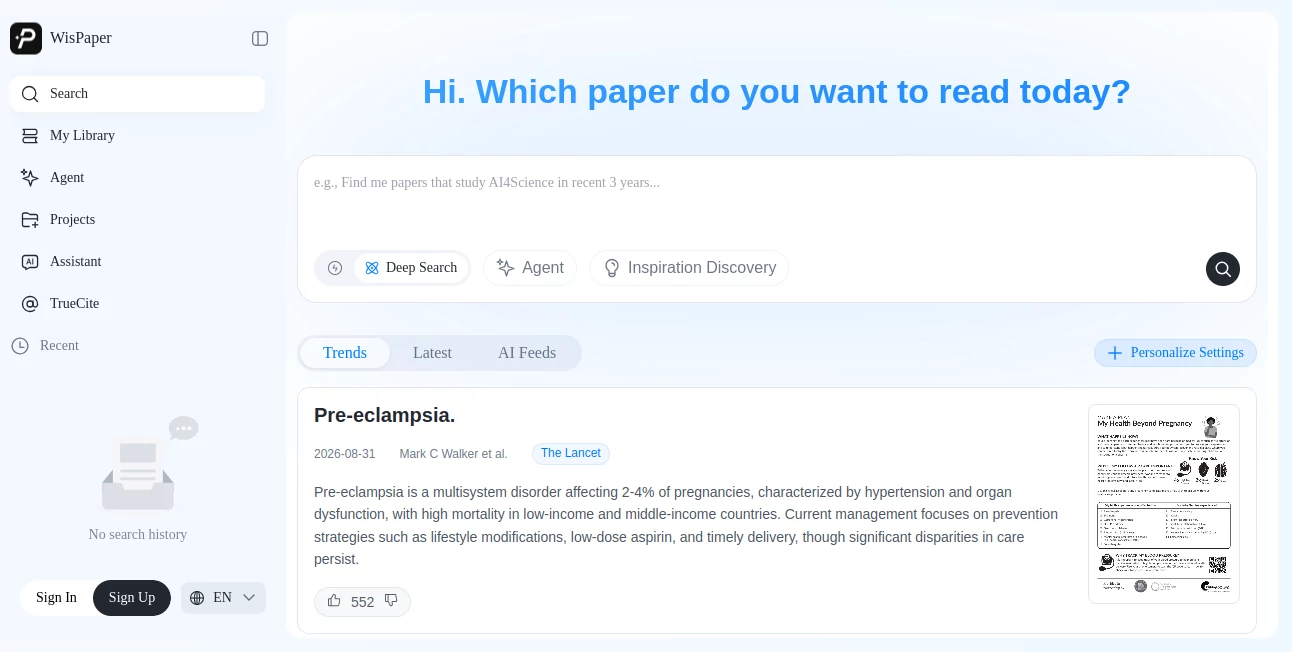
- AI Feeds: Follow topics, keywords, or authors and receive personalized research updates instead of manually checking large numbers of newly published papers.
- Knowledge Base: Organize research material, notes, citations, and related information so that useful knowledge can accumulate across projects.
- Research Library: Keep important papers and research resources accessible within a centralized workspace.
User Interface
The workspace is built around the way researchers actually move through a project. Search, library management, feeds, question answering, and agent-based research are presented as connected parts of the same environment. This makes the experience more practical than jumping between several unrelated applications.
For someone working on a literature review, for example, the process can begin with a research question, continue through paper discovery and deeper reading, and then move toward organized notes and synthesis. The result is a workflow that feels considerably less fragmented.
Accuracy & Performance
Research tools are only as useful as the sources behind their answers. The platform emphasizes citation grounding, allowing users to trace generated answers back to relevant passages in academic literature. Its website reports a 95% literature retrieval accuracy figure, alongside access to more than 500 million pieces of academic literature metadata and over 130 million full-text articles.
That source-focused approach is particularly useful when working with technical subjects where a confident but unsupported answer is not enough. Researchers can inspect the underlying material rather than treating an AI response as the final authority.
Capabilities
The strongest part of the platform is the way several research tasks connect together. A researcher can use search to locate literature, use deeper research functions to investigate a topic, ask questions about papers, monitor new publications, and build a reusable research knowledge base.
The platform also supports idea discovery and research-gap exploration. For example, a graduate student beginning a thesis could use it to map an unfamiliar field, identify recurring themes, compare existing work, and locate questions that deserve further investigation. More experienced researchers can use the same workflow to monitor developments across multiple subfields without constantly starting from scratch.
Security & Privacy
Privacy matters when research notes, unpublished ideas, documents, and project information are stored in an online workspace. The service states that users retain ownership of their submitted content and that user content is not used to train or improve the underlying large language models. It may process submitted information to provide requested services and perform aggregated or de-identified analysis where applicable.
Users should still review the current privacy policy and institutional requirements before uploading confidential, unpublished, or sensitive research material.
Use Cases
Literature Reviews: Researchers can reduce the amount of manual screening required when exploring large bodies of academic literature. Search, deep reading, question answering, and synthesis tools can work together during the review process.
Thesis and Dissertation Research: Students can use the platform to understand unfamiliar subjects, organize sources, investigate research gaps, and build a structured knowledge base throughout a long-term project.
Keeping Up With New Research: AI Feeds are useful for researchers who need to monitor specific topics, keywords, or authors. Instead of repeatedly checking multiple sources, users can receive a more focused stream of relevant papers.
Research Idea Discovery: When the challenge is not finding information but figuring out what to investigate next, the research and survey capabilities can help reveal trends, connections, and potential gaps.
Academic Writing Preparation: Researchers can use the accumulated literature, notes, and source material as a foundation for developing reviews, manuscripts, and research plans. Human verification and original scholarly judgment should remain part of the final writing process.
Pros and Cons
- Pros: Combines literature search and research workflows in one workspace.
- Pros: Provides source-grounded answers and traceable academic references.
- Pros: Includes personalized research feeds for monitoring new literature.
- Pros: Supports deep research, AI surveys, question answering, and agent-based workflows.
- Pros: Offers a free plan for users who want to explore the core experience.
- Cons: Advanced research capabilities consume credits, so intensive users may need a paid plan.
- Cons: Some newer capabilities are not available on the free plan.
- Cons: Researchers should still verify important findings and citations before using them in formal academic work.
Pricing Plans
The platform offers a free plan with basic research functionality, while paid subscriptions provide additional credits, storage, and access to more advanced capabilities. The Plus plan is listed at $4.20 per month when billed annually, with 10,000 monthly credits and 10 GB of high-speed storage. The Pro plan costs $15 per month and includes 200,000 monthly credits and 50 GB of high-speed storage. Higher-volume users can choose the Max plan, which is listed at $75 per month and provides 1,000,000 monthly credits and 250 GB of high-speed storage.
Annual subscriptions are advertised with a 15% saving. Credit packs can also be purchased separately, which is useful for someone who only occasionally needs additional research capacity. Purchased credits do not expire according to the current pricing information.
How to Use It
- 1. Create an account: Start with the free option to explore the available research features.
- 2. Define your research topic: Begin with a focused question, topic, keyword, or research direction rather than a vague search.
- 3. Search the literature: Use academic search and deeper research functions to identify relevant papers.
- 4. Read and investigate: Use question answering and source-grounded research capabilities to understand important papers and concepts more efficiently.
- 5. Organize your findings: Save useful papers, notes, citations, and research information in your workspace.
- 6. Monitor the field: Set up personalized feeds around important topics, keywords, or authors to keep track of new research.
- 7. Develop your research direction: Use survey and idea-discovery features to investigate trends, unanswered questions, and possible research gaps.
- 8. Verify before publishing: Treat AI-generated conclusions as research assistance, not as a replacement for reading the original sources and applying your own academic judgment.
Comparison with Similar Tools
Traditional academic search engines are excellent for finding papers, but researchers often need several additional tools after the initial search. One application may handle references, another may provide paper summaries, and another may monitor new publications. This fragmented workflow can become especially frustrating during a large literature review.
The main advantage here is the attempt to bring those stages together. Search, deep research, AI-assisted reading, personalized feeds, question answering, and knowledge management are designed to operate inside one research environment. It is therefore particularly attractive to users who want more than a simple paper-search engine.
It should not, however, replace established academic databases, original paper reading, methodological expertise, or careful citation checking. Its value is greatest when it acts as a research accelerator alongside the researcher's own judgment.
Conclusion
For researchers dealing with an ever-growing mountain of academic literature, having one place to search, investigate, organize, and monitor information can make a noticeable difference. The combination of academic search, source-grounded answers, research agents, personalized feeds, and knowledge management gives the platform a broader role than a conventional AI chatbot.
It is especially well suited to graduate students, academics, and research teams who regularly perform literature reviews or need to stay current with fast-moving fields. The free plan provides an accessible starting point, while the paid tiers offer considerably more capacity for people with heavier research workloads.
Most importantly, the platform works best as a research partner rather than an unquestioned authority. When its AI-assisted workflows are combined with original sources, critical thinking, and careful verification, it can remove much of the repetitive work surrounding academic research and leave more time for the questions that actually matter.
Frequently Asked Questions (FAQ)
What is this AI research platform?
It is an AI-powered academic research workspace designed to help scientists, students, and scholars search literature, investigate research questions, read papers, monitor new publications, and organize research knowledge.
Is there a free plan?
Yes. A free plan is available and provides access to core research features, although some newer and more advanced capabilities require a paid subscription.
Can it help with literature reviews?
Yes. Literature discovery, deeper research, question answering, survey capabilities, and knowledge organization can all support different stages of a literature review.
Can it track new academic papers?
Yes. The AI Feeds feature allows users to specify topics, keywords, or authors and receive personalized research updates.
Does it provide citations for AI answers?
The platform is designed around citation grounding, with answers linked to relevant academic source material so users can verify the information against the underlying literature.
Can researchers upload their own documents?
The service includes research storage and a knowledge-base workflow for user-provided material. Users should review the current privacy terms before uploading confidential or unpublished documents.
Are purchased credits permanent?
According to the current pricing information, purchased credit packs do not expire. Subscription credits are handled differently and unused monthly balances are cleared when the subscription cycle ends.
Is it suitable for academic writing?
It can support the research and preparation stages of academic writing by helping users find literature, understand sources, organize evidence, and investigate research questions. Final manuscripts should still be reviewed and verified by the author.
AI Knowledge Management , AI Research Tool , Education , AI Knowledge Base .
These classifications represent its core capabilities and areas of application. For related tools, explore the linked categories above.
Wispaper AI details
Website unavailable — View Alternatives
Pricing
- Freemium
Apps
- Web App
Categories

Wispaper AI Alternatives Product

Creget

Pinpoint Ans…

Metric Conve…

Lessie AI

Sourcetable
ChatterSift

IntoTheBlock

ukamiru

Arobis AI Vi…