2KEN
What is 2KEN?
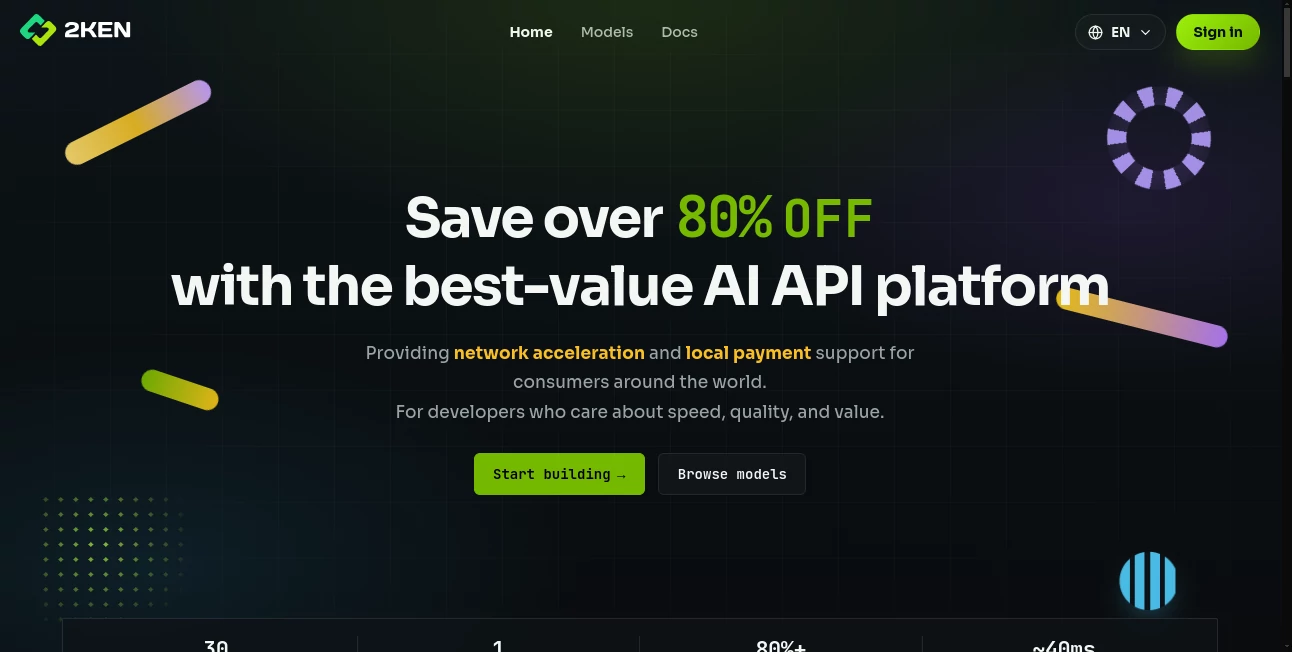
Working with multiple AI models can quickly become complicated. Different providers have different APIs, pricing structures, authentication methods, and usage limits. 2KEN takes a simpler approach by bringing access to more than 200 leading AI models through a unified AI gateway.
The platform is designed for developers and businesses that want to experiment with or build products around models from different providers without creating a separate integration for every model. It also uses an OpenAI-compatible API, making it easier for developers with existing OpenAI-based applications to connect to other models without rebuilding their entire stack.
Another appealing point is the pay-as-you-go approach. Instead of committing to another monthly subscription, users can pay for the model usage they actually need. For teams testing several models or applications with changing workloads, this can make AI infrastructure easier to manage.
Key Features
- Access to more than 200 AI models through one platform.
- OpenAI-compatible API for easier integration with existing applications.
- Pay-as-you-go pricing without mandatory monthly fees.
- Model pricing comparison to help developers evaluate costs before choosing a model.
- Support for models from multiple major AI providers.
- Real-time pricing information across supported models.
- Usage designed for both individual developers and larger applications.
- Enterprise-focused reliability with a stated 99.99% uptime.
- SOC 2 and GDPR-focused security and compliance.
- A pricing calculator for estimating model usage against a monthly budget.
User Interface
The interface is built around a straightforward developer-first experience. Instead of making users jump between numerous AI provider dashboards, the service puts model access and pricing information into one place.
The model pricing section is particularly useful when comparing different options. Developers can see the relative cost of input and output tokens and make a more informed decision before moving a model into production.
The pricing calculator adds another practical touch. Someone working with a fixed monthly AI budget can estimate how much usage that budget could provide across different models. For developers who regularly compare model economics, this can save quite a bit of manual calculation.
Accuracy & Performance
Model quality ultimately depends on the underlying AI model selected, but the gateway is designed to make access to those models more convenient. Rather than changing the behavior of the models themselves, its main value is in providing a common access layer.
The service reports 99.99% uptime over its recent 30-day status period and shows global latency monitoring. Its website also reports an average global latency of around 182 milliseconds at the time of the latest displayed measurement.
For developers building applications where reliability matters, having a centralized gateway can also make infrastructure management more predictable. Actual response speed will naturally vary depending on the selected model, request size, workload, and provider.
Capabilities
The biggest strength is the breadth of model access. Instead of choosing a single AI provider and building around it, developers can work with a wide range of models from a common integration point.
This is especially useful when different tasks require different models. A development team might prefer one model for complex reasoning, another for fast responses, and another for cost-sensitive workloads. Having these options available through one API can make experimentation considerably easier.
The OpenAI-compatible approach is another important capability. Developers who already understand the OpenAI API structure can potentially integrate the gateway into existing workflows with fewer changes than would be required when learning an entirely different API.
Security & Privacy
Security becomes increasingly important when AI APIs are used inside commercial applications. The service states that its infrastructure follows SOC 2 and GDPR security and compliance standards.
These claims make the platform more interesting for organizations that need to consider compliance when introducing third-party AI infrastructure. Businesses should still review the current terms, privacy documentation, data-handling policies, and model-specific policies before sending sensitive or regulated information through any external AI gateway.
Use Cases
AI Application Development: Developers can use a single API layer when building applications that rely on several language models.
Model Testing: Teams can compare different models without creating completely separate integrations for every provider.
Cost Optimization: Developers can compare token prices and select less expensive models for workloads where the additional capability of a premium model is unnecessary.
Prototyping: Startups and independent developers can experiment with different models while keeping their infrastructure relatively simple.
Production AI Systems: Businesses can use a centralized gateway as part of an architecture that needs access to multiple AI models.
Budget-Conscious Development: Pay-as-you-go billing can be useful for projects where usage fluctuates rather than remaining consistent every month.
Pros and Cons
Pros
- Access to 200+ AI models from one platform.
- OpenAI-compatible API simplifies integration.
- No mandatory monthly subscription.
- Pay-as-you-go model can suit variable workloads.
- Useful model pricing comparison tools.
- Designed with developer and enterprise use in mind.
- Reported 99.99% uptime.
- SOC 2 and GDPR compliance claims add confidence for business users.
Cons
- Choosing between hundreds of models can still require technical evaluation.
- Actual model performance varies between providers and models.
- Users working with only one AI provider may not need a multi-model gateway.
- Businesses with strict compliance requirements should review the current policies before deployment.
Pricing Plans
The pricing approach is based on usage rather than a traditional fixed monthly subscription. Users can purchase AI usage and pay according to the models and tokens they consume.
The website emphasizes that there are no monthly fees and provides a model-by-model pricing calculator. Displayed examples show significant savings compared with the listed official model prices, although the exact cost depends on the model selected and the amount of input and output generated.
This approach can be particularly attractive for developers whose usage changes from month to month. A small prototype, for example, does not necessarily need the same spending commitment as a production application processing millions of requests.
How to Use the Platform
- Create an account and access the developer dashboard.
- Choose the AI model that fits the application's requirements and budget.
- Generate an API key for authentication.
- Use the OpenAI-compatible API structure to connect the application.
- Send requests through the unified gateway.
- Monitor usage and compare model costs as the project grows.
- Switch between available models when performance, speed, or pricing requirements change.
Comparison with Similar Tools
Traditional AI development often means integrating directly with each model provider. That approach gives developers direct access to individual ecosystems, but it can also create additional API integrations, billing accounts, credentials, and maintenance work.
A unified gateway takes a different route. Its main advantage is flexibility: one integration can provide access to a much larger selection of models. This makes it especially appealing for teams that frequently test new models or want to avoid being tied too closely to one provider.
For a developer building a simple application around one specific model, direct access to that provider may remain the most straightforward choice. For teams comparing models or building AI products that may change providers over time, a unified gateway can be considerably more practical.
Conclusion
2KEN presents a compelling option for developers who want broader access to modern AI models without maintaining a separate integration for every provider. Its combination of 200+ models, an OpenAI-compatible API, usage-based pricing, and model cost comparison makes the service particularly interesting for AI developers, startups, and teams experimenting with different model architectures.
The pay-as-you-go structure is another strong point. Instead of paying for a fixed subscription regardless of usage, developers can work with the models they need and scale their spending alongside their applications.
For anyone building an AI-powered product where model choice, pricing, and flexibility matter, this unified approach is worth exploring. The biggest advantage is not simply the number of available models, but the ability to work with them through a common developer experience.
Frequently Asked Questions (FAQ)
What is 2KEN?
2KEN is a unified AI gateway that provides access to more than 200 AI models through a common platform and API.
Does it support an OpenAI-compatible API?
Yes. The platform provides an OpenAI-compatible API, which can make integration easier for applications already built around the OpenAI API format.
Does the platform require a monthly subscription?
No. Its pricing model is based on usage, allowing users to pay as they consume AI model resources rather than committing to a mandatory monthly fee.
How many AI models are available?
The platform currently advertises access to more than 200 AI models, with pricing and availability presented through its model catalog.
Is it suitable for businesses?
It can be suitable for businesses and development teams that need access to multiple AI models. The service also states that its infrastructure follows SOC 2 and GDPR security and compliance standards. Organizations should review the current policies and requirements before using it with sensitive data.
Can developers compare model prices?
Yes. The platform provides model pricing information and a calculator that can help developers estimate usage costs and compare different models before choosing one.
AI API Design , Large Language Models (LLMs) , AI Developer Tools .
These classifications represent its core capabilities and areas of application. For related tools, explore the linked categories above.

2KEN Alternatives Product

AI2AI project
Layven

git-lrc
langextract.…

AI Agent Ski…

DevUtilX

ModelsLab
Kimi K2.5

freellm