












Layven
What is Layven?
Your agents and your teammates need to work on the same files. Right now they don't. The agent has its sandbox, the team has its drive, and the two meet by copy-paste.
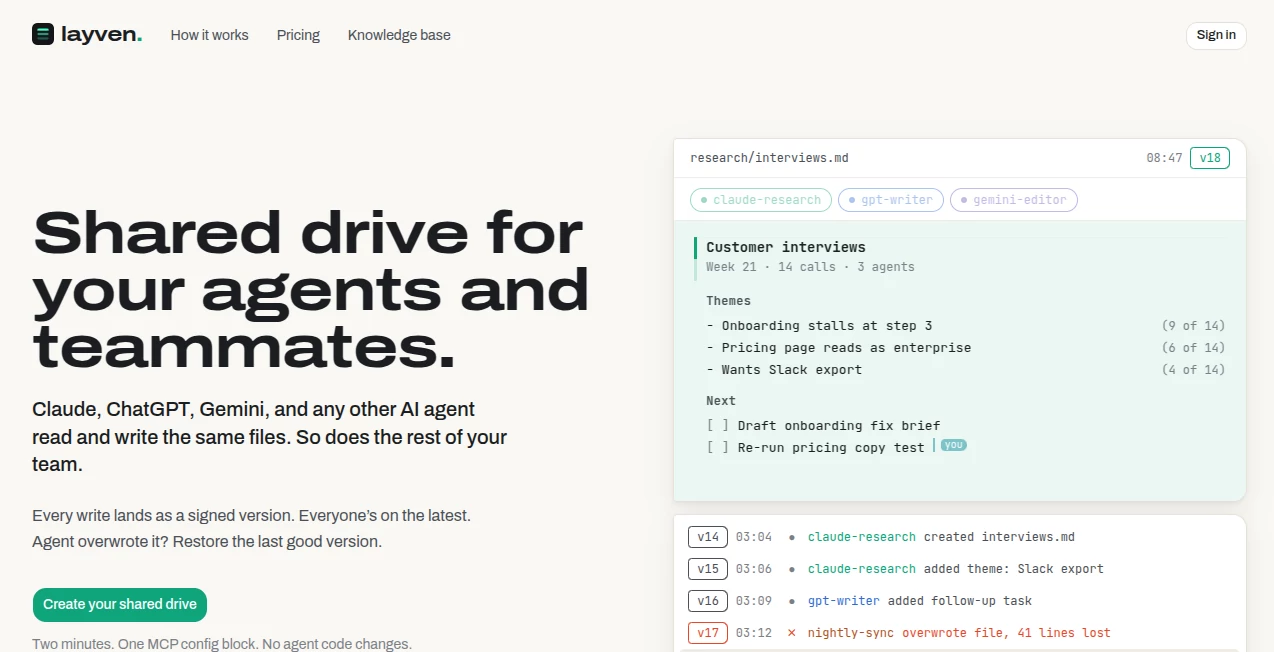
Layven is one shared drive for both. Claude, ChatGPT, Gemini and any other AI agent read and write the same files your colleagues do, through a single MCP config block. Two minutes to set up, no changes to your agent code.
Every write lands as a signed version attributed to whoever made it, agent or human. Everyone is always on the latest. When an agent overwrites something it shouldn't have, you restore the last good version, or roll a whole folder back to any point in time, in one call. Advisory locks and compare-and-swap stop parallel agents clobbering each other, and the activity feed shows exactly who changed what and when.
Key Features
- Real-time event and message processing
- Distributed workflow execution
- Scalable architecture for growing workloads
- Integration with APIs, enterprise systems, and streaming platforms
- Low-code configuration for deployment
- Support for edge and cloud environments
- High availability and fault tolerance
- Flexible data transformation capabilities
- Simplified monitoring and operational management
- Designed for enterprise-grade reliability
User Interface
The interface is designed around productivity rather than unnecessary complexity. Configuration, deployment, and workflow management are organized logically, making it easier for technical teams to understand processing pipelines and operational status. Even large distributed deployments remain manageable through centralized monitoring and clear workflow visualization.
Accuracy & Performance
The platform is built to process large volumes of events with minimal latency while maintaining dependable delivery. Its distributed architecture enables workloads to scale horizontally as demand increases, ensuring consistent performance even during traffic spikes. Organizations handling mission-critical operations can benefit from resilient processing that minimizes downtime and data loss.
Capabilities
Beyond simple data routing, the platform supports sophisticated event processing, transformation, filtering, enrichment, and orchestration across multiple systems. It can connect legacy infrastructure with modern cloud services, allowing companies to unify operational data without replacing existing investments. This flexibility makes it useful across manufacturing, finance, logistics, telecommunications, and many other industries.
Security & Privacy
Enterprise environments demand dependable security, and the platform is designed with resilience, controlled deployment, and operational reliability in mind. Organizations maintain control over their infrastructure while benefiting from robust processing capabilities suitable for production workloads where availability and consistency are essential.
Use Cases
- Real-time data integration
- Enterprise application integration
- IoT event processing
- Streaming analytics pipelines
- Business workflow automation
- Financial transaction processing
- Manufacturing monitoring systems
- Log aggregation and transformation
- Cloud migration projects
- Digital transformation initiatives
Pros and Cons
- Pros
- Excellent scalability for enterprise workloads
- Supports both real-time and batch processing
- Reduces development effort through configurable workflows
- Reliable distributed architecture
- Flexible integration with multiple data sources
- Suitable for cloud, edge, and hybrid deployments
- Cons
- Best suited for technical teams familiar with event-driven architectures
- Small projects may not require its advanced capabilities
- Initial planning is important for complex enterprise deployments
Pricing Plans
Pricing details are not publicly listed. Organizations interested in deployment options or enterprise licensing are encouraged to contact the vendor directly for customized plans based on infrastructure requirements and business needs.
How to Use Layven
Begin by defining the systems and data sources that need to exchange information. Configure event-processing workflows that transform, route, or enrich incoming data according to business requirements. Deploy the workflows across the desired environment, monitor operational performance, and adjust processing logic as business demands evolve. The platform is designed to simplify scaling without requiring major architectural changes.
Comparison with Similar Tools
Compared with traditional message brokers or standalone streaming frameworks, this solution focuses on delivering a complete event-processing environment instead of only transporting data. It combines workflow orchestration, distributed deployment, scalability, and operational management into a unified platform, helping organizations reduce integration complexity while accelerating production deployments.
Conclusion
Organizations looking to modernize their data infrastructure often struggle with fragmented tools and operational overhead. This platform addresses those challenges by bringing together event processing, workflow management, distributed deployment, and enterprise scalability within a single solution. Its combination of flexibility, resilience, and simplified operations makes it an excellent choice for businesses seeking reliable data integration and real-time processing capabilities that can grow alongside evolving operational requirements.
Frequently Asked Questions (FAQ)
What type of businesses can benefit from this platform?
It is suitable for organizations that process real-time data, integrate multiple systems, or manage distributed enterprise workflows.
Can it process streaming data?
Yes. It is designed to support real-time event and streaming data processing with scalable architecture.
Does it support enterprise integrations?
Yes. It can integrate with APIs, enterprise applications, messaging systems, and various data sources.
Is it appropriate for digital transformation projects?
Yes. Its architecture helps organizations modernize existing systems while minimizing infrastructure complexity.
Does it scale for large workloads?
Yes. The distributed design allows deployments to expand efficiently as processing demands increase.