














AI Agent Skills
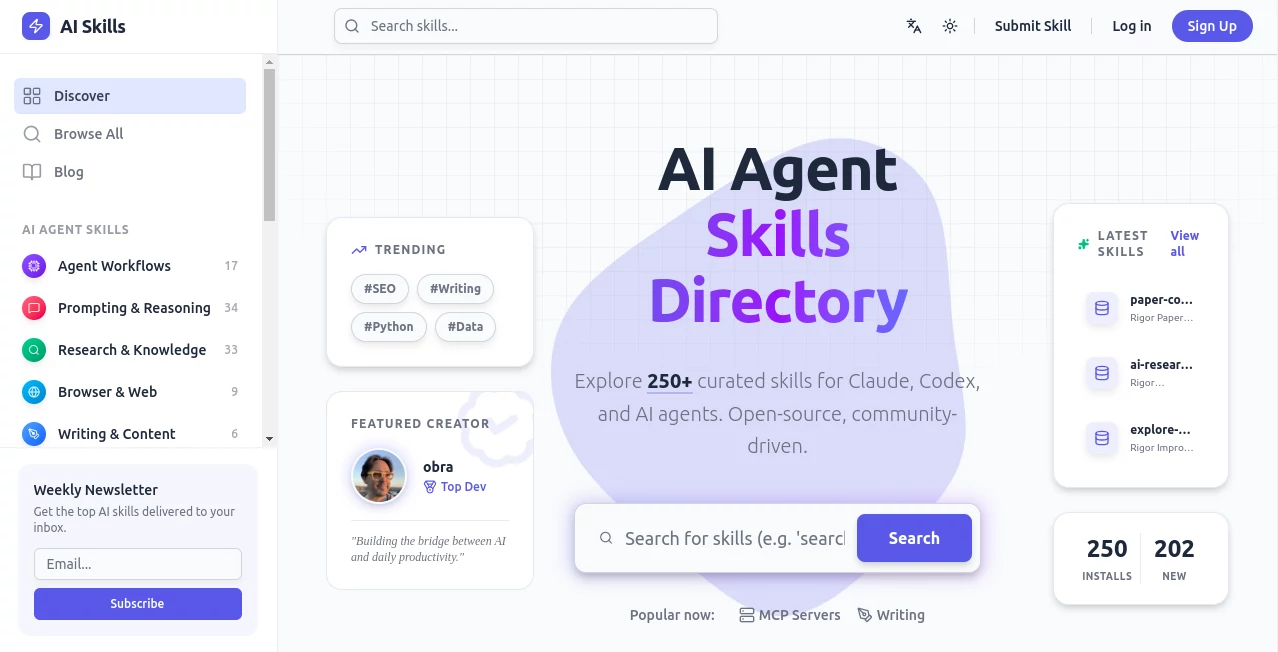
What is AI Agent Skills?
In today’s fast-moving digital landscape, businesses and developers are constantly searching for smarter ways to automate tasks and build intelligent systems. This platform is designed to simplify that journey by offering a structured environment where AI agents can be created, customized, and deployed without unnecessary complexity.
Instead of spending weeks stitching together different tools, users can focus on designing meaningful workflows that actually solve real problems. It feels less like a technical burden and more like shaping a digital assistant that understands what you want to achieve.
Key Features
User Interface
The interface is built with clarity in mind. Even users who are not deeply technical can navigate through agent creation steps without feeling overwhelmed. Everything is organized into logical sections that guide you naturally through the process.
Accuracy & Performance
Performance is optimized for real-time responsiveness. AI-driven workflows execute smoothly, allowing users to test and refine their agents quickly. The system is designed to reduce lag and improve output consistency, especially when handling multiple tasks.
Capabilities
This platform supports a wide range of AI-driven tasks including workflow automation, agent behavior customization, and integration with external systems. It allows developers and creators to build modular logic that adapts to different use cases.
Whether you're building a simple automation or a more advanced multi-step AI agent, the flexibility remains one of its strongest advantages.
Security & Privacy
Security is treated as a core foundation. User data and workflows are handled with controlled access layers, ensuring that sensitive information remains protected. The system is designed to support safe experimentation without exposing internal logic unnecessarily.
Use Cases
- Automating repetitive business workflows
- Creating AI assistants for customer support tasks
- Building internal productivity agents for teams
- Developing experimental AI-driven prototypes
- Integrating AI logic into SaaS applications
Pros and Cons
Pros
- Easy-to-use interface for building AI agents
- Flexible workflow customization
- Suitable for both beginners and developers
- Supports automation at scale
Cons
- Advanced features may require learning time
- Some integrations may depend on external tools
Pricing Plans
Pricing information is typically structured around different usage needs, ranging from individual experimentation to business-level deployment. While exact plans may vary, platforms like this often provide flexible options depending on scale and feature access.
How to Use AI Agent Skills
Getting started is straightforward. Users usually begin by defining an objective, then selecting or designing an AI agent structure. From there, workflows are added step by step, allowing the agent to perform specific actions based on input conditions.
After configuration, the agent can be tested, refined, and deployed into real-world scenarios such as automation pipelines or internal tools.
Comparison with Similar Tools
Compared to traditional automation platforms, this solution focuses more on intelligent decision-making rather than simple rule-based execution. Unlike rigid systems, it allows agents to adapt based on context and input variations, making it more suitable for modern AI-driven applications.
Conclusion
For anyone exploring the future of AI automation and intelligent systems, this platform offers a practical and flexible starting point. It bridges the gap between complex AI development and real-world usability, making it easier to bring ideas to life without unnecessary friction.
Frequently Asked Questions (FAQ)
What is this platform used for?
It is used to build and manage AI agents that can automate tasks, workflows, and decision-making processes.
Do I need coding experience?
Not necessarily. While coding knowledge can help, many features are designed to be accessible for non-developers as well.
Can it be used for business automation?
Yes, it is suitable for business workflows, customer support automation, and internal productivity systems.
Is it scalable for large projects?
Yes, it is designed to support both small experiments and larger-scale deployments depending on requirements.