
AgentSkillsHub
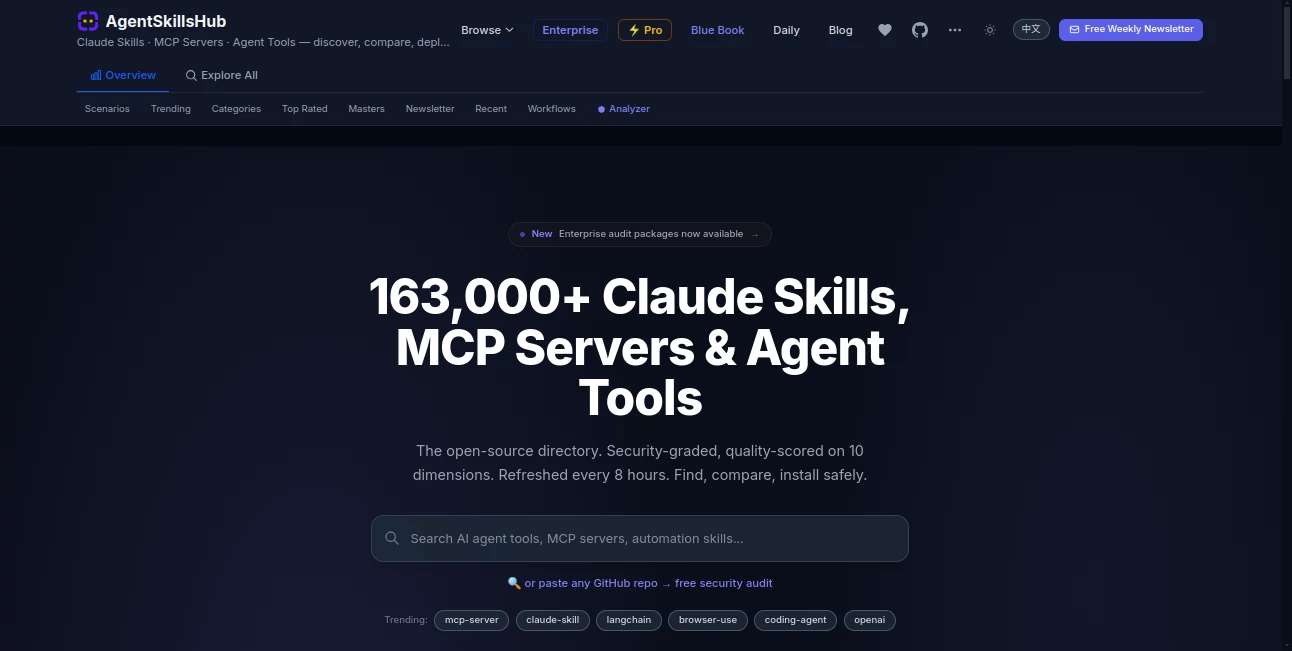
What is AgentSkillsHub?
AgentSkillsHub is an open-source directory built for developers who are exploring the rapidly growing world of AI agent skills, MCP servers, Claude skills, Codex skills, coding assistants, and developer automation tools. Instead of relying only on popularity, the platform combines GitHub activity, documentation quality, code-related signals, community engagement, and security information to make discovery more practical.
The directory currently tracks more than 163,000 AI agent projects and refreshes its data every eight hours. That makes it particularly useful for developers who want to keep up with a fast-moving ecosystem where new repositories appear constantly and older projects can change significantly over time.
One of the most useful ideas behind the platform is that finding an AI agent tool is only half the job. Developers also need to know whether a project looks mature, how actively it is maintained, what it is designed to do, and whether there are potential security concerns before installing unfamiliar code.
Key Features
- Large directory covering more than 163,000 AI agent projects and open-source repositories.
- Dedicated categories for MCP servers, Claude skills, Codex skills, agent tools, prompt libraries, AI coding assistants, and other AI tools.
- Quality scoring designed to help distinguish production-ready projects from experimental repositories.
- Security grades including SAFE, CAUTION, UNSAFE, and UNAUDITED.
- Automatic data refreshes every eight hours.
- GitHub-based discovery and metadata collection.
- Search and filtering by keywords, programming language, and tool category.
- Scenario-based collections covering areas such as browser automation, web scraping, code review, workflow automation, and security auditing.
- Side-by-side comparison features for evaluating multiple projects.
- Security analysis through the built-in Skill Analyzer.
- Trending and star-velocity information for discovering projects gaining community attention.
- Open documentation of the platform's scoring and editorial methodology.
User Interface
The interface is designed around discovery rather than a complicated setup process. Visitors can start with a broad catalog, move into a specific category, or explore a scenario based on the task they want to accomplish.
This organization is especially helpful when you do not already know the exact repository or skill you need. A developer interested in browser automation, database tooling, code review, or prompt engineering can begin with a scenario and then compare available projects.
The individual listings also provide useful context such as GitHub stars, programming language, quality information, security status, and project descriptions. It feels more practical than browsing an enormous collection of repositories without any additional context.
Accuracy & Performance
The platform relies heavily on automated data collection from GitHub. Its pipeline includes repository discovery, metadata enrichment, README analysis, quality scoring, category classification, and composability analysis. The process runs every eight hours, helping the catalog stay reasonably current as projects evolve.
The quality score uses multiple signals rather than treating GitHub stars as the only indicator of value. Documentation, examples, completeness, specificity, and agent readiness are among the factors considered. This gives users another way to judge a project when popularity alone does not tell the full story.
Security information is also presented as a separate layer. The site's rule-based scanner checks for patterns associated with issues such as credential harvesting, data exfiltration, suspicious installation commands, privilege escalation, and access to sensitive files. The platform clearly notes that this is a first-layer automated scan rather than a complete human security audit.
Capabilities
The directory goes beyond simply listing repositories. Developers can discover projects by category, search for specific capabilities, compare tools, and browse curated scenarios based on common agent workflows.
Its coverage includes MCP servers, Claude and Codex skills, general agent utilities, coding assistants, prompt collections, and other open-source AI projects. Popular scenarios include browser automation, database management, web scraping, workflow automation, code completion, security auditing, and code review.
The platform also publishes research and analysis about the AI agent ecosystem. Its security research, for example, examines large collections of agent skills and highlights why developers should consider the security implications of installing third-party agent extensions.
Security & Privacy
Security is one of the platform's strongest differentiating features. Each indexed repository receives a security status based on an automated rule-based scan, with results presented as SAFE, CAUTION, UNSAFE, or UNAUDITED.
The scanner looks for several categories of potentially dangerous behavior, including credential harvesting, data exfiltration, suspicious shell installation patterns, privilege escalation, persistence mechanisms, and attempts to access sensitive configuration or credential files.
It is important to understand what these grades mean. An automated security grade should be treated as an initial screening layer, not a guarantee that a repository is completely safe. Developers should still inspect source code, permissions, dependencies, installation instructions, and project activity before deploying an unfamiliar tool in a sensitive environment.
Use Cases
- Finding AI agent skills: Developers can discover open-source skills designed to extend the capabilities of modern coding agents.
- Discovering MCP servers: Users can explore projects that connect AI agents with external services, databases, and workflows.
- Developer research: The catalog provides a convenient starting point when researching new tools and open-source projects.
- Browser automation: Scenario collections help developers locate projects for automated browser workflows.
- Code review: Developers can explore tools designed to support automated code analysis and review.
- Workflow automation: The directory can help teams find agent tools for repetitive development and business workflows.
- Security research: Security grades and published research provide an additional layer of information before installing third-party agent software.
- Technology discovery: Trending projects and GitHub activity make it easier to spot repositories gaining community attention.
- Comparing projects: Developers can evaluate multiple options instead of selecting the first repository they encounter.
Pros and Cons
- Pros: Very large collection of AI agent projects, frequent data updates, quality scoring, security grading, GitHub-based data, useful scenario pages, comparison functionality, and transparent methodology.
- Pros: Particularly valuable for developers working with MCP, Claude skills, Codex skills, AI coding assistants, and open-source agent ecosystems.
- Pros: Security information is presented alongside discovery features, which is useful when evaluating unfamiliar repositories.
- Cons: Automated security grading cannot replace a complete manual security audit.
- Cons: The size of the catalog can feel overwhelming for newcomers who are not yet familiar with AI agent terminology.
- Cons: Some indexed repositories may be experimental, inactive, or relatively new, so users should review the project's current GitHub activity before adopting it.
Pricing Plans
The directory is centered on discovering open-source AI agent tools and publicly available repository information. The core discovery experience does not present a conventional paid subscription structure on the main platform. Users can browse the catalog, explore categories and scenarios, review quality information, and examine security grades without needing to approach the platform like a traditional commercial SaaS product.
This model makes sense for its audience. Developers are primarily coming to research repositories, compare projects, and understand the growing AI agent ecosystem rather than purchase an AI generation service.
How to Use the Directory
Start by choosing a category that matches the type of project you are looking for. For example, you can explore MCP servers, Claude skills, Codex skills, coding assistants, agent tools, or prompt libraries.
If you already have a specific task in mind, scenario pages can provide a faster route. Search for an area such as browser automation, web scraping, code review, database tooling, or workflow automation and examine the available projects.
Once you find a promising repository, review its description, GitHub activity, quality score, programming language, documentation, and security grade. For anything that will receive access to sensitive files, credentials, production systems, or private data, take the additional step of reviewing the source code and permissions yourself.
For developers comparing several alternatives, the comparison functionality can make the selection process easier by putting relevant project information side by side.
Comparison with Similar Tools
Traditional GitHub search is excellent for finding source code, but it often leaves developers responsible for evaluating popularity, documentation, maintenance, relevance, and security on their own. AI-focused marketplaces can make discovery easier, but their catalogs and ranking methods vary considerably.
This platform takes a more specialized approach by combining repository discovery with quality scoring, security grading, categories, scenarios, and comparison tools. The result is closer to a research layer for the AI agent ecosystem than a simple list of GitHub links.
For developers who already know exactly which repository they want, going directly to GitHub may still be the fastest option. For developers exploring an unfamiliar area, however, a structured catalog with additional signals can significantly reduce the amount of manual research required.
Conclusion
The AI agent ecosystem is expanding too quickly for developers to evaluate every new skill, MCP server, and automation project manually. A structured discovery platform can therefore save considerable research time, particularly when it combines popularity signals with documentation, quality, maintenance, and security information.
With a catalog covering more than 163,000 projects, frequent updates, scenario-based discovery, quality scoring, and security grading, the platform offers a practical starting point for developers building with AI agents. Its strongest value is not simply the number of repositories it tracks, but the additional context it puts around those repositories.
For anyone experimenting with AI coding agents, MCP, open-source skills, or developer automation, it is a useful place to discover projects, compare alternatives, and perform an initial risk check before bringing unfamiliar code into an existing workflow.
Frequently Asked Questions (FAQ)
What type of tools can I find in the directory?
The catalog covers MCP servers, Claude skills, Codex skills, general AI agent tools, prompt libraries, AI coding assistants, and other open-source AI projects.
How often is the directory updated?
The platform states that its automated data pipeline refreshes every eight hours. New repositories can therefore appear relatively quickly as the underlying GitHub ecosystem changes.
How are tools quality-scored?
Projects receive a composite quality score based on multiple signals. These include aspects such as completeness, clarity, specificity, examples, README structure, and readiness for use with AI agents.
What do the security grades mean?
The security system uses automated rule-based analysis and assigns statuses such as SAFE, CAUTION, UNSAFE, or UNAUDITED. These results are intended as an initial security screening and should not be considered a replacement for a full manual audit.
Can developers compare different AI agent tools?
Yes. The platform includes comparison functionality designed to help developers evaluate multiple projects and make a more informed choice based on available project information.
Is the directory useful for developers who are new to AI agents?
Yes, although the large catalog can initially feel extensive. Category pages and scenario-based collections make it easier to start with a specific task instead of searching through the entire ecosystem at once.
AI Workflow Management , AI Developer Docs , AI Developer Tools , AI Tools Directory .
These classifications represent its core capabilities and areas of application. For related tools, explore the linked categories above.

AgentSkillsHub Alternatives Product

Sourcetable

Launchelion

4ga Boards

AI For That

Geekflare AI

WebToMind

Syncity AI

SaaSTool - R…

volume shade…