
















Launchelion
What is Launchelion?
Finding a genuinely useful AI product can be surprisingly difficult. New tools appear every day, but many disappear just as quickly, making it hard for founders, creators, developers, and early adopters to know which launches are worth watching. Launchelion takes a focused approach by bringing newly launched AI products into one place and giving people a simple way to discover what is new.
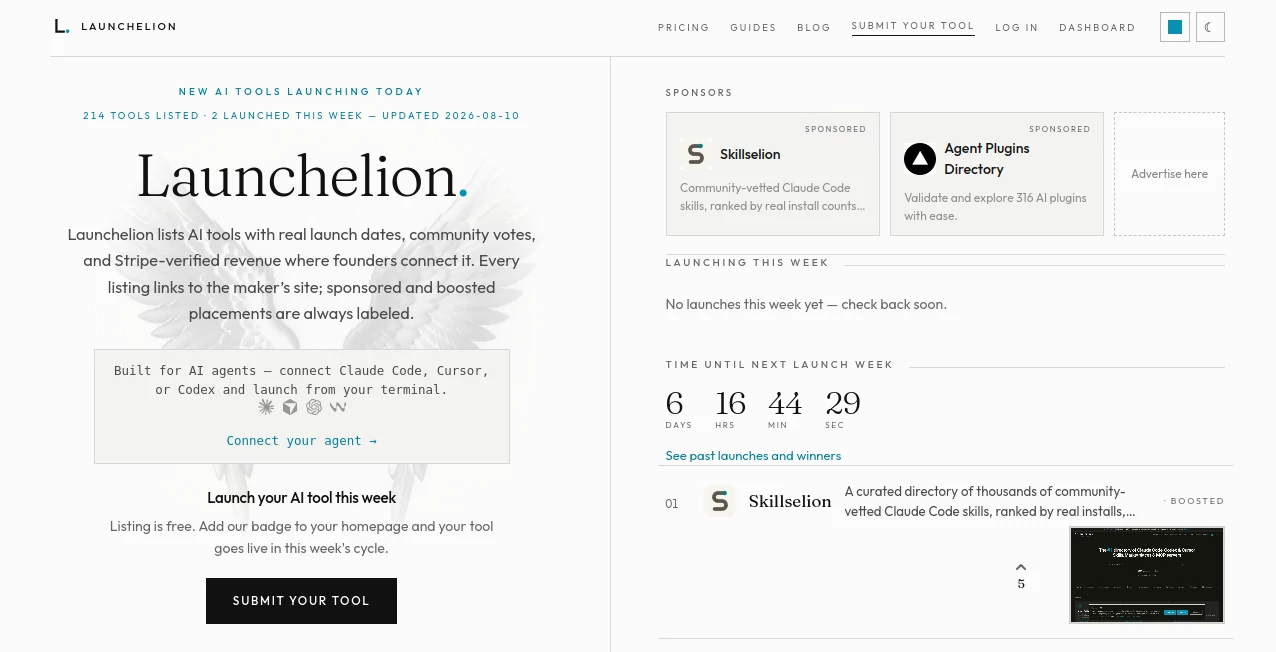
The platform is built around real launch dates, community activity, and signals that can help visitors understand more than just a product name and a short description. Founders can submit their AI products, while visitors can browse recent launches, explore past products, and see which tools are attracting attention.
One particularly useful detail is the emphasis on verified information. Listings can include Stripe-verified revenue when a founder chooses to connect it, while sponsored and boosted placements are clearly labeled. That distinction makes the directory more useful for people who want to explore new AI products without confusing paid visibility with organic community interest.
Key Features
- AI product discovery focused on newly launched tools
- Real launch dates displayed on listings
- Community votes and comments
- Stripe-verified revenue signals when connected by founders
- Weekly launch cycles for free submissions
- Permanent listing pages
- Past launches and winners for discovering established products
- Clearly labeled sponsored and boosted placements
- Free AI tool submissions
- Paid options for faster publication and additional exposure
- Sponsored articles and comparison-page placement through Spotlight
- Support for AI-agent based submission workflows through connected coding agents
User Interface
The interface keeps the focus where it belongs: on the products being launched. Visitors can move between the current launch feed, past launches, guides, blog content, pricing, and submission options without having to work through an overloaded dashboard.
The launch feed is especially straightforward. Each product is presented with a concise explanation of what it does, while voting activity gives visitors another way to spot products that are receiving attention. For someone casually browsing during a coffee break, this makes the experience feel more like discovering interesting products than searching through a huge software catalog.
Accuracy & Performance
A directory of new products is only useful when its information can be trusted. The platform addresses this by emphasizing real launch dates and by giving founders a way to verify ownership through a homepage badge for free listings. Revenue information is presented as a Stripe-verified signal when founders connect their account rather than as an unsupported claim.
The result is a more informative discovery experience. Instead of judging a new AI product purely from marketing copy, visitors can look at launch timing, community response, and available verification signals together. That is particularly helpful when comparing several young products in the same space.
Capabilities
The platform serves two audiences at once. For visitors, it works as a discovery directory where new AI products can be found before they become widely known. For founders, it provides a launch channel with several levels of exposure.
A founder can submit a product for free and have it enter the next weekly launch cycle. Paid options provide faster publication and promotional exposure, while the Spotlight option adds a dedicated sponsored article and placement on relevant comparison pages. This gives smaller products a practical way to get in front of people actively looking for new AI software.
Another interesting capability is its support for AI agents. Developers can connect agents such as Claude Code, Cursor, or Codex and work with the launch process directly from a terminal. That makes the platform feel particularly relevant to the way modern AI-first products are being built and shipped.
Security & Privacy
Trust is important for a platform that handles product submissions, ownership verification, and optional revenue connections. The site uses a homepage badge as part of its free-listing verification process, helping confirm that the person submitting a product controls the associated website.
The platform also states that its analytics are privacy-friendly and only used when visitors accept them, while essential login functionality remains available. Sponsored placements and paid links are explicitly identified, which adds useful transparency for both founders and visitors.
Use Cases
- Discovering new AI products: Browse recently launched tools instead of relying solely on established AI brands.
- Finding products for a specific workflow: Explore the directory when looking for new solutions across areas such as marketing, development, research, productivity, and creative work.
- Launching an AI startup: Submit a newly released product and establish a permanent listing around its actual launch date.
- Building early visibility: Founders can use community voting and optional promotional placements to attract attention during the early stages of a product.
- Competitive research: Past launches and category comparison pages can help founders understand what similar products are entering the market.
- Tracking the AI ecosystem: Regular visitors can use the launch feed to keep up with the steady stream of new AI products.
Pros and Cons
Pros
- Strong focus on newly launched AI products
- Free submission option for founders
- Real launch dates make product discovery more meaningful
- Community votes provide an additional discovery signal
- Optional Stripe-verified revenue information can add useful context
- Permanent listing pages give products a lasting presence
- Paid placements are clearly labeled
- Simple interface that keeps browsing focused on products
- Useful launch options for both small projects and established AI companies
Cons
- The directory is primarily focused on AI products, so it is not designed as a general software marketplace.
- Free submissions depend on the weekly launch cycle rather than immediate publication.
- Some promotional features require a paid placement.
- Revenue verification is only available when a founder connects the relevant Stripe information.
Pricing Plans
The platform offers a free way to list an AI product. The free listing costs $0 and includes publication in the next weekly cycle, a permanent listing page with the product's real launch date, and community voting and comments.
For founders who want faster exposure, the Skip the Queue option is priced at $19 as a one-time payment. According to the pricing page, it provides immediate publication once payment clears, removes the badge requirement, and includes 30 days in the homepage sponsored area.
The Spotlight option is available for $39 per spotlight or $29 per month for two spotlights each month. It includes the benefits of the faster publication option along with a sponsored article and placement on relevant alternative pages. Paid placements are labeled as sponsored.
How to Use Launchelion
- Create or access an account on the platform.
- Choose the option to submit an AI product.
- Add the required product and website information.
- For a free listing, place the verification badge on the product homepage as requested.
- Submit the product for review and wait for the next weekly launch cycle.
- Once published, monitor community votes and comments to see how visitors respond.
- If immediate publication or additional exposure is important, choose one of the available paid placement options.
For visitors, the process is even simpler: browse the launch feed, open products that catch your attention, and use community activity and available verification signals to decide which ones deserve a closer look.
Comparison with Similar Tools
Traditional AI directories are often designed around categories, popularity, or large collections of established products. This platform takes a different route by putting launch timing at the center of discovery. That makes it particularly interesting for people who want to find products early rather than simply search for the most famous AI tools.
Product Hunt-style launch platforms can be useful for broad startup discovery, while specialized AI directories can provide extensive catalogs. The advantage here is the narrower focus: visitors come specifically to see AI products that are launching or have recently launched.
For founders, the distinction is also important. A permanent listing combined with a real launch date can provide a useful reference point long after the initial launch week has passed. Optional promotional features then give founders additional ways to increase visibility without disguising paid exposure as organic activity.
Conclusion
For anyone who enjoys discovering AI products before they become household names, Launchelion offers a focused and practical place to start. Its emphasis on real launch dates, community activity, optional revenue verification, and clearly marked promotional placements gives the directory more context than a simple collection of AI links.
For founders, the combination of free listings and optional promotional packages makes it accessible at different stages of a product launch. A small project can start with a free listing, while a company looking for a faster or more visible launch can choose additional exposure.
The strongest part of the experience is its focus. Rather than trying to be everything to everyone, it concentrates on one useful question: what AI products are launching now? For developers, founders, marketers, researchers, and curious early adopters, that can make finding the next interesting tool considerably easier.
Frequently Asked Questions (FAQ)
Is it free to list an AI product?
Yes. AI products can be submitted for free. Free listings enter the next weekly launch cycle and include a permanent listing page, the real launch date, community votes, and comments.
How can I publish an AI product immediately?
The Skip the Queue option is designed for immediate publication. It is listed at $19 as a one-time payment and is intended to publish once the payment clears.
What is the Spotlight option?
Spotlight is a paid promotional option that adds a sponsored article about the product and placement on relevant comparison pages. It is listed at $39 for one spotlight or $29 per month for two spotlights.
Are sponsored listings clearly identified?
Yes. The platform states that sponsored and boosted placements are labeled, and paid links are marked as sponsored. This helps visitors distinguish promotional exposure from normal community activity.
Does the directory show AI product revenue?
Some listings can display Stripe-verified revenue when founders choose to connect their Stripe information. This provides an additional signal without presenting unverified revenue claims as facts.
Who can benefit from using this platform?
AI founders can use it to launch and promote products, while developers, marketers, researchers, creators, and other AI enthusiasts can use it to discover recently launched tools and follow emerging products.