AgentSwarms
What is AgentSwarms?
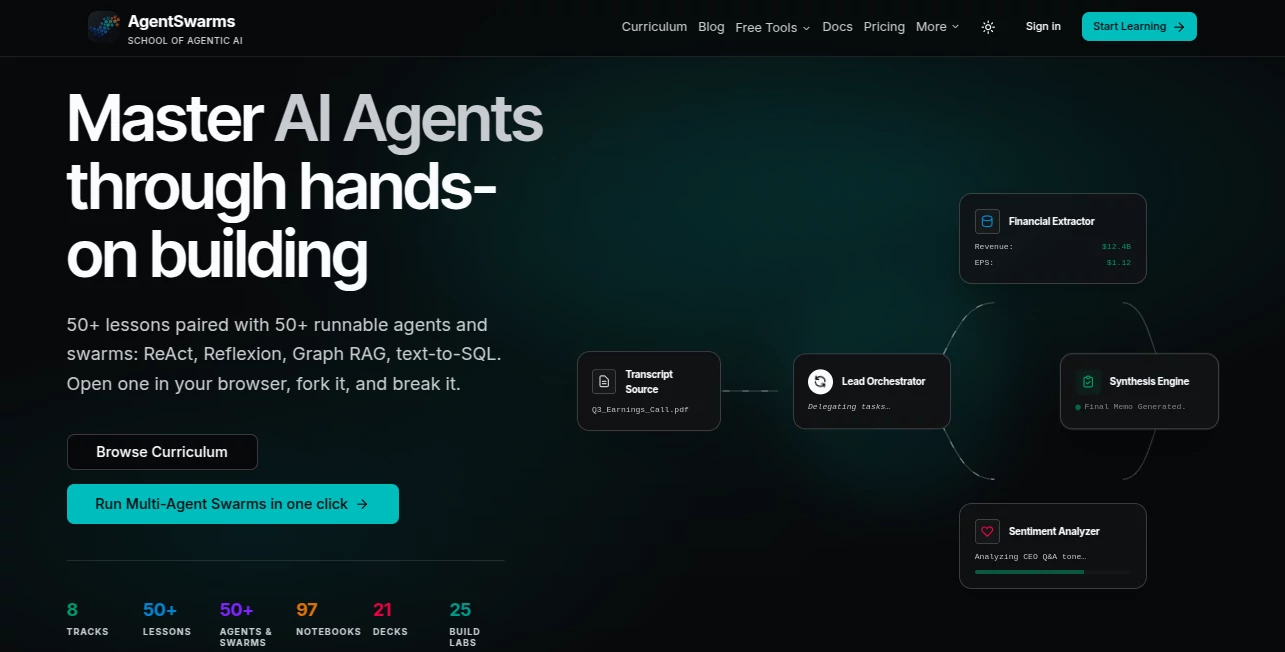
Learning how modern AI agents work can be overwhelming. Many tutorials focus on theory, while production platforms often expect users to understand advanced concepts before getting started. This platform bridges that gap by combining interactive lessons with fully runnable projects, allowing learners to explore real-world agent architectures directly in the browser. Every lesson is paired with practical examples, making it easier to understand concepts such as tool calling, retrieval-augmented generation (RAG), multi-agent orchestration, memory, and guardrails through experimentation rather than passive reading.
Instead of reading endless documentation, users can open a working project, inspect every component, modify prompts, replace models, connect knowledge bases, and immediately observe how those changes affect the final outcome. This practical workflow shortens the learning curve and gives developers, students, and AI enthusiasts the confidence to build increasingly sophisticated autonomous systems.
Another standout aspect is its education-first philosophy. Rather than simply providing a visual builder, the platform explains why each pattern exists, when it should be used, and what common mistakes developers should avoid. The result is an experience that feels much closer to working alongside an experienced mentor than following a traditional online course.
Key Features
User Interface
The browser-based interface is clean, modern, and designed for exploration. Interactive lessons appear alongside working examples, allowing users to learn and build simultaneously. Templates, guided walkthroughs, visual swarm builders, trace inspectors, and playground environments make navigation intuitive even for newcomers. Since everything runs in the browser, there is no complicated installation process before starting.
Accuracy & Performance
The platform focuses on practical implementation rather than simplified demonstrations. Users can experiment with real AI providers, inspect token usage, monitor latency, analyze execution traces, and evaluate agent behavior under different conditions. Features like Human-in-the-Loop approvals, budget controls, and production-inspired workflows help learners understand how reliable AI systems are designed in real business environments.
Capabilities
- Interactive curriculum covering modern agent architectures
- Dozens of runnable AI agents and multi-agent workflows
- Visual drag-and-drop swarm builder
- Support for RAG implementations and knowledge bases
- Tool calling and API integrations
- Voice-enabled AI agent creation
- Community marketplace for sharing and remixing projects
- Interactive notebooks and guided build labs
- Trace inspection for debugging and optimization
- Support for multiple leading language model providers
- Exportable agent and swarm projects
- Hands-on learning with realistic production patterns
Security & Privacy
Security receives considerable attention throughout the platform. Personal projects remain private unless intentionally shared with the community. Saved provider credentials are encrypted, users retain ownership of their created agents, and exported projects prevent vendor lock-in. Additional safeguards such as budget limits, approval workflows, and detailed execution monitoring encourage responsible experimentation while helping users understand best practices for deploying AI safely.
Use Cases
- Learning the fundamentals of agentic AI
- Building multi-agent automation workflows
- Understanding RAG and knowledge retrieval systems
- Experimenting with prompt engineering techniques
- Creating AI-powered research assistants
- Developing customer support assistants
- Building AI coding assistants
- Teaching AI concepts in educational environments
- Rapid prototyping before production deployment
- Exploring orchestration and planning strategies
Pros and Cons
Pros
- Excellent combination of theory and practical implementation.
- No complicated local setup required.
- Large collection of interactive lessons and templates.
- Supports many popular AI model providers.
- Community features encourage collaborative learning.
- Visual builder simplifies complex workflows.
- Includes debugging and observability tools.
- Suitable for both beginners and experienced developers.
Cons
- Some advanced concepts may still require basic AI knowledge.
- Public beta means certain features continue to evolve.
- Daily usage limits apply to the included AI credits.
Pricing Plans
The platform is currently available free during its public beta period. Users receive generous AI usage credits without needing a credit card, while also having the option to connect their own API keys from supported AI providers. Future premium plans are expected after beta, but the service clearly communicates that a permanent free tier will remain available for learners.
How to Use AgentSwarms
Begin by creating a free account and opening one of the available interactive lessons. Select a ready-made template that matches your learning goal, whether it focuses on retrieval, planning, coding, research, or multi-agent collaboration. Follow the guided walkthrough, run the project, inspect the execution traces, and then customize prompts, models, or tools to observe different behaviors. As confidence grows, users can build entirely new agents, connect them into swarms, publish their work, or export projects for external environments.
Comparison with Similar Tools
Unlike many visual AI builders that assume users already understand agent architecture, this platform emphasizes education before production. Interactive explanations accompany every important concept, making it easier to understand why specific workflows exist instead of simply connecting blocks on a canvas.
Compared with traditional online AI courses, the experience is significantly more engaging because every lesson immediately becomes an executable project. Learners can intentionally break workflows, inspect failures, repair them, and develop a deeper understanding that would be difficult to achieve through videos alone.
For developers who eventually plan to use advanced orchestration frameworks, the platform serves as an excellent stepping stone by teaching transferable concepts rather than locking users into a proprietary ecosystem.
Conclusion
For anyone serious about understanding modern AI agents, this educational platform delivers an impressive blend of structured learning, practical experimentation, and production-inspired workflows. The combination of guided lessons, runnable examples, visual builders, debugging tools, and community collaboration creates an environment where knowledge is gained through doing rather than memorizing. Whether you're taking your first steps into agentic AI or refining advanced orchestration skills, it offers one of the most engaging ways to build genuine expertise.
Frequently Asked Questions (FAQ)
Is it suitable for complete beginners?
Yes. The guided curriculum gradually introduces concepts before moving into more advanced multi-agent systems.
Do I need programming experience?
Basic programming knowledge is helpful but not mandatory, as many examples can be explored through the visual interface.
Can projects be exported?
Yes. Created agents and swarm configurations can be exported, helping users avoid vendor lock-in.
Does it support multiple AI providers?
Yes. Users can work with several major language model providers or connect their own API keys.
Is the platform currently free?
Yes. During the public beta period, users can access the platform with generous AI usage credits at no cost.
AI Workflow Management , AI Education Assistant , Large Language Models (LLMs) , AI Developer Tools .
These classifications represent its core capabilities and areas of application. For related tools, explore the linked categories above.

AgentSwarms Alternatives Product

Dialogues wi…
BookTranslat…

Sovi.AI

TriviaFlow

Syncity AI

Ask Bishop

globalize.now

TruthSpine

Simple Dev T…