
BathroomAI
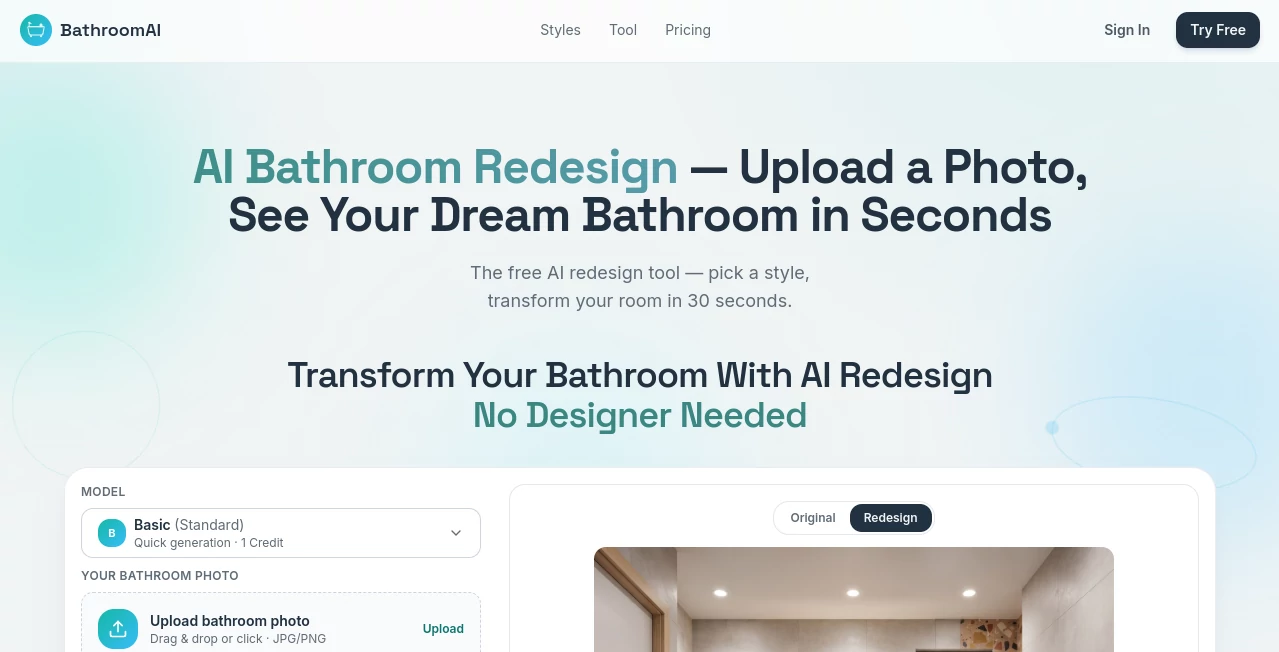
What is BathroomAI?
AI Bathroom Redesign is a practical way to explore bathroom renovation ideas before making expensive changes. Instead of trying to picture a new space from a mood board or a collection of unrelated inspiration photos, users can start with their existing bathroom and explore how different design directions could look.
This is especially useful when the hardest part of a renovation is simply making a decision. A bathroom may need new tiles, a different vanity, updated lighting, a more modern shower area, or a completely different visual style. Seeing possible results first can make those choices much easier.
The concept is straightforward: use an existing bathroom image as the starting point and let artificial intelligence create a redesigned visual interpretation. The result can then be used as inspiration when discussing ideas with a contractor, interior designer, or simply deciding what kind of renovation feels right.
Key Features
- AI-assisted bathroom redesign from an existing space
- Visual exploration of different bathroom styles
- Ideas for modernizing outdated interiors
- Useful inspiration for tile, vanity, shower, lighting, and decor changes
- Photo-based visualization rather than designing an entirely imaginary room
- Fast experimentation with renovation concepts
- Helpful starting point for homeowners planning a remodel
User Interface
The appeal of an AI bathroom redesign tool is its simplicity. Most users do not want to learn complicated 3D modeling software just to see whether a darker tile or a floating vanity would suit their bathroom. A photo-based workflow removes much of that complexity.
A straightforward experience is particularly valuable for homeowners who already know what they dislike about their current bathroom but are unsure what they want instead. Rather than spending hours creating a detailed floor plan, they can begin with the room they already have and explore visual possibilities from there.
Accuracy & Performance
AI-generated renovation images are best treated as visual concepts rather than construction drawings. They can provide a surprisingly useful impression of colors, materials, furniture, lighting, and overall atmosphere, but they should not replace measurements or professional planning.
For example, a generated image might make a compact bathroom appear more spacious than it really is. Plumbing locations, wall dimensions, electrical requirements, ventilation, waterproofing, and the exact clearance needed around fixtures still need to be checked in the real room.
Used with those limitations in mind, AI visualization can save considerable time during the early design stage. It is much easier to reject an idea after seeing it than after buying the wrong tiles or fixtures.
Capabilities
The strongest use of this type of tool is visual experimentation. A dated bathroom can be explored through contemporary, minimalist, luxury, spa-inspired, Scandinavian, industrial, or other design directions without physically changing anything.
It can also help users think about individual design decisions. A new vanity, different wall treatment, updated flooring, improved lighting, a glass shower enclosure, or warmer materials can dramatically change the character of a bathroom. Seeing these possibilities together gives homeowners a clearer sense of what belongs in the same design.
For someone collecting renovation ideas, the generated concepts can also serve as a visual reference when communicating with professionals. Instead of saying “I want something modern but warm,” a homeowner can show the kind of atmosphere they have in mind.
Security & Privacy
When using any service that processes photographs, privacy deserves attention. Bathroom photographs can contain personal information about a home, so users should review the provider's privacy policy and understand how uploaded images are processed, stored, and deleted.
It is also sensible to avoid including unnecessary personal information in photographs. A clean image focused on the bathroom is generally better for both privacy and design visualization.
Use Cases
Homeowners planning a bathroom renovation can use AI visualization to compare several ideas before committing to materials or hiring a contractor. This is perhaps the most obvious use case, but it is far from the only one.
- Renovation planning: Explore possible designs before purchasing materials.
- Style discovery: Find out which bathroom styles actually suit an existing space.
- Tile inspiration: Compare lighter, darker, patterned, or stone-inspired finishes.
- Vanity ideas: Visualize different approaches to storage and bathroom furniture.
- Rental improvements: Explore design directions without immediately committing to permanent changes.
- Interior designers: Create quick visual concepts during the early stages of a project.
- Contractor discussions: Use visual references to communicate the desired aesthetic.
- Home sellers: Explore potential renovation concepts that could improve the presentation of a property.
Pros and Cons
Pros
- Easy way to explore bathroom renovation concepts
- Useful for visual thinkers who struggle with traditional plans
- Can help narrow down design preferences before spending money
- Good source of inspiration for outdated bathrooms
- Useful for comparing different aesthetic directions
Cons
- AI visuals should not be considered construction plans
- Generated proportions may not always match the real room perfectly
- Some fixtures or architectural details may be interpreted incorrectly
- Actual renovation costs and technical requirements still need professional evaluation
Pricing Plans
Pricing and available usage can change over time, so users should check the current options directly on the service before making a purchase. The most important point is to understand whether generations, high-resolution exports, or additional redesigns are subject to usage limits or paid access.
For someone simply exploring ideas for one bathroom, a free or low-cost option can be enough to establish a direction. Users working on several rooms or comparing many concepts may benefit more from a plan that provides greater generation capacity.
How to Use AI Bathroom Redesign
- Take a clear photo: Photograph the bathroom from a useful angle with enough of the room visible.
- Upload the image: Use the bathroom photograph as the foundation for the redesign.
- Choose a design direction: Think about the style, colors, materials, and atmosphere you want.
- Generate the concept: Let the AI create a visual interpretation of the proposed renovation.
- Review the result: Look closely at the tiles, fixtures, storage, lighting, and overall layout.
- Compare ideas: Generate or explore alternative directions instead of settling on the first concept.
- Plan realistically: Confirm dimensions, plumbing, electrical work, materials, and construction requirements with a professional.
Comparison with Similar Tools
AI bathroom visualization belongs to a broader group of interior-design tools that turn photographs into redesigned spaces. Some alternatives focus on general room redesign, while others are specifically built around bathroom renovation.
The biggest difference between these services is usually the level of control. Some concentrate on quick style transformations, while others provide dedicated controls for materials, flooring, paint, objects, or individual room elements. For a homeowner, the best choice depends on whether the goal is simply inspiration or a more controlled design workflow.
Compared with traditional 3D design software, photo-based AI tools are considerably easier to approach. They are not intended to replace precise architectural planning, but they can be excellent during the idea stage when speed and visual experimentation matter more than technical accuracy.
Conclusion
Bathroom renovations involve a surprising number of decisions. Tiles, fixtures, colors, storage, lighting, and layout all need to work together, and making those choices from a catalog alone can be difficult.
AI bathroom visualization offers a more intuitive starting point. By turning an existing space into a range of possible design concepts, it gives homeowners something concrete to react to. You may discover that the minimalist idea you liked on Pinterest feels too cold in your own bathroom, or that a warm spa-inspired design works far better than expected.
That makes this kind of tool most valuable before the renovation begins. It encourages experimentation while changes are still inexpensive, helping users develop a clearer vision before talking to contractors or purchasing materials.
Frequently Asked Questions (FAQ)
What is an AI bathroom redesign tool?
It is a design visualization tool that uses artificial intelligence to create a redesigned interpretation of a bathroom, usually from an uploaded photograph. It can help users explore styles, materials, colors, fixtures, and renovation ideas.
Can AI redesign my existing bathroom?
Yes. Photo-based AI design tools are intended to work from an existing room image, allowing users to see how different design directions could look in their actual space.
Can I use an AI redesign as a construction plan?
No. AI-generated images are visual references rather than architectural or engineering drawings. Measurements, structural conditions, plumbing, electrical requirements, ventilation, and building regulations should be checked separately.
What kind of bathroom photo should I upload?
A clear photograph taken from a reasonable distance is usually the best starting point. Try to show as much of the bathroom as possible, keep the image reasonably well lit, and avoid unnecessary objects that obscure walls, flooring, or fixtures.
Is AI bathroom design useful before a renovation?
Yes. Its main advantage is allowing homeowners to explore ideas before spending money on tiles, fixtures, furniture, or construction work. It can also make conversations with designers and contractors easier by providing a visual reference.
AI Design Assistant , Design & Art , AI Design Generator , AI Interior & Room Design .
These classifications represent its core capabilities and areas of application. For related tools, explore the linked categories above.

BathroomAI Alternatives Product

AI Thumbnail…

Nano Banana …

Nano Banana 2

Simplified

Nano Banana …

chibi genera…

HTMLSlides

Uni-1

GPT Image 2 …