
Algomizer
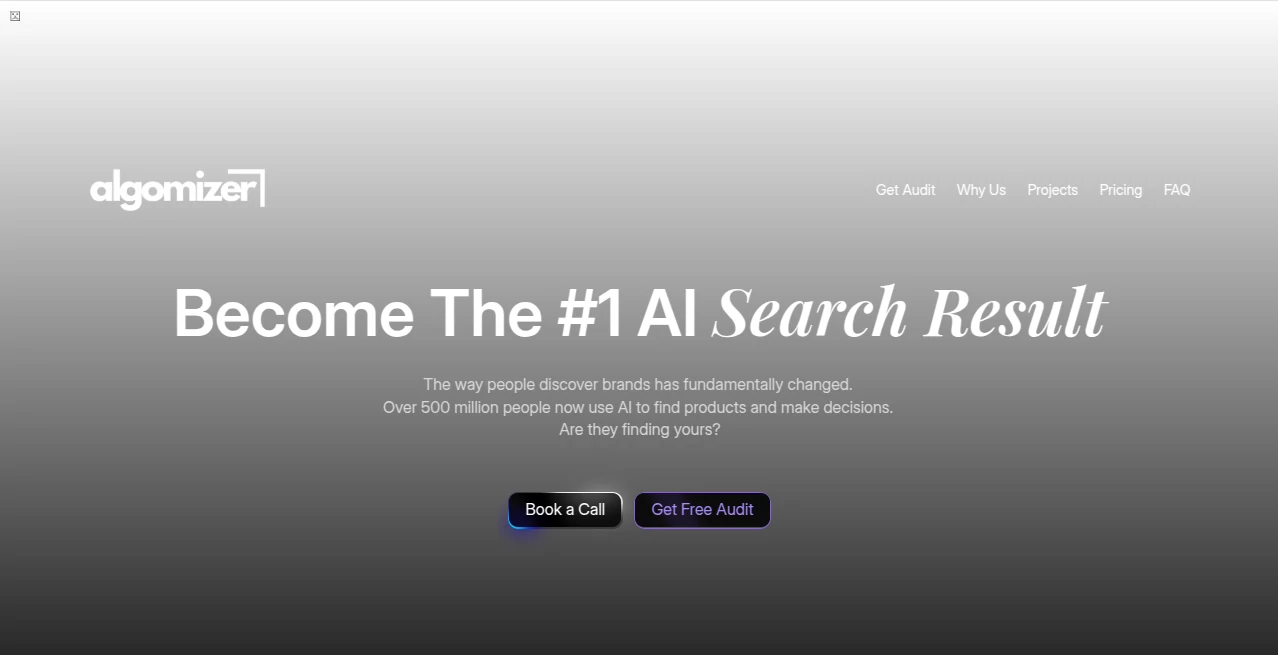
What is Algomizer?
Search has changed fundamentally. People used to type a query into Google and scroll through ten blue links. Today, a growing share of that behavior happens inside ChatGPT, Perplexity, Gemini, and Claude — and if your brand isn't showing up in those AI-generated answers, you're losing ground to competitors who figured this out before you did.
This is exactly the problem this platform was built to solve. It's an AI search optimization platform that helps businesses control how they appear inside the answers that large language models generate every second of the day. Not just whether you appear, but how accurately, how favorably, and how often.
The shift from traditional search to generative AI has created a visibility gap that conventional SEO tools simply weren't designed to close. This platform closes it — with a focused suite of tools covering visibility tracking, brand intelligence, prompt exploration, and content optimization, all built around the mechanics of how modern AI systems actually retrieve and present information.
Key Features
User Interface
The dashboard is clean and purposeful. You're not confronted with an overwhelming wall of metrics the moment you log in — instead, the layout surfaces what matters first: how your brand is currently represented across AI platforms, where the gaps are, and what's changed since the last time you checked.
Navigation between modules feels logical rather than arbitrary. Moving from visibility tracking to prompt exploration to custom alerts takes seconds. For a tool that deals with genuinely complex underlying data — multiple AI models, dozens of topic categories, brand mentions tracked across platforms — the interface manages to stay approachable. Someone without a technical background can understand what they're looking at without a lengthy onboarding process.
Accuracy & Performance
The platform monitors brand mentions across ChatGPT, Claude, Perplexity, Gemini, and other major AI search surfaces. Results aren't just a simple count of mentions — they're scored and analyzed so you understand the quality of representation, not just the frequency.
The case study numbers that the platform has published are worth paying attention to. A SaaS company using the optimization services saw its AI mention score climb to 81 out of 100, feature accuracy reach 94%, and monthly recurring revenue increase by 52%. Another SaaS client hit a mention score of 78 out of 100 alongside a 73% rise in referral traffic from AI-influenced channels. An e-commerce retailer reached an AI mention score of 84 out of 100 and saw a 32% revenue increase from AI-influenced channels. These are meaningful outcomes, not vanity metrics.
Capabilities
The platform's core capability stack covers four interconnected areas:
- Visibility Tracking: Monitor exactly how your brand appears in AI-generated answers across major platforms. Understand not just whether you're mentioned, but how accurately AI systems describe your products, pricing, and features.
- Brand Intelligence: Dig into the signals that shape how AI models interpret your brand. This means understanding what sources those models are drawing from, what category associations they've made, and where misrepresentations or gaps are creating problems.
- Prompt and Topic Explorer: Surface the specific questions and prompts where your brand should appear but doesn't. This is a genuine competitive advantage — knowing the prompts where a competitor is being recommended instead of you is actionable intelligence that most tools don't provide.
- Custom Alerts: Get proactive notifications when something changes in how AI platforms represent your brand. Whether it's a drop in mention quality or a new competitor displacement, you find out immediately rather than on your next scheduled audit.
Beyond monitoring, the platform also delivers active optimization — restructuring content for AI comprehension, implementing structured data, aligning category associations, and ensuring that features, integrations, and pricing are represented accurately by large language models. That combination of monitoring plus active intervention is what separates it from tools that only tell you what's happening without helping you change it.
Security & Privacy
For a platform handling commercially sensitive brand intelligence — competitive positioning, pricing data, feature sets — security posture matters. The platform is built with enterprise compliance and scalability in mind, making it suitable for organizations where data governance isn't optional. Access controls and data handling are designed to meet the expectations of enterprise procurement processes, not just startup-friendly convenience.
Use Cases
The clearest use case is any business that has invested heavily in traditional SEO and suddenly realized that a growing portion of their target audience is getting answers from AI assistants before they ever land on a search results page. The organic traffic that once flowed reliably from Google rankings is increasingly being intercepted upstream — and the businesses that understand this early are the ones positioning themselves in AI answers now.
- SaaS companies where AI models are frequently queried for software comparisons, pricing, and feature breakdowns — categories where inaccurate AI representation directly costs trial signups and qualified leads
- E-commerce brands looking to capture AI-influenced purchase decisions, where a customer asking an AI assistant "what's the best product for X" should be met with an accurate, favorable response
- Professional services firms whose brand reputation depends on consistent, accurate representation across every channel where prospective clients are forming impressions
- Marketing agencies managing AI search visibility as a service offering for multiple clients simultaneously
- Enterprise brands that can't afford inaccurate AI representation across product lines, pricing tiers, and integration capabilities
There's also a less obvious but equally important use case: companies that are being misrepresented by AI — outdated pricing cited, features attributed incorrectly, competitor products confused with theirs. Fixing that kind of AI misrepresentation before it compounds across millions of queries is exactly the problem this platform was designed to handle.
Pros and Cons
Where it excels:
- Covers both monitoring and active optimization — most competing tools only do one or the other
- Multi-platform coverage across ChatGPT, Claude, Perplexity, and Gemini from a single interface
- Prompt and topic exploration gives you intelligence on where you're missing mentions, not just where you have them
- Custom alerts mean you're not flying blind between monthly audits
- Real case study results demonstrate measurable revenue impact, not just vanity visibility scores
- Designed for both SMBs and enterprise, with workflows that scale accordingly
Points to consider:
- Pricing starts at $1,000 per month — a meaningful investment that requires clear budget allocation, especially for smaller teams
- The platform is specialized for AI search visibility; it doesn't replace a traditional SEO tool for conventional search ranking workflows
- Custom pricing without a fully transparent self-serve tier means you'll need to go through a discovery process before knowing exactly what you'll pay
- The GEO/AEO space is still maturing — best practices are evolving quickly, so optimization strategies require ongoing refinement rather than a set-and-forget approach
Pricing Plans
Pricing starts from $1,000 per month, positioning it squarely in the professional and enterprise tier of AI visibility tools. This isn't a self-serve SaaS product at $29 a month — the pricing reflects the depth of the service, which combines software infrastructure with active optimization work rather than just handing you a dashboard and walking away.
For businesses where AI search visibility translates directly into qualified pipeline — SaaS companies, e-commerce brands, professional services firms — the return on that investment can be significant. The case studies showing 52% MRR growth and 73% referral traffic increases give a realistic sense of what the upside looks like when the optimization work lands effectively.
For teams that want to explore before committing to a full engagement, getting in touch directly to understand what plan structure fits your specific situation and scale is the recommended starting point. The platform works with small businesses, mid-size companies, and enterprise organizations, so the right entry point varies.
How to Use Algomizer
The onboarding process is built around understanding your brand's current AI visibility baseline before any optimization work begins. Here's how a typical engagement unfolds:
- Step 1 — Baseline audit: The platform assesses how your brand is currently represented across major AI platforms — what's accurate, what's outdated, what's missing, and where competitors are appearing instead of you.
- Step 2 — Prompt and topic mapping: Using the topic explorer, you identify the specific questions and categories where your brand should be appearing but isn't. This shapes the optimization priorities.
- Step 3 — Content restructuring and optimization: Content is reformatted for AI comprehension — structured data implementation, category alignment, pricing and feature accuracy improvements, and competitive differentiation signals that large language models can readily interpret.
- Step 4 — Ongoing monitoring and alerts: The visibility tracking and alert system runs continuously, surfacing changes in how AI platforms represent your brand so your team can respond quickly rather than discovering problems weeks later.
- Step 5 — Performance measurement: AI mention scores, feature accuracy rates, and downstream metrics like referral traffic and trial signups are tracked to measure the real-world impact of the optimization work.
Comparison with Similar Tools
The GEO and AEO tooling landscape has grown quickly in the past year. Platforms like Profound, AthenaHQ, Geostar, and ALLMO all play in this space, and each has a different emphasis.
Profound focuses heavily on AI visibility tracking and competitive intelligence at around $399 per month — it's strong on the monitoring side but less focused on the active optimization layer. AthenaHQ leans into content-focused recommendations at $295–$595 per month, helping teams identify what content changes will improve citation probability. ALLMO offers share-of-voice measurement and sentiment tracking across models with good competitive benchmarking features.
The meaningful distinction here is the combination of monitoring, intelligence, and active optimization in one platform. Many tools give you the data; fewer help you act on it in a structured, measurable way. For businesses that want a partner in improving AI visibility rather than just a dashboard that reports it, the service-oriented approach — content restructuring, category alignment, structured data implementation — is what makes this platform stand apart from pure tracking tools.
For teams that primarily need a monitoring layer and are comfortable handling the optimization work internally, lighter tools at lower price points may be sufficient. But for organizations where AI misrepresentation is actively costing business — incorrect pricing cited, features mis-described, competitor products recommended instead — the combination of detection and active correction is where the real value sits.
Conclusion
The era of AI-first search is not coming — it's here. Every day, millions of people ask ChatGPT, Perplexity, and Gemini questions that used to flow through Google. If your brand isn't appearing accurately in those answers, you're losing influence over purchasing decisions, qualification calls, and trial signups that you may never even know you lost.
This platform addresses that reality with the seriousness it deserves. It's not a thin monitoring dashboard layered over a generic SEO tool. It was purpose-built for LLM visibility optimization, with the depth of tooling and the active optimization approach that actually moves the needle — as the case study results consistently demonstrate.
For any business where brand representation in AI answers is a meaningful commercial variable, the question isn't whether to invest in this category. It's whether to start now or after your competitors have already staked their position in the answers your customers are reading.
Frequently Asked Questions (FAQ)
What is GEO and AEO, and how is this different from SEO?
Traditional SEO optimizes your content to rank in Google's search results. Generative Engine Optimization (GEO) and Answer Engine Optimization (AEO) focus on how AI-powered platforms like ChatGPT, Perplexity, and Gemini represent your brand when generating answers. The signals these AI systems use are different from Google's ranking factors — structured data, content clarity, category alignment, and cross-source consistency matter more than keyword density or backlink volume.
Which AI platforms does the tool monitor?
Monitoring covers ChatGPT, Claude, Perplexity, and Gemini — the four platforms currently driving the most AI-generated search behavior. As new platforms gain traction, coverage expands accordingly.
What does an AI mention score actually measure?
The AI mention score is a 0–100 index reflecting how frequently and accurately your brand appears in AI-generated answers relevant to your category. It combines mention frequency, description accuracy, and context quality rather than treating all mentions as equivalent.
Is this only relevant for large enterprise businesses?
No. The platform works with small businesses, mid-size companies, and enterprises. The use case is most compelling wherever AI search is influencing purchasing decisions — which includes SMBs in competitive SaaS, e-commerce, and professional services categories, not just Fortune 500 brands.
How long before you see results?
Timeline varies by how AI models update their representations, but the case studies show measurable improvements in mention scores and downstream metrics within the engagement period. The monitoring layer provides visibility immediately; optimization results compound over time as AI platforms incorporate the restructured content signals.
Does this replace our existing SEO setup?
No — it complements it. Traditional search optimization and AI search optimization are different disciplines targeting different surfaces. Most teams run both, with this platform covering the AI visibility layer that conventional SEO tools don't address.
AI SEO Assistant , AI Digital Marketing Generator , AI Analytics Assistant .
These classifications represent its core capabilities and areas of application. For related tools, explore the linked categories above.

Algomizer Alternatives Product

Website Audi…

Beamtrace

Analyse

PurityRadar

ModelsLab

Diploria AI

DidYouSEO

Aura++

Fina Money