Applied Compute Training
What is Applied Compute Training?
Applied Compute is built for teams that want more control over how their AI models learn, perform, and improve. Instead of treating a foundation model as a finished product, the platform gives engineering and research teams the infrastructure to customize models around their own data, workflows, evaluations, and production requirements.
The central idea is straightforward: take the data and expertise already inside a company and turn them into models that are better suited to the work that actually matters. Teams can start from open models, train them against their own environments and graders, evaluate results as experiments run, and continue improving models after deployment.
This approach is particularly interesting for organizations building AI agents, enterprise applications, coding systems, research tools, and other products where generic model performance is not enough. The platform is designed to make sophisticated post-training workflows more practical without forcing teams to build and operate an entire GPU infrastructure stack themselves.
Key Features
- Model customization using your own datasets, environments, graders, and evaluation criteria.
- Support for starting from open models and switching to stronger models as they become available.
- Live monitoring, evaluations, and token-level metrics during training runs.
- Reinforcement learning infrastructure designed for long-horizon and tool-using agents.
- Online training using real production traffic as a source of new training signals.
- Bring-your-own-harness support so training environments can closely reflect production systems.
- Large-scale fine-tuning designed to work across thousands of GPUs without requiring customers to manage the underlying cluster.
- Continual learning techniques that can turn production traces into useful training signals.
User Interface
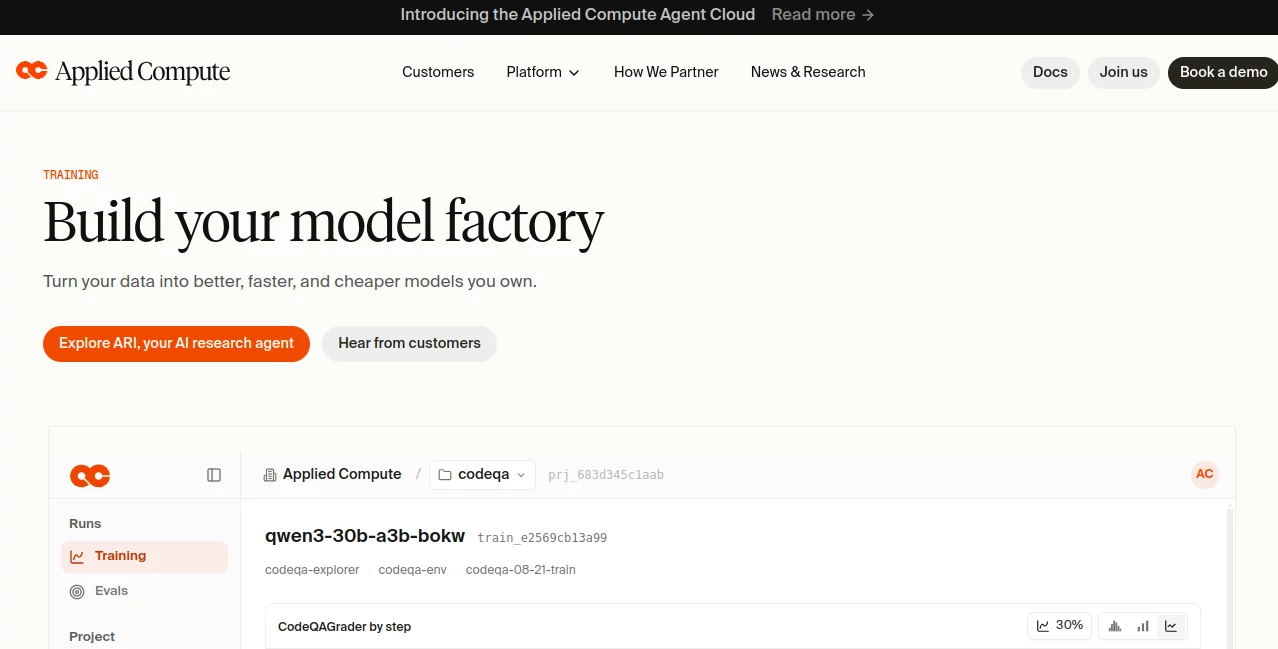
The training environment is designed more like a research cockpit than a basic model dashboard. Researchers can monitor runs, inspect rollouts, compare experiments, review evaluation results, and investigate changes in model behavior while training is underway.
That level of visibility is useful when a training run does not behave as expected. Instead of simply seeing that a metric went up or down, teams can inspect what the model is actually doing and use those observations to refine the next experiment.
The experience also includes an AI research agent called Ari, which can monitor runs, analyze traces, remember findings, and help automate parts of the research loop. For teams running many experiments, this can remove some of the repetitive investigation that normally consumes researchers' time.
Accuracy & Performance
Performance is one of the strongest reasons to consider this platform. Its infrastructure is designed around high-throughput training, long-context workloads, reinforcement learning, and large-scale model customization rather than simple prompt-based experimentation.
The platform allows teams to optimize models against evaluations that reflect their actual product requirements. Rewards can be calibrated around specific KPIs and domain expertise, which makes the training process more closely connected to measurable business outcomes.
Real customer examples published by the company show substantial gains in specialized workloads. These include higher performance on legal-agent evaluations, faster bug detection, fewer critical menu errors, and stronger corporate-law results at lower model costs. Such results should be viewed as use-case dependent, but they demonstrate the potential of specialized post-training compared with relying solely on general-purpose models.
Capabilities
The platform goes beyond conventional fine-tuning. Teams can train tool-using agents, work with long-horizon tasks, and optimize models using custom harnesses and graders. Training can cover text, images, code, and structured data, allowing the same infrastructure to support different types of AI applications.
One particularly useful capability is online training. Production traffic can become part of the improvement cycle, allowing teams to identify failures, collect useful traces, generate new training signals, and feed those insights into future runs.
There is also support for frontier-scale full-parameter fine-tuning. The infrastructure is designed to handle extremely large models while reducing the operational burden associated with managing clusters, storage, communication, and GPU utilization.
Security & Privacy
Security is positioned as an important part of the platform for enterprise and public-sector customers. The company states that it is SOC 2 certified and ISO 42001 certified, with deployment options that can provide different levels of infrastructure control.
Customers can choose between serverless and VPC deployment approaches, while role-based access controls and audit logs provide visibility into activity. The company also states that customer data can remain within the customer's perimeter, an important consideration for organizations working with sensitive business information.
Another notable point is model ownership. The platform is designed around the idea that customers own the intelligence they build, including decisions about what data is used for training, what models are deployed, and what information is retained.
Use Cases
This platform is best suited to teams that have moved beyond basic AI experimentation and need models that understand a particular domain or workflow.
- AI agents: Train agents to perform complex, multi-step tasks using realistic production environments.
- Software engineering: Improve coding agents, repository exploration, debugging, code review, and tool usage.
- Legal AI: Customize models around legal workflows, expert evaluations, and specialized benchmarks.
- Enterprise AI: Encode company-specific knowledge, processes, quality standards, and domain expertise into models.
- Research teams: Run repeated experiments while monitoring rollouts, evaluations, rewards, and model behavior.
- Production AI: Turn real user interactions and production traces into signals for continuous model improvement.
- Large-scale model training: Fine-tune very large open models without taking responsibility for operating an entire GPU cluster.
Pros and Cons
Pros
- Strong focus on custom model training rather than simple API access.
- Designed for reinforcement learning and long-horizon agent workloads.
- Supports custom harnesses and domain-specific graders.
- Detailed training observability helps researchers understand model behavior.
- Production traffic can become part of the improvement loop.
- Supports large-scale training without requiring customers to manage the underlying GPU infrastructure.
- Strong emphasis on enterprise security, deployment control, and model ownership.
Cons
- The platform is primarily aimed at advanced AI teams rather than casual users.
- It may be excessive for companies that only need prompting or lightweight API-based customization.
- Public self-service pricing is not provided, making initial cost comparison more difficult.
- Getting the most value from the platform requires meaningful datasets, evaluations, engineering resources, and a clear training objective.
Pricing Plans
No public pricing table is displayed for the training platform. The website directs interested teams toward booking a demo and discussing their requirements with the company.
This pricing approach makes sense for a platform aimed at enterprise-scale model training, where compute requirements, model size, training duration, deployment architecture, and support needs can vary dramatically between customers.
For organizations considering the platform, the most useful questions to ask during an evaluation would include expected GPU usage, supported model sizes, training configuration, inference requirements, data deployment options, and the level of research or engineering support included.
How to Use It
- Select an appropriate open model as the starting point for your project.
- Provide the dataset, environment, and grader that represent the behavior you want to improve.
- Connect your existing agent harness when the production environment needs to be reproduced during training.
- Launch a training experiment and monitor its metrics, evaluations, and rollouts.
- Use the evaluation results to identify weaknesses and adjust rewards, data, or training configuration.
- Run additional experiments until the model reaches the required performance level.
- Deploy the resulting checkpoint for production inference.
- Capture useful production traces and feedback to create signals for future training runs.
Comparison with Similar Tools
Traditional model APIs are usually designed to give developers access to capable models without requiring them to manage the training process. That is convenient, but it can become limiting when a company needs a model optimized around proprietary workflows or highly specific evaluation criteria.
Conventional fine-tuning services can provide customization, but more advanced reinforcement learning and agent training often require additional infrastructure for environments, graders, rollouts, experiment tracking, and large-scale compute.
This platform takes a broader approach by combining model customization, post-training infrastructure, evaluation, deployment, and continuous improvement. The distinction becomes especially important for companies building AI agents where the quality of the entire task trajectory matters more than the quality of a single generated response.
For a small project that simply needs an AI assistant or text-generation API, this level of infrastructure may be unnecessary. For an organization trying to turn proprietary data and expert knowledge into a specialized model, however, the difference can be substantial.
Conclusion
For serious AI teams, model ownership and customization can be far more valuable than simply choosing whichever general-purpose model happens to rank highest today. This platform takes that idea seriously by providing the training infrastructure, evaluation workflow, observability, and production feedback loop needed to build models around real business requirements.
Its strongest appeal is the combination of advanced post-training capabilities with infrastructure that handles much of the complexity behind large-scale experimentation. The ability to bring your own harness, optimize toward custom evaluations, train at substantial scale, and learn from production traffic creates a practical path from experimentation to a continuously improving AI system.
It is not a beginner-oriented AI tool, and organizations without meaningful data or a clear evaluation strategy may not see its full value. But for engineering and research teams building specialized agents or enterprise AI products, it offers a compelling alternative to treating foundation models as fixed, off-the-shelf intelligence.
Frequently Asked Questions (FAQ)
What is this platform used for?
It is used to train, post-train, evaluate, deploy, and continuously improve custom AI models, particularly for enterprise applications and AI agents.
Can I train my own AI model?
Yes. Teams can start from open models and customize them using their own datasets, environments, graders, evaluations, and training workflows.
Does it support reinforcement learning?
Yes. Reinforcement learning is a major part of the platform, including support for long-horizon agents, asynchronous RL, custom environments, and production-oriented training workflows.
Can production data be used for training?
Yes. Online training and continual-learning capabilities allow useful production traffic and traces to become training signals for future model improvements.
Does it support large AI models?
Yes. The infrastructure is designed for large-scale training, including full-parameter fine-tuning of multi-trillion-parameter models and scaling across thousands of GPUs.
Is there a free plan?
No public free or self-service plan is listed on the training page. Interested organizations are directed toward a demo and a discussion with the team.
Is this suitable for beginners?
It is primarily designed for AI research, engineering, and enterprise teams with experience in model training, evaluation, datasets, and production AI systems.
Do customers own the models they train?
The company states that customers own the intelligence they build and control decisions about training data, deployment, and retained memory.
Can I use my existing AI agent environment?
Yes. The bring-your-own-harness capability allows teams to train inside an environment that closely matches the one used in production.
AI Testing & QA , AI Research Tool , AI Developer Docs , AI Developer Tools .
These classifications represent its core capabilities and areas of application. For related tools, explore the linked categories above.
Applied Compute Training details
Website unavailable — View Alternatives
Pricing
- Freemium
Apps
- Web App
Categories

Applied Compute Training Alternatives Product

KaneAI

EntreDash

Domain Rank …

Aiso

SearchSpot

Odysseus AI

Ecom Mediate…

Harvey

WhatsMyName …