














ARKADS
What is ARKADS?
Creating short-form advertising content usually takes more than writing a script and generating a video. Marketers need to understand what makes an existing ad work, find the right hook, adapt the idea to their own product, and then produce several versions worth testing. ARKADS brings these steps into one connected workflow, starting with ad analysis and moving through scripting, AI UGC production, and final video assembly.
The platform is built around a simple idea: instead of starting every campaign from a blank page, marketers can study a proven advertisement and use those insights as a foundation for new creative. Its Hook Analyzer examines a source ad, while the Ad Clone workflow turns the findings into structured inputs, scripts, AI-generated UGC clips, and a finished video.
This approach can be particularly useful for DTC brands, performance marketers, affiliates, and teams that need to produce and test advertising variations without organizing a traditional shoot for every new concept.
Key Features
- Hook Analyzer for breaking down short-form advertisements
- Shot-by-shot analysis with transcripts, timelines, and creative findings
- Ad Clone workflow for turning ad insights into new creative concepts
- AI UGC video generation with selectable actors
- Multiple hooks and clips designed for creative testing
- Consistent actor references across different shots
- Automatic merging of selected clips into a finished UGC video
- Support for analyzing public TikTok, Instagram, and Facebook videos
- MP4 upload support for source advertisements up to 90 seconds
- Script Runner and UGC automation features
User Interface
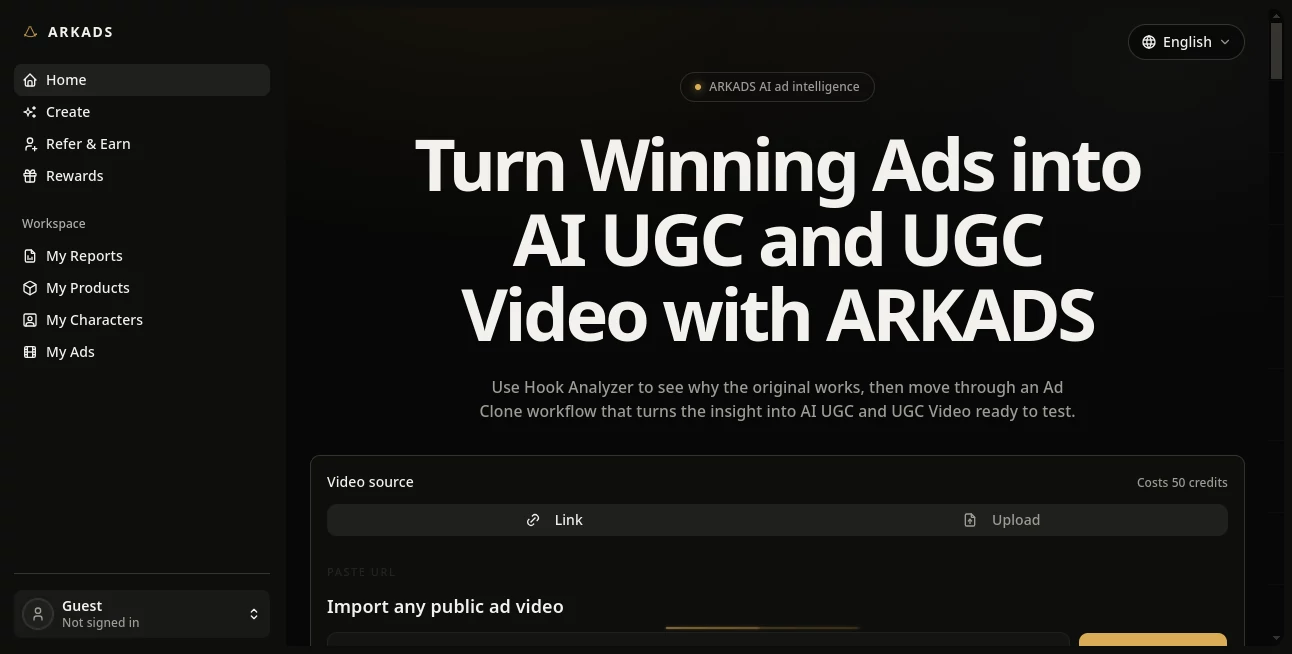
The interface follows a straightforward workflow rather than forcing users to jump between separate research, scripting, video generation, and editing applications. The main process moves from analyzing a reference advertisement to preparing an Ad Clone, rendering individual UGC clips, and finally combining the selected clips into one video.
One useful detail is the way analysis findings remain connected to their source material. The platform can separate observations from interpretation and provide access to the relevant frame or transcript segment behind a finding. That makes the creative analysis easier to review before turning it into a new advertisement.
Accuracy & Performance
The analysis workflow is designed to provide more context than simply asking an AI system to summarize an advertisement. The Hook Analyzer separates an ad into shots and keyframes, transcribes spoken dialogue, and identifies elements such as the hook, pacing, proof, offer, and positioning.
This evidence-based approach can make the transition from research to production more practical. Rather than treating every recommendation as a prediction of campaign performance, users can inspect the source material and decide which creative elements are worth adapting.
Video rendering is handled as individual jobs, allowing users to choose the clips they actually want to test. The platform also states that failed individual renders are refunded separately, so a problem with one clip does not consume the entire batch.
Capabilities
The strongest part of the platform is the connection between ad intelligence and video creation. A source advertisement can be analyzed, its audience, problem, promise, proof, and transformation can be derived, and those inputs can then be edited before scripting.
The Ad Clone workflow can create five hooks and multiple clips while maintaining shared shot rules. Users can select an actor, define their product, specify forbidden claims, and adapt the creative structure to their own brand.
After generating the individual clips, users can arrange the strongest takes and merge them into a completed UGC video. Frame rate, resolution, and loudness are normalized during the merge, helping produce a more consistent final result.
Security & Privacy
When working with advertising material, rights and compliance are important considerations. The platform makes it clear that users remain responsible for the claims made in their advertisements. Compliance warnings are presented as prompts for review rather than legal clearance.
Users should therefore review generated scripts, product claims, trademarks, and any source material before publishing a campaign. This is especially important when creating advertisements based on content belonging to other brands.
Use Cases
DTC brands: A direct-to-consumer company can study a successful competitor advertisement, identify its creative structure, and use those insights to build a new UGC concept around its own product.
Performance marketing teams: Teams running paid campaigns can use the analysis workflow to understand why a reference advertisement is compelling and then develop multiple hooks and creative variations for testing.
Affiliate marketers: Affiliates can create product-focused UGC videos without arranging an influencer shoot, hiring an actor, or building a traditional production workflow for every campaign.
Creative testing: Marketers who regularly need new ad variations can generate individual hooks and clips, select the strongest versions, and combine them into finished videos for campaign testing.
Small marketing teams: A small team can keep research, scripting, generation, and video assembly within one workflow instead of moving files between several specialized applications.
Pros and Cons
- Pros: Combines ad analysis and AI UGC production in one workflow.
- Pros: Provides source evidence behind important creative findings.
- Pros: Supports TikTok, Instagram, and Facebook ad analysis.
- Pros: Offers multiple hooks and clips for creative testing.
- Pros: Maintains actor consistency across shots.
- Pros: Includes automatic merging of selected UGC clips.
- Cons: Users still need to review advertising claims and compliance themselves.
- Cons: Video generation uses credits, so frequent creative testing can increase usage.
- Cons: The workflow is primarily focused on advertising and UGC rather than general-purpose video production.
Pricing Plans
The service currently offers three subscription periods. The monthly option costs $39.99 per month and includes 1,500 credits. It also includes ad analysis and AI reports, AI video generation, Script Runner and UGC automation, plus TikTok, Instagram, and Facebook analysis.
The three-month option costs $35.00 per month when billed at $104.99 every three months and includes 5,000 credits. For users planning a longer testing cycle, the six-month plan costs $31.67 per month when billed at $189.99 every six months and includes 10,000 credits.
All listed plans include the core Hook Analyzer, Ad Clone scripting, actors, AI UGC rendering, and UGC video merging workflow. New accounts also receive 50 credits, enough for one analysis.
How to Use It
Start by opening the Hook Analyzer and providing a public TikTok, Instagram, or Facebook link, or upload an MP4 video of up to 90 seconds. The system analyzes the advertisement and returns information such as the transcript, timeline, shots, and creative findings.
Next, create an Ad Clone by adding information about your product, any claims that should be avoided, and the actor you want to use. The analysis provides structured inputs that can be reviewed and adjusted before the final script is created.
Once the script is ready, choose the hooks and clips you want to test and render the AI UGC takes. After reviewing the generated clips, select the strongest versions, arrange them in the preferred order, and merge them into a finished UGC video.
Comparison with Similar Tools
Many AI video platforms focus primarily on generating a video from a prompt, script, or predefined template. This workflow takes a different approach by placing advertisement analysis before generation.
The distinction becomes important for performance marketers. Instead of simply producing another generic AI video, users can begin with a reference advertisement, examine its hook and creative structure, and carry those findings into a new production workflow.
Another practical difference is the connection between individual AI UGC clips and the final video. Users can generate several possible hooks, select the strongest takes, and assemble them into one finished creative. For teams that treat advertising as an ongoing testing process, this can make the workflow more structured than using separate analysis, generation, and editing tools.
Conclusion
For marketers who regularly produce short-form advertising content, the biggest advantage here is not simply AI video generation. The more interesting proposition is the connection between understanding an existing ad and producing a new one.
The combination of Hook Analyzer, Ad Clone scripting, AI UGC generation, actor consistency, and video merging creates a practical workflow for turning advertising research into testable creative. It is especially well suited to DTC brands, performance teams, affiliates, and marketers who need a steady supply of UGC-style advertising variations.
If your current process involves watching competitor ads, taking notes, writing scripts, generating UGC, and editing everything in separate places, bringing those steps together can save considerable time. The final creative should still be reviewed by a human before publication, but the production process becomes much easier to manage.
Frequently Asked Questions (FAQ)
What type of videos can I create?
The platform focuses on AI-generated UGC and short-form advertising videos. Users can create individual UGC clips and combine selected clips into a finished video.
Can I analyze TikTok, Instagram, and Facebook ads?
Yes. The Hook Analyzer supports public TikTok, Instagram, and Facebook links. Users can also upload an MP4 source video up to 90 seconds for analysis.
Does it generate scripts automatically?
Yes. The Ad Clone workflow uses information from the analyzed advertisement and the user's product to create an editable script with multiple hooks and clips.
Can I choose the actor in the generated video?
Yes. Users can select the actor who should appear in the Ad Clone workflow, and the same actor reference can be carried across shots to maintain visual consistency.
Can the generated videos be used in advertising campaigns?
Yes, the generated scripts, prompts, and video renders can be used in campaigns. However, users remain responsible for reviewing claims, compliance requirements, and the rights associated with their advertising material.
What happens if an individual video generation fails?
Each AI UGC clip is treated as its own render job. According to the service's FAQ, failed individual renders can be refunded separately rather than affecting the rest of a batch.
How much does the service cost?
The available plans start at $39.99 per month for the monthly option, with longer billing periods reducing the effective monthly price. The three-month and six-month plans include 5,000 and 10,000 credits respectively.
Is there a free trial?
New accounts receive 50 credits, which is enough for one Hook Analyzer analysis. This provides a way to experience the analysis workflow before committing to a paid plan.