














pomelli
What is pomelli?
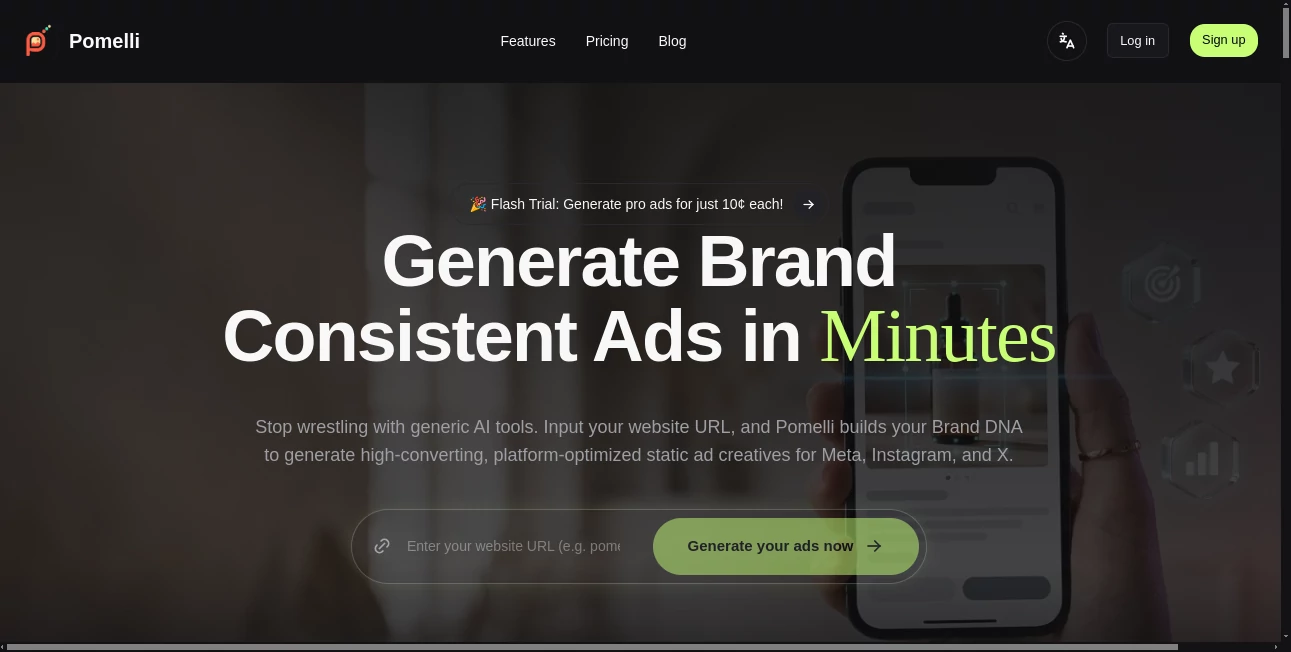
Creating advertising content that actually looks like it belongs to a real brand can be surprisingly difficult. A business may have a clear visual identity, but turning that identity into fresh advertising creatives still takes time, design skills, and plenty of manual work. Pomelli approaches this problem from a different direction by starting with the business itself rather than a blank design canvas.
The platform analyzes a company's website to understand its visual identity and uses that information to create brand-consistent marketing creatives. This makes it particularly useful for small businesses, online stores, agencies, and marketing teams that need a steady supply of advertising material without rebuilding every design from scratch.
One of its most interesting ideas is to use the existing website as the source of brand context. Instead of repeatedly explaining colors, typography, product positioning, and visual preferences, the system can extract those signals and use them throughout the creative process.
Key Features
- Brand DNA extraction: The platform analyzes website content and visual elements to understand important aspects of a brand's identity.
- Brand-consistent advertising: Generated creatives are designed around the visual direction and rules associated with the business.
- AI-generated ad creatives: Businesses can produce marketing images intended for social advertising and promotional campaigns.
- Campaign generation: The system helps turn marketing ideas into complete creative directions instead of requiring users to begin with a finished design concept.
- Natural editing: Headlines and creative elements can be refined without having to completely regenerate an advertisement.
- Batch generation: Higher-tier plans allow multiple creatives to be produced as part of a larger production workflow.
- Commercial licensing: The current paid plans include support for commercial use.
- Production-ready exports: Generated advertising assets can be downloaded for use across marketing channels.
User Interface
The workflow is designed to feel closer to a marketing assistant than a traditional graphic-design application. Users can begin with their website and campaign requirements, review generated creative directions, and then refine the results.
This approach can be especially convenient for people who do not spend their entire day inside professional design software. Rather than managing numerous layers, effects, and technical controls, the user can focus on what the advertisement should communicate.
For a small e-commerce business, for example, the process can feel much more practical: provide the business context, define the campaign objective, review several concepts, and select the strongest version for further refinement.
Accuracy & Performance
Brand consistency is one of the platform's main selling points. Its website describes strict brand guardrails designed to keep generated advertising material aligned with the supplied brand identity. This is important because a visually impressive advertisement is not particularly useful if its colors, messaging, or overall appearance feel disconnected from the business.
Performance also depends on the selected subscription level. The Pro and Ultimate plans provide larger monthly credit allocations and priority generation queues, while batch generation becomes available for users with more demanding production requirements.
As with any generative image system, the final creative should still be reviewed before publication. Small visual details, product representations, typography, or other elements may occasionally need human checking before an advertisement goes live.
Capabilities
The strongest capability is the combination of brand analysis and advertising generation. Instead of treating every request as an isolated image-generation task, the platform attempts to maintain a consistent creative direction across multiple advertisements.
It can also be useful when a marketing team needs variations quickly. A campaign may require several visual concepts, different headlines, or a larger collection of creatives for testing. Batch generation and the larger credit allowances in the higher plans make this type of workflow more practical.
Another useful feature is the ability to refine advertising copy without regenerating the entire visual. This can save time when the design is already right but the headline needs to be shorter, clearer, or more persuasive.
Security & Privacy
When a marketing platform analyzes a business website, privacy and control over brand information naturally become important considerations. Businesses should review the provider's privacy policy and terms before submitting sensitive material or confidential information.
The current product positioning also emphasizes brand protection and controlled creative generation. For companies working with proprietary campaigns, product launches, or unreleased marketing concepts, reviewing the platform's current privacy and data-handling terms is a sensible step before moving a complete production workflow onto the service.
Use Cases
Small businesses: Local businesses can create professional advertising creatives without maintaining a dedicated design department.
E-commerce stores: Online retailers can produce promotional imagery around their products and maintain a more consistent visual direction across campaigns.
Marketing agencies: Agencies managing several clients can benefit from a workflow that starts with each client's existing brand identity rather than creating every campaign manually.
Social advertising: Businesses running paid campaigns can generate multiple creative directions and select the versions that best match their campaign goals.
Product launches: A new product often requires several advertisements in a short period. A brand-aware generation workflow can reduce the amount of repetitive creative work involved.
Creative testing: Teams that regularly experiment with different visual concepts can use multiple generated variations to explore new advertising directions more quickly.
Pros and Cons
- Pros: Website-based brand analysis, strong focus on brand consistency, advertising-focused workflow, campaign-oriented generation, commercial licensing on paid plans, batch generation on higher plans, and priority generation for larger plans.
- Cons: Credit limits vary considerably between plans, the service is more specialized toward marketing creatives than general-purpose design, and AI-generated advertising should still be reviewed before publication.
Pricing Plans
The current pricing structure is divided into three main paid plans. The Base plan costs $19.90 per month and includes unlimited product information crawling, 3,000 monthly credits, approximately 200 images per month, commercial licensing support, and email support.
The Pro plan costs $49.90 per month and increases the allowance to 9,500 credits, with approximately 630 images and around 9 videos per month. It also adds batch generation and a priority generation queue.
The Ultimate plan costs $99.90 per month and provides 21,000 monthly credits, approximately 1,400 images and around 21 videos per month. It includes access to all features, priority generation, commercial licensing support, and one-on-one dedicated service.
For occasional users, the Base plan is the more approachable starting point. Agencies and teams producing advertising material regularly may find the larger credit allocations in the Pro and Ultimate plans more suitable.
How to Use It
- Start with your website: Provide the website that represents your business and brand.
- Let the system understand the brand: The platform uses available website information to establish the visual and messaging context for future creatives.
- Define your campaign: Explain the advertising objective, product, audience, or promotional idea you want to communicate.
- Review generated concepts: Compare the available creative directions and identify the versions that best fit your campaign.
- Refine the selected creative: Adjust headlines and other supported elements instead of starting over whenever possible.
- Generate additional variations: Produce more concepts when you need different options for testing or multiple advertising placements.
- Download and review: Export the finished creative and check product details, text, branding, and visual accuracy before publishing.
Comparison with Similar Tools
Traditional design platforms such as Canva are excellent when users want direct control over templates, layouts, and individual design elements. Copywriting-focused platforms are generally stronger when the primary requirement is producing written marketing material. General image generators, meanwhile, offer broad creative freedom but may require users to repeatedly describe their brand style.
The main distinction here is the brand-first workflow. Instead of treating branding as a collection of settings that the user manually applies to every project, the platform attempts to derive the brand context directly from the company's website and use it as the foundation for advertising generation.
That makes it particularly appealing to businesses whose main challenge is not simply creating an attractive image, but creating a large number of advertisements that still feel like they came from the same company.
Conclusion
For businesses that constantly need fresh advertising creatives, the biggest advantage is the focus on consistency. Generating one attractive image is easy enough with many modern AI tools; producing dozens of useful marketing assets without losing the identity of the brand is a much harder problem.
The website-driven approach, brand-aware generation, campaign workflow, editing capabilities, and scalable credit plans make this a compelling option for small businesses, e-commerce brands, agencies, and marketing teams. It does not eliminate the need for creative judgment, but it can significantly reduce the repetitive production work that often slows advertising campaigns down.
If your goal is to turn an established brand identity into a continuous stream of advertising creatives, this is a tool worth exploring.
Frequently Asked Questions (FAQ)
What is this AI marketing tool used for?
It is designed to help businesses generate brand-consistent advertising creatives and marketing content based on their existing brand identity.
How does the platform understand my brand?
It can analyze a business website and use information from the site to establish the visual and marketing context used when creating advertising material.
Can I use the generated content commercially?
Yes. The current Base, Pro, and Ultimate plans state that commercial licensing is supported.
Does it support batch generation?
Yes. Batch generation is included in the Pro plan and above, making it more suitable for teams that need to produce larger quantities of advertising creatives.
How many images can I generate?
The approximate monthly output depends on the plan. The Base plan lists around 200 images, Pro around 630 images, and Ultimate around 1,400 images based on the advertised monthly credit allowances.
Is it suitable for small businesses?
Yes. The Base plan is specifically positioned for individuals and starters, while the overall workflow is designed to reduce the amount of design and creative work required from smaller teams.
Should AI-generated advertisements be reviewed before publishing?
Yes. Human review is recommended to confirm that product details, text, logos, colors, and other important elements accurately represent the real business and its products.
Which plan is best for agencies?
The Pro plan is a practical starting point for agencies because it provides a substantially larger credit allowance, batch generation, and priority generation. Larger agencies or high-volume commercial teams may benefit from the Ultimate plan.