
June
What is June?
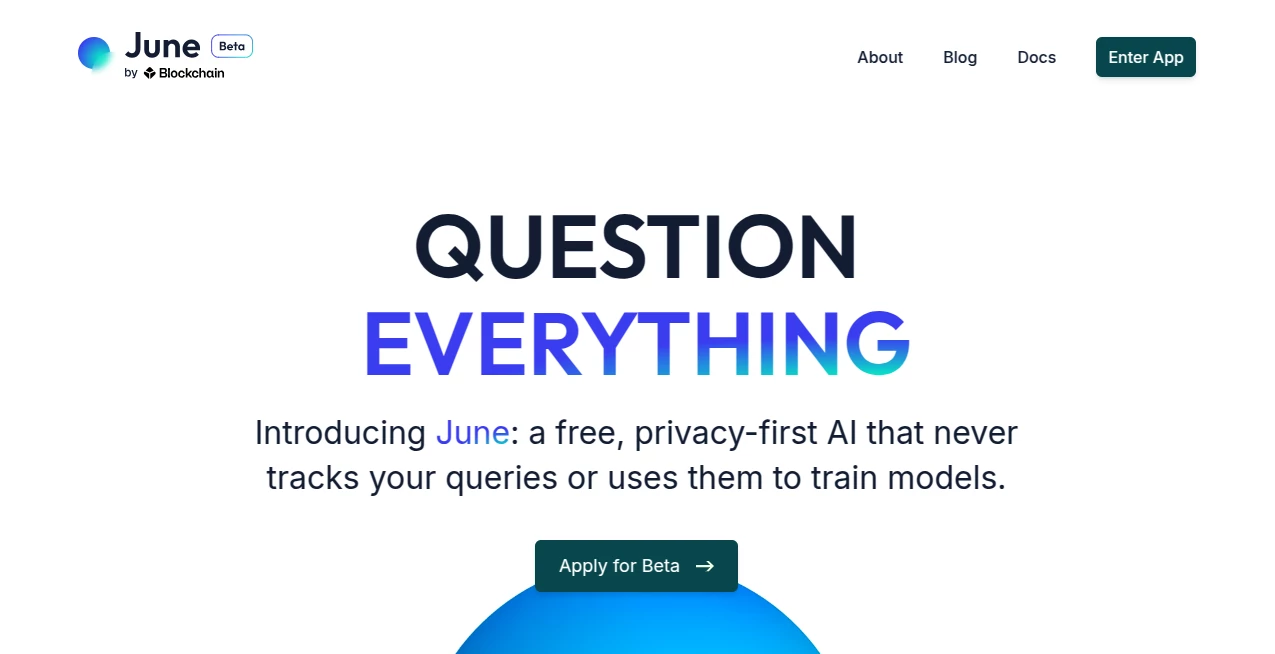
June is a privacy-first AI platform built for people who want the flexibility of modern AI without giving up control over their conversations. It brings several leading language models into one place, allowing users to switch between different models instead of maintaining separate accounts and interfaces for every task.
The platform has a particularly strong connection to cryptocurrency, blockchain, and Web3. Its interface includes prompts and tools for exploring topics such as Ethereum, DeFi, blockchain technology, and digital assets, while still working well for everyday questions, research, coding, and general problem-solving.
Privacy is one of its clearest selling points. The service states that it does not track user queries, store chat history, or use personal information to train its models. For users who are uncomfortable with the data practices of conventional AI services, that approach makes the platform worth a closer look.
Key Features
- Access to multiple leading AI models from a single interface.
- Privacy-focused conversations with no chat history storage according to the platform's stated policy.
- Models from providers including OpenAI, Anthropic, Google, xAI, DeepSeek, Qwen, and others.
- Dedicated interest in cryptocurrency, blockchain, DeFi, and Web3 topics.
- AI image and video generation through supported models.
- Developer API compatible with the OpenAI chat completions format.
- Support for coding workflows and integrations with AI coding agents.
- Credit-based usage with free access and additional paid usage options.
- Points and leaderboard features that reward users for interacting with the platform.
User Interface
The interface keeps the central experience familiar: ask a question, choose a model, and start working. One particularly useful detail is the ability to change models without jumping between different websites. Someone working on a coding problem can use one model, then switch to another for brainstorming or a second opinion.
The design also puts privacy front and center rather than hiding it in a legal page. Settings include options such as response style, output speed, and experimental feature previews. A profile can also be configured with preferences such as currency, crypto experience, and preferred response style.
For a new user, the learning curve is relatively gentle. The experience feels closer to a modern AI chat application than a complicated developer dashboard, while more advanced users can move into the API and developer documentation when they need greater control.
Accuracy & Performance
Accuracy naturally depends on the model selected and the question being asked. The major advantage here is choice: users are not locked into a single model when a particular answer does not meet their expectations.
For research and technical questions, switching models can be useful as a practical second-opinion workflow. A user might ask one model to explain a concept, another to challenge the answer, and a third to turn the result into working code. That flexibility is more useful than simply having a long list of models for the sake of variety.
The platform also supports prompt caching through its API. Repeated requests with matching prompt prefixes can reuse previous model work, potentially reducing both response time and credit consumption when the same instructions or reference material are used repeatedly.
Capabilities
The service goes beyond basic text conversations. Its supported ecosystem includes large language models for general questions, reasoning, coding, research, and creative work. The available model lineup has included GPT, Claude, Gemini, Grok, DeepSeek, Kimi, Qwen, and several other model families.
Developers get a particularly interesting option through the API. The API is designed to work with the OpenAI chat completions format, so existing applications can often be adapted by changing the API endpoint and authentication details rather than rebuilding an entire integration from scratch.
Image and video generation are also available through the API, using an asynchronous request-and-poll workflow. This opens the door to applications that need more than text generation, including automated creative pipelines and AI-powered media products.
Coding users can connect the API with tools such as OpenAI Codex and OpenCode. That makes the service more than a consumer chat interface; it can also act as a model provider inside a developer's existing workflow.
Security & Privacy
Privacy is arguably the platform's defining characteristic. Its website states that user queries are not tracked and that personal information is not used to train models. It also states that chat history is not stored.
The API follows the same privacy-focused philosophy. According to the documentation, data sent through the API is not used to train models and is not persisted on the platform's servers.
That said, users should still treat any online AI service responsibly, especially when handling confidential business information, credentials, personal records, or regulated data. Privacy claims are valuable, but organizations should always review the current terms and policies before using an AI service for sensitive workloads.
Use Cases
- Crypto research: Explore blockchain, Ethereum, DeFi, Web3, and cryptocurrency-related questions through conversational AI.
- General research: Compare explanations from different models when researching a complicated subject.
- Coding: Generate, review, explain, and troubleshoot code using different model providers.
- AI development: Connect applications to multiple models through a single OpenAI-compatible API.
- Creative work: Use text, image, and video generation capabilities for content and media projects.
- Model comparison: Switch between different AI models when one response is not quite right.
- Privacy-conscious AI use: Work with conversational AI while benefiting from a platform designed around minimal data retention.
- AI agents: Use the API with compatible coding agents and other developer tools.
Pros and Cons
- Pros: Privacy-first approach, multiple AI models in one place, strong cryptocurrency and Web3 focus, OpenAI-compatible API, image and video generation support, developer integrations, and flexible credit options.
- Cons: Model availability and usage limits can change, some advanced features require higher usage tiers, and users looking only for a simple single-model chatbot may find the multi-model approach more than they need.
Pricing Plans
The platform uses a credit-based approach rather than treating every model as an entirely separate subscription. Different models can consume different amounts of credits depending on usage, which gives users a more unified way to access multiple AI providers.
A free tier is available for core usage, while higher plans provide larger usage limits. The platform has also introduced Pro and Max tiers for users who need more capacity. In addition, users can purchase credit packs or make smaller one-off payments when they need additional usage without necessarily moving to a higher subscription.
Another interesting option is crypto-native payment support through x402. This allows eligible users to pay for individual requests or credit top-ups using USDC on Base, providing an alternative to traditional subscription and checkout flows. Because pricing, model availability, and limits can change, checking the current pricing page before purchasing is recommended.
How to Use the Platform
Getting started is straightforward. Create an account and access the chat interface, then choose the AI model that best matches the task. For a normal question, simply enter a prompt and continue the conversation naturally.
If the first answer is not what you expected, try another model rather than rewriting the entire request from scratch. This is one of the platform's biggest practical advantages. Different models often approach the same question from different angles.
Developers can generate an API key and use the compatible API endpoint in their applications. Existing projects built around OpenAI-compatible tooling can generally be adapted by changing the provider configuration and authentication details.
For more advanced workflows, the API can also be connected to coding agents and supported image or video generation endpoints. This makes it possible to move from casual experimentation to a more automated AI workflow.
Comparison with Similar Tools
Many AI assistants concentrate on providing one primary model or one tightly controlled ecosystem. This platform takes a different route by putting multiple model families behind one interface and API.
That distinction matters for users who care about flexibility. Instead of choosing a single AI provider and staying with it, users can select the model that makes the most sense for a particular job. It also creates an easier way to experiment with newer models without rebuilding an entire workflow around each provider.
Another difference is the emphasis on cryptocurrency and Web3. While a general AI assistant can certainly answer blockchain questions, this platform is designed with those subjects much closer to its core identity. For developers and crypto users who also want modern AI capabilities, that combination is appealing.
The privacy positioning is another important consideration. Users who prioritize minimal data retention may find the approach more attractive than services whose business models depend heavily on collecting and retaining interaction data.
Conclusion
This is a strong choice for users who want more freedom in how they work with AI. The ability to move between multiple models, combined with privacy-focused design and a developer-friendly API, gives it a useful position in an increasingly crowded AI market.
Its connection to cryptocurrency and Web3 makes the platform particularly interesting for developers, researchers, traders, and technology enthusiasts working in those areas. At the same time, it remains useful for everyday questions, coding, research, and creative tasks.
The most compelling part is not simply the number of models available. It is the combination of model choice, privacy, API access, and crypto-native features in one environment. For anyone who regularly moves between different AI tools, that can make the workflow considerably simpler.
Frequently Asked Questions (FAQ)
Is the platform free to use?
Yes. A free tier is available for core usage, although usage limits and access to certain models or features can vary.
Which AI models are available?
The platform supports a broad selection of models, including offerings from OpenAI, Anthropic, Google, xAI, DeepSeek, Qwen, Kimi, and other providers. The exact lineup can change as new models are added.
Is user data used to train AI models?
The service states that user data and conversations are not used to train models and that chat history is not stored.
Can developers use the API?
Yes. The API provides an OpenAI-compatible interface, allowing developers to connect applications and existing tools with relatively little configuration.
Does it support image and video generation?
Yes. Supported image and video generation models can be accessed through the API using asynchronous generation requests.
Can it be used for cryptocurrency research?
Yes. Cryptocurrency, blockchain, DeFi, and Web3 are important areas of focus, making the platform especially relevant for users working in the crypto ecosystem.
Can I switch between AI models?
Yes. One of the main features is the ability to switch between supported models from the same environment instead of maintaining separate interfaces for each provider.
AI Blockchain , Large Language Models (LLMs) , AI Chatbot , Web3 .
These classifications represent its core capabilities and areas of application. For related tools, explore the linked categories above.

June Alternatives Product

Your Own AI

Sourcetable

gpt-plus.ai

Vapi

ChatView-AI …

CoolVerdict

AI2AI project

ZynfoAI

Document Chat