
AskSpot
What is AskSpot?
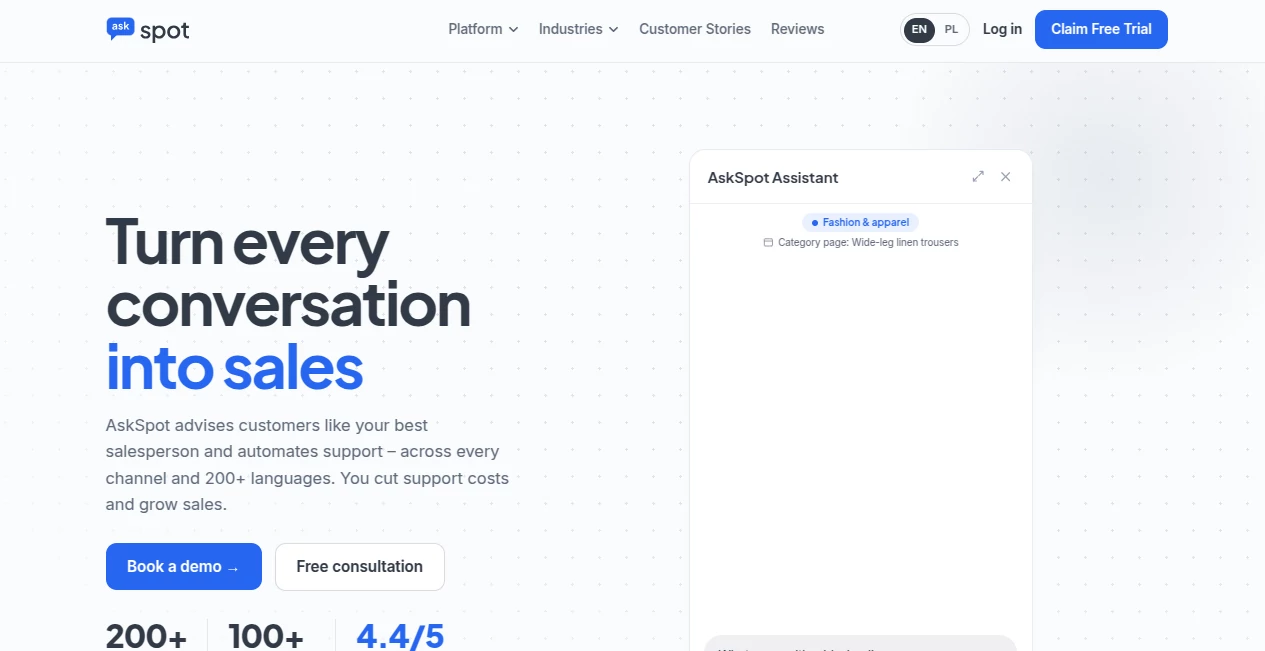
AskSpot is an AI-powered sales and customer support solution built specifically for e-commerce businesses. Its main purpose is straightforward: help shoppers find the right products, answer questions quickly, and reduce the amount of repetitive work handled by support teams. Instead of functioning as a basic FAQ chatbot, it works with a store's own product catalog, policies, and connected systems to guide customers through the buying process.
The platform combines two major functions. Its AI Chat Agent works directly with shoppers, while the AI Inbox Agent helps manage support conversations across channels such as email, chat, and marketplaces. The company says its technology is used by more than 100 European clients and has handled over 150,000 conversations, with a reported 4.4/5 conversation rating.
For an online store with hundreds or thousands of products, this approach can make a noticeable difference. A customer can ask something as specific as whether a product is compatible with their needs, compare alternatives, or ask about delivery and returns without having to search through multiple pages.
Key Features
- AI-powered product recommendations based on customer needs and budget
- Conversational product search using natural language
- Answers about product specifications, delivery, returns, and store policies
- Product comparisons and alternative recommendations
- Cross-selling and upselling suggestions
- Order status, return, complaint, and support automation
- Automatic ticket classification and reply drafting
- Conversation analytics for understanding customer demand
- Support for more than 200 languages
- Integration with e-commerce platforms, marketplaces, CRM, and helpdesk systems
User Interface
The customer-facing experience is designed around conversation rather than complicated menus. Shoppers can type ordinary questions and receive recommendations based on the store's catalog. This is particularly useful when customers know what they want to achieve but do not know the exact product name.
On the support side, incoming tickets can be classified, summarized, and prepared for response. Teams can also use draft mode, allowing an employee to review an AI-generated response before sending it. This creates a practical middle ground between full automation and completely manual support.
Accuracy & Performance
Performance is closely tied to the store's own data because responses are grounded in product information, policies, and connected systems rather than relying only on generic answers. The platform also describes a multi-stage testing process in which responses are automatically checked, reviewed by specialists, tested in a staging environment, and optionally introduced outside normal working hours first.
The reported figures are particularly interesting for larger stores. The platform states that its chat system can resolve up to 80% of cases without human intervention, while its support inbox solution can resolve up to 51% of tickets automatically. Actual results will naturally depend on catalog quality, ticket volume, industry, and the complexity of customer requests.
Capabilities
The strongest part of the platform is its ability to connect sales and support into the same customer experience. A shopper might begin by asking which product is suitable for a particular requirement, compare two options, ask about delivery, and then continue toward checkout without switching to another support channel.
The system can also work with real-time operational information from connected systems. For example, support teams can use it for order status, returns, payments, and complaints. Product recommendations can take budget, requirements, compatibility, and available alternatives into account.
There is also a useful analytics layer. Conversations reveal what customers are repeatedly searching for, which products attract questions, and where shoppers hesitate before buying. For an e-commerce manager, those conversations can become useful feedback for improving product pages and the wider shopping experience.
Security & Privacy
Data protection is an important part of the platform's positioning. Customer and store data are hosted in the European Union using infrastructure from Microsoft Azure and Google Cloud. The company states that customer data is not used to train external AI models.
The platform also states that it supports GDPR requirements, provides a Data Processing Agreement, and follows transparency principles associated with the EU AI Act. Organizations can additionally use an isolated environment dedicated to their business.
Use Cases
This solution is particularly well suited to online retailers where customers regularly need help choosing between products. Consumer electronics stores can use it for specifications and compatibility questions, while fashion retailers can provide sizing and product guidance. Furniture stores can answer questions about dimensions and whether an item will fit into a particular space.
It can also be useful for sports and outdoor retailers, beauty stores, automotive businesses, food and beverage shops, and multi-category marketplaces. Support teams can use the inbox functionality for repetitive requests involving shipping, returns, payments, invoices, and order status.
A practical example would be a customer searching for a running shoe. Instead of browsing dozens of products, the shopper can explain their experience level and requirements. The assistant can then narrow down suitable choices and explain why particular products make sense. That is much closer to speaking with a knowledgeable store employee than using a conventional keyword search.
Pros and Cons
Pros:
- Designed specifically for e-commerce sales and support
- Combines product recommendations with customer service automation
- Supports more than 200 languages
- Works with a store's own catalog and business information
- Can handle product discovery, comparisons, orders, returns, and FAQs
- Offers analytics based on customer conversations
- Includes human review and staging options before full deployment
- Provides EU data residency and GDPR-focused controls
Cons:
- Pricing is not publicly listed as a fixed self-service plan
- Businesses need an integration and onboarding process before going live
- The quality of recommendations depends heavily on the accuracy of catalog and connected business data
- Smaller stores with very low support volume may not need the full range of automation features
Pricing Plans
The platform does not present conventional public pricing tiers with fixed monthly prices. Instead, pricing is provided according to the business and expected usage. The AI Inbox Agent is described as a monthly subscription with pay-per-ticket pricing above the included plan allowance.
Every rollout starts with a free two-week trial, giving businesses an opportunity to evaluate the system before committing. The company also offers a live demo using a retailer's own catalog and support environment, followed by an implementation plan and pricing based on the specific requirements.
How to Use It
Getting started begins by connecting the platform to the online store, product catalog, and relevant support systems. Depending on the setup, integrations can include platforms such as Shopify, Magento, PrestaShop, WooCommerce, and IdoSell, along with marketplaces and helpdesk systems.
Once connected, the AI processes the store's catalog and relevant business information. Customers can then interact with the sales assistant through the store, while support requests can be handled through the inbox functionality.
Before going fully live, businesses can test responses in a private staging environment. The platform also supports an after-hours rollout, which is a sensible option for companies that want to monitor real conversations before expanding automation across their busiest periods.
Comparison with Similar Tools
Traditional customer-service chatbots usually focus on predefined questions and answers. General-purpose AI assistants can produce fluent responses but may not understand a retailer's current inventory, product relationships, or support workflows without considerable configuration.
This platform takes a more specialized route. Its focus is e-commerce, with product discovery, recommendations, order support, returns, customer questions, and conversion-oriented conversations all built into the same system. That makes it a stronger fit for retailers that want AI to participate directly in the shopping journey rather than simply answer basic FAQs.
The distinction becomes especially important for stores with large catalogs. A conventional chatbot might tell a customer where to find a product. A specialized e-commerce agent can instead understand the customer's requirements, compare suitable products, recommend an option, answer follow-up questions, and continue the conversation toward purchase.
Conclusion
For e-commerce businesses, the most valuable AI is often the kind that fits naturally into existing customer journeys. This platform takes that idea seriously by combining sales assistance and support automation rather than treating them as completely separate problems.
Its ability to work with product catalogs, provide personalized recommendations, handle repetitive support requests, operate across more than 200 languages, and provide conversation analytics makes it particularly attractive to growing online retailers. The free two-week trial and staged testing process also give businesses a practical way to evaluate performance before relying on automation at scale.
If an online store receives a steady stream of product questions and repetitive support requests, this solution is worth considering. It is not simply about replacing human conversations; the more compelling value is giving customers faster answers while allowing human teams to spend their time on cases where personal attention actually matters.
Frequently Asked Questions (FAQ)
What type of businesses can use this platform?
It is primarily designed for e-commerce businesses, including consumer electronics, fashion, beauty, furniture, sports, automotive, food and beverage, and multi-category marketplaces.
How many languages are supported?
The platform supports more than 200 languages, allowing retailers to serve customers across multiple markets without setting up a separate AI system for every language.
Can it recommend products?
Yes. It can understand customer requirements, ask follow-up questions, compare products, consider budget and needs, and recommend suitable options from the store's own catalog.
Can it handle customer support?
Yes. The support functionality can classify tickets, draft responses, and handle requests involving orders, returns, payments, shipping, and complaints. The company reports that up to 51% of support tickets can be resolved without human intervention.
Is there a free trial?
Yes. Each rollout starts with a free two-week trial, allowing a business to evaluate the system before moving forward with a paid implementation.
Does it use customer data to train external AI models?
The company states that store and customer data are not used to train external AI models. It also states that data and conversations remain hosted in the EU and that GDPR-focused controls are available.
How long does implementation take?
The company states that a demo on a customer's helpdesk can take around two to three days, while a full rollout generally takes about three to five business days after API access is provided.
Is pricing publicly available?
No fixed public pricing table is presented. Pricing is based on the business requirements and usage, with the support inbox offering described as a monthly subscription combined with pay-per-ticket pricing above the included allowance.
AI Chatbot , AI Sales Assistant , AI Customer Service Assistant , AI E-commerce Assistant .
These classifications represent its core capabilities and areas of application. For related tools, explore the linked categories above.

AskSpot Alternatives Product

Emochi

Geekflare AI

Friendify

Your Own AI

Sellerview.ai

Toflow AI

FINIITE AI

SellerPic

MyReply